Japan Pension Service · Employer manual
Employees’ pension and health insurance: procedures for employers
Published by Japan Pension Service. HTML edition by Foreigners in Japan. This is an unofficial reproduction; the original PDF is authoritative.
Original PDF on nenkin.go.jp ↗About this publication: Foreigners in Japan
Hiring someone, changing pay, paying a bonus, starting maternity or childcare leave, or closing the business? This Japan Pension Service procedures manual gives the report for each event, with instructions and filled-in form samples.
Who this is for
For employers, HR teams and payroll staff who file Employees’ Pension Insurance and Employees’ Health Insurance reports. Use the contents list to go straight to the event you are handling.
What it covers
- Registering workplace insurance and staff changes: procedures for hiring, retirement, dependants and changes in employee coverage.
- Payroll and employer reports: remuneration and bonus reporting, workplace changes and business closure.
- Leave and contributions: contribution exemption during maternity and childcare leave, remuneration changes afterwards, and the closing chapter on paying contributions.
Helpful next steps
- Check how to pay workplace contributions
Use the payment guide for employer invoices, payment methods and contribution calculations.
Official publication: original wording
Employees’ Pension Insurance (EPI) and Employees’ Health Insurance (EHI) Procedures Guide for Employers

Text from this illustration: Search box graphic: “Japan Pension Service” typed in a search field with the 検索 (search) button, source page 1
Japan Pension Service
Japan Pension Service is responsible for public pension operation.
Contents
This is a general guide. For detail, visit Japan Pension Service (JPS) website or ask JPS branch office.
Overview of insurance systems
The Employees’ Pension Insurance (EPI) and Employees’ Health Insurance (EHI) are the systems in which workers employed by a company pay salary-based contributions, so to support each other in times of needs.
Enrollment in EPI / EHI is compulsory as long as workers and their workplace meet the legal criteria. It is not employers’ or workers’ option to enroll in or not.
Main procedures the employer needs to do
As the employer of an EPI / EHI covered workplace, you need to enroll your workers to be covered and report their remuneration (salary) to JPS, in accordance with the law.
Also, you are responsible for the payment of insurance contributions; the amount is evenly shared by the employer and the employees.
Main reporting for respective event
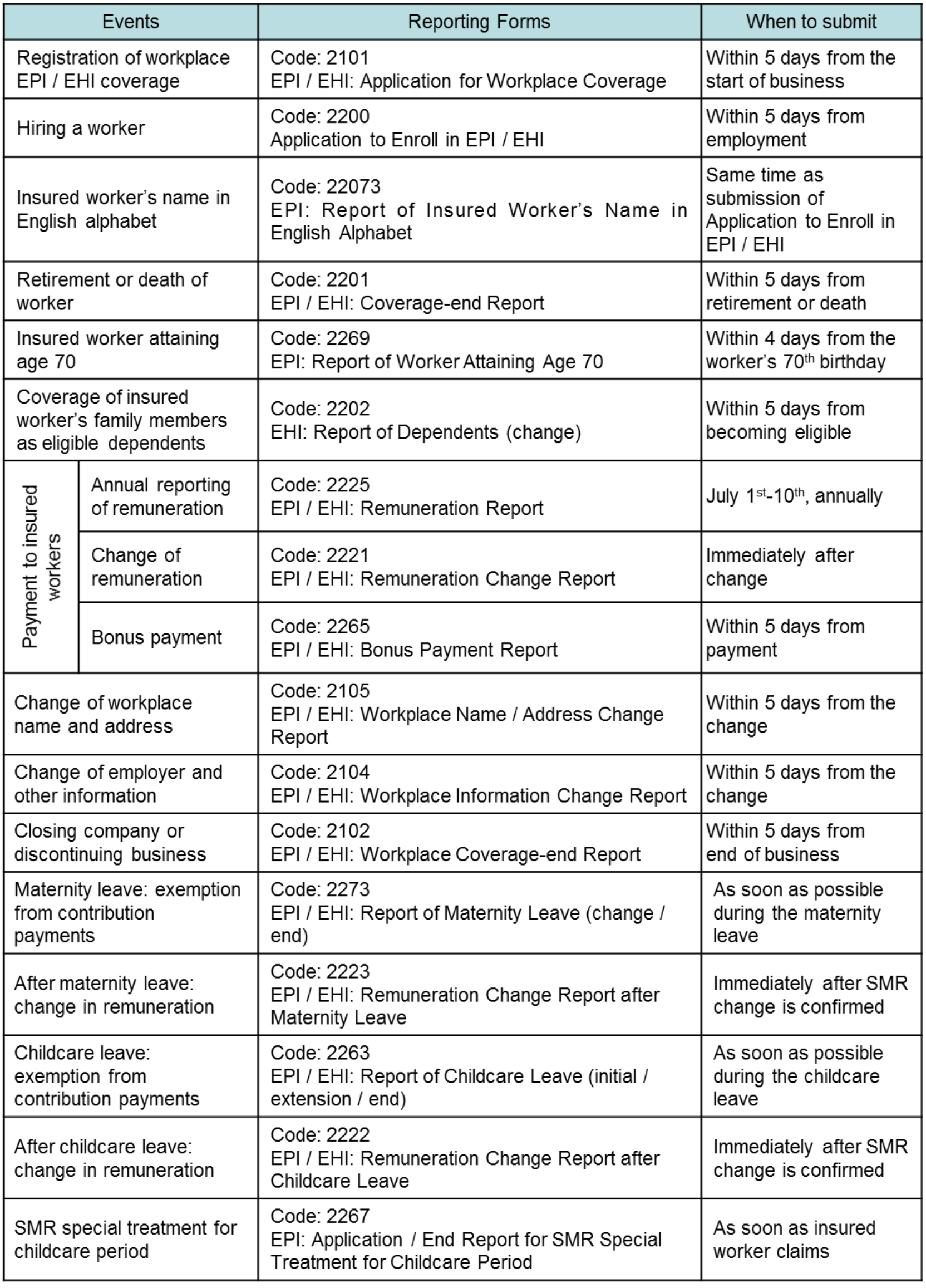
Table text: Main reporting for respective event: events, reporting forms (with codes) and when to submit, source page 4
| Events | Reporting Forms | When to submit | |
|---|---|---|---|
| Registration of workplace EPI / EHI coverage | Code: 2101 EPI / EHI: Application for Workplace Coverage | Within 5 days from the start of business | |
| Hiring a worker | Code: 2200 Application to Enroll in EPI / EHI | Within 5 days from employment | |
| Insured worker’s name in English alphabet | Code: 22073 EPI: Report of Insured Worker’s Name in English Alphabet | Same time as submission of Application to Enroll in EPI / EHI | |
| Retirement or death of worker | Code: 2201 EPI / EHI: Coverage-end Report | Within 5 days from retirement or death | |
| Insured worker attaining age 70 | Code: 2269 EPI: Report of Worker Attaining Age 70 | Within 4 days from the worker’s 70th birthday | |
| Coverage of insured worker’s family members as eligible dependents | Code: 2202 EHI: Report of Dependents (change) | Within 5 days from becoming eligible | |
| Payment to insured workers | Annual reporting of remuneration | Code: 2225 EPI / EHI: Remuneration Report | July 1st-10th, annually |
| Change of remuneration | Code: 2221 EPI / EHI: Remuneration Change Report | Immediately after change | |
| Bonus payment | Code: 2265 EPI / EHI: Bonus Payment Report | Within 5 days from payment | |
| Change of workplace name and address | Code: 2105 EPI / EHI: Workplace Name / Address Change Report | Within 5 days from the change | |
| Change of employer and other information | Code: 2104 EPI / EHI: Workplace Information Change Report | Within 5 days from the change | |
| Closing company or discontinuing business | Code: 2102 EPI / EHI: Workplace Coverage-end Report | Within 5 days from end of business | |
| Maternity leave: exemption from contribution payments | Code: 2273 EPI / EHI: Report of Maternity Leave (change / end) | As soon as possible during the maternity leave | |
| After maternity leave: change in remuneration | Code: 2223 EPI / EHI: Remuneration Change Report after Maternity Leave | Immediately after SMR change is confirmed | |
| Childcare leave: exemption from contribution payments | Code: 2263 EPI / EHI: Report of Childcare Leave (initial / extension / end) | As soon as possible during the childcare leave | |
| After childcare leave: change in remuneration | Code: 2222 EPI / EHI: Remuneration Change Report after Childcare Leave | Immediately after SMR change is confirmed | |
| SMR special treatment for childcare period | Code: 2267 EPI: Application / End Report for SMR Special Treatment for Childcare Period | As soon as insured worker claims | |
Official forms in Japanese available at https://www.nenkin.go.jp/ Click 様式のダウンロード, 申請・届出様式(健康保険・厚生年金保険) and then 健康保険・厚生年金保険適用関係届書・申請書一覧
Registration of workplace EPI / EHI coverage
When you start a business which meets the criteria to be covered by EPI / EHI (see Notes below,) you must register your workplace.
Application to be submitted:
EPI / EHI: Application for Workplace Coverage 新規適用届
Additional application / report:
• Application to enroll in EPI / EHI (including Report of employment of workers aged 70 and older) 資格取得届
• EPI / EHI: Application for Automatic Bank Account Transfer for contribution payments (submission recommended) 口座振替納付申出書
Documents to be attached
• For HOJIN corporation
- Certified copy of corporation register* 登記簿謄本 issued by Legal Affairs Bureau
- Copy of notification of corporation number 法人番号指定通知書
• For business operated by individuals
- Certified copy of your Resident Registry* 住民票
* Date of issue should be within 90 days before submission.
By when:
Within 5 days from the start of business
By whom:
Employer
How to submit:
• Post to the appropriate processing center or JPS branch office in charge
• In person at the JPS branch office in charge
• Online application
Notes
● Is my workplace subject to EPI / EHI coverage?
If your workplace meets either of criteria below, you must register for coverage.
-HOJIN corporation or other legal person, with 1 or more workers
-Business operated by individuals, with 5 or more workers on a regular basis (Excluding particular types of business such as agriculture, forestry, fishery or livestock industry)
Instruction and sample to fill in the form
Read instruction below to fill in each item from ① to㉓.
Follow the sample in red ink to enter specific information in the form in Japanese.
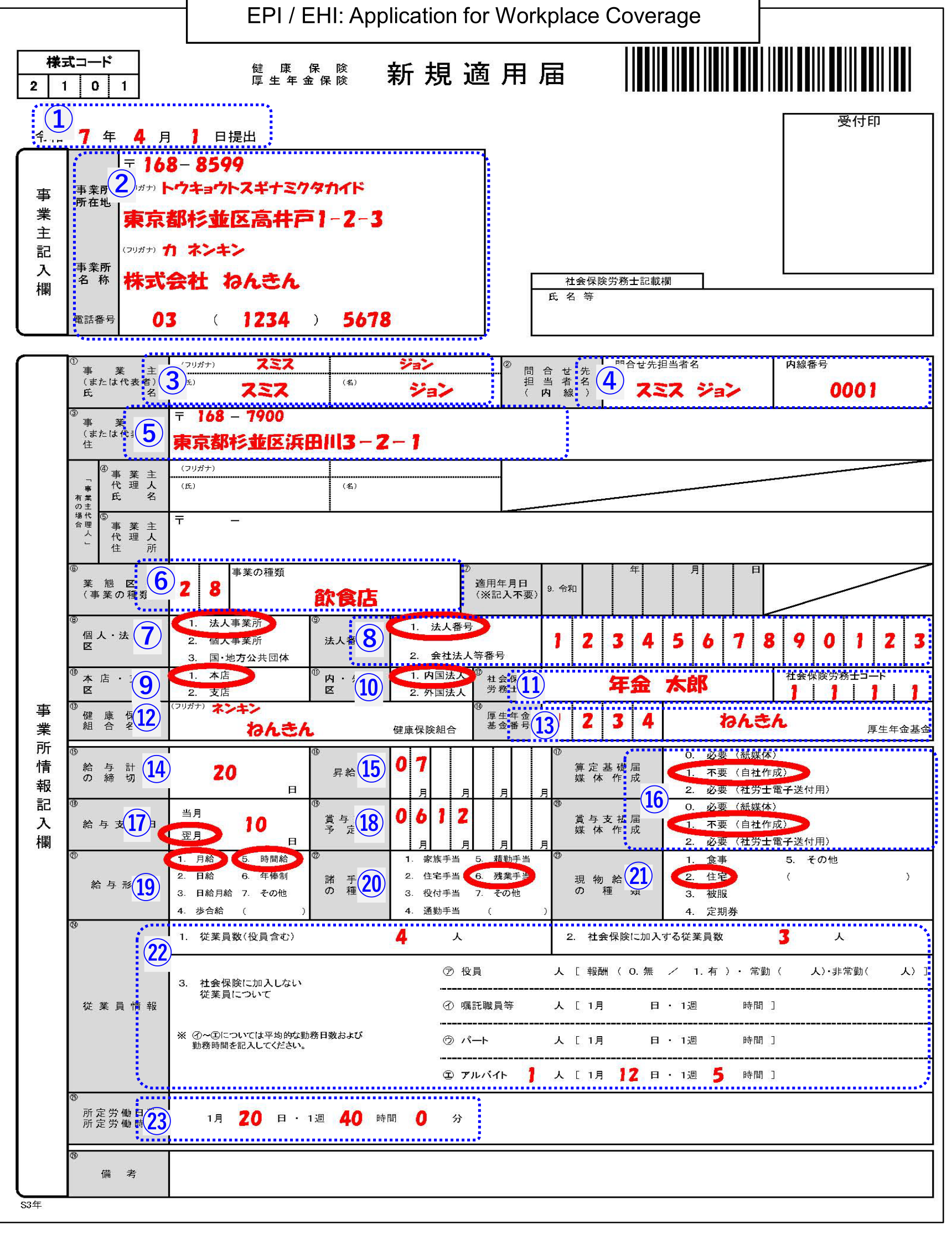
Text from this illustration: Annotated workplace coverage application, source page 6
Text printed on the form, in reading order. The circled numbers are the item numbers the instructions refer to.
EPI / EHI: Application for Workplace Coverage
①
②
zzzz
③
⑤
④
⑥
⑦
⑨
⑫
⑭
⑰
⑲
⑧
⑩
⑮
⑱
⑳
⑪
⑬
⑯
㉑
㉒
㉓
① Date of submission (Year in Reiwa era / Month / Day)
② Enter address, name and phone number of workplace. If possible, enter appropriate abbreviation in Japanese KATAKANA characters in front of the name to indicate workplace type as below:
カ for Kabushiki gaisha 株式会社
ユ for Yugen gaisha 有限会社
メ for Gomei gaisha 合名会社
シ for Goshi gaisha 合資会社
If other, enter as is.
③ Full name of employer (family name, given name)
④ Contact person’s name and extension telephone number
⑤Address of employer
➅ Business category
➆Corporation category (Circle the applicable number: 1. HOJIN Corporation, 2. Business operated by individuals, 3. National or local public institution)
⑧Corporation number or corporation registration number
➈Circle 1. for head office or 2. for branch office.
⑩Circle 1. for domestic corporation or 2. for foreign corporation.
⑪Labor and Social Security Attorney’s name and its 4-digit code if applicable
⑫ Name of Health Insurance Society with its KATAKANA characters if applicable
⑬ Employees’ Pension Fund number and name if applicable
⑭ Salary calculation date of a month
⑮ Month of pay raise in a year
⑯ Need forms for remuneration report (in upper block) and/or bonus payment report (in bottom block) sent?
0. Need paper forms, 1. No need, 2. Need e-forms for use of Labor and Social Security Attorney
⑰ Enter pay day and circle 当月for current month or 翌月for next month.
⑱ Bonus month in a year
⑲ Payment system (Circle the applicable number: 1. Monthly salary, 2. Daily wages, 3. Daily basis wages, 4. Percentage pay, 5. Hourly wages, 6. Annual salary, 7. Other)
⑳ Allowance provided (Circle the applicable number: 1. Family, 2. Housing, 3. Supervisory post, 4. Commutation, 5. Regular attendance, 6. Overtime, 7. Other)
㉑ Payment in kind provided (Circle the applicable number: 1. Meal, 2. Housing, 3. Clothing, 4. Train/bus pass, 5. Other)
㉒ Enter employee information:
1. Total number of workers including executive members
2. Number of the workers subject to social insurance coverage
3.㋐ Number of executive members NOT subject to social insurance coverage, their type of remuneration (0. no / 1. payable) and their type of attendance (full-time/part-time)
3.㋑ Number of short-time contract workers NOT subject to social insurance coverage, of work days per month and of work hours per week
3.㋒ Number of part-timers NOT subject to social insurance coverage, of work days per month and of work hours per week
3.㋓ Number of ARUBAITO part-timers NOT subject to social insurance coverage, of work days per month and of work hours per week
㉓ Enter standard work days per month, work hours per week for regular workers.
Hiring a worker
When you employ a worker, including a worker aged 70 and older, you must submit Application to Enroll in EPI / EHI.
Application / Report to be submitted:
Application to Enroll in EPI / EHI (including Report of employment of workers aged 70 and older) 資格取得届
Additional report (if applicable):
・EHI: Report of Dependents (change) (Refer to P16) 被扶養者(異動)届
・EPI: Report of Insured Worker‘s Name in English Alphabet (Refer to P9) 被保険者ローマ字氏名届
By When:
Within 5 days from employment
By whom:
Employer
How to submit:
• Post to the appropriate processing center or JPS branch office in charge
• In person at the JPS branch office in charge
• Online application
Notes
● Who should be enrolled as insured workers?
-Regular employees, HOJIN corporation’s officers and representatives.
- Part-timers whose scheduled work hours per week and scheduled work days per month are at least three fourths of those of regular workers engaged in the same task at the same workplace.
- Even part-timers whose scheduled work hours or days are less than three fourths of those of regular workers may be insured if they meet certain criteria, i.e. working 20 hours or more per week for a company with more than 50 insured workers: referred to as shorter-hours part-timers.
● Non-Japanese workers
Regardless of nationality, non-Japanese workers shall be equally insured if they meet the criteria. You should enroll them likewise.
● Workers aged 70 and older
If your worker is aged 70 and older, they are not subject to EPI coverage, or its contribution payments. However, you still must submit Report of employment of workers aged 70 and older in order to allow JPS to suspend whole or part of their pension benefits properly based on salary income.
Instruction and sample to fill in the form
Read instruction below to fill in each item from ① to ⑳.
Follow the sample in red ink to enter specific information in the form in Japanese.
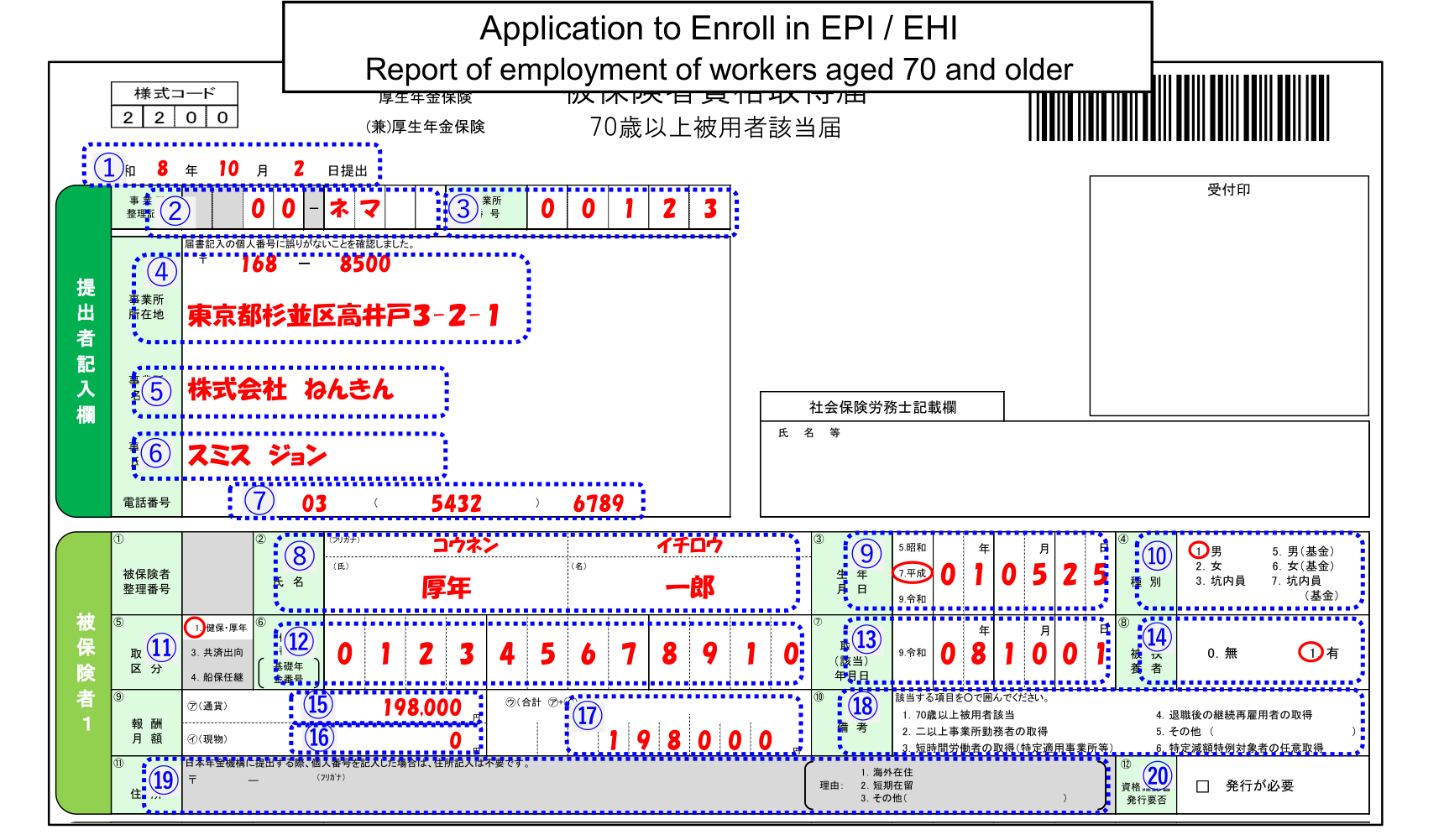
Text from this illustration: Annotated application to enroll in EPI and EHI, source page 9
Text printed on the form, in reading order. The circled numbers are the item numbers the instructions refer to.
Application to Enroll in EPI / EHI
Report of employment of workers aged 70 and older
健 康 保 険厚生年金保険
被保険者資格取得届
(兼)厚生年金保険
70歳以上被用者該当届
➀
令和 8 年 10 月 2 日提出
➁
➂
受付印
事 業 所整理記号
0 0 - ネマ
事業所
番 号 0 0 1 2 3
➃
届書記入の個人番号に誤りがないことを確認しました。〒
168 -8500
提出所在地者記
事業所
東京都杉並区高井戸3-2-1
➄
入名 称株式会社 ねんきん
事業所
社会保険労務士記載欄
欄
➅
氏 名 等
事業主氏 名
スミス ジョン
➆
電話番号
03
(
5432
) 6789
①
②
➇
③
➈
④
➉
(フリガナ)
コウネン
イチロウ
5.昭和
年
月
日
1.男 5.男(基金) 2.女 6.女(基金)
被保険者整理番号
(氏)
(名)
生 年 7.平成月 日
9.令和0 1 0 5 2 5
氏 名
厚年
一郎
種 別 3.坑内員 7.坑内員
(基金)
被保険者1報 酬
⑫
⑬
⑭
⑤
⑪
1.健保・厚年
⑥
⑦
年
月
日
⑧
個人
取 得 3.共済出向番号区 分
0 1 2 3 4 5 6 7 8 9 1 0
取得(該当)
9.令和0 8 1 0 0 1
0.無
1.有
被 扶養 者
基礎年
4.船保任継金番号
⑮
年月日
⑱
⑨
⑰
⑩
㋐(通貨)
198,000
㋒(合計 ㋐+㋑)
該当する項目を○で囲んでください。 1.70歳以上被用者該当
⑯
円
4.退職後の継続再雇用者の取得 5.その他 (
備 考 2.二以上事業所勤務者の取得
月 額 ㋑(現物)
0
1 9 8 0 0 0
円
円
3.短時間労働者の取得(特定適用事業所等) 6.特定減額特例対象者の任意取得
⑳
⑪
⑲
日本年金機構に提出する際、個人番号を記入した場合は、住所記入は不要です。
⑫
1.海外在住
〒
―
(フリガナ)
理由: 2.短期在留
発行が必要
住 所
資格確認書発行要否
3.その他( )
)
① Date of submission (Year in Reiwa era / Month / Day)
② Workplace code (You can find the code on the documents JPS sent you: e.g. EPI contribution invoice)
③ Workplace number (You can find the number on the document JPS sent you: e.g. EPI contribution invoice)
④ Address of workplace
⑤ Name of workplace
⑥ Full name of employer (family name, given name)
⑦ Phone number of workplace
⑧ Full name of worker (family name, given name)
⑨ Worker’s date of birth (Circle the applicable number for Japanese era: 5. Showa, 7. Heisei, 9. Reiwa, and enter Year / Month / Day, as registered on the Resident Registry 住民票.)
⑩Type of worker (Circle the applicable number: 1. Male, 2. Female, 3. Miners, 5. Male covered by pension fund, 6. Female covered by pension fund, 7. Miners covered by pension fund)
⑪ Enrollment category (Circle the applicable number: 1. Enrollment in EPI / EHI, 3. Worker seconded from Mutual Aid Association, 4. Retired member of Seamen’s insurance)
⑫ Worker’s 12-digit Individual Number or 10-digit Basic Pension Number (Based on the My Number Act, when entering Individual Number, you should verify if worker’s Individual Number itself is correct AND if Individual Number belongs to the worker, by referring to the worker’s My Number Card or Resident Registry住民票.)
⑬ Date of enrollment in EPI / EHI (e.g. the date of employment) (Year in Reiwa era / Month / Day)
⑭ Dependents application (If circle 1. 有 you also submit EHI: Report of Dependents.)
⑮ Estimated monthly remuneration amount paid in Japanese yen
⑯ Estimated monthly remuneration amount provided in kind (If meals, housing, or commuting passes are provided in kind, convert them to monetary value. For conversion, refer to “Value of In-Kind Wages Determined by the Minister of Health, Labour and Welfare.”)
⑰ Total amount of ⑮ and ⑯
⑱ Remarks (Circle the number if applicable: 1. Worker aged 70 and older, 2. Working at two workplaces or more, 3. shorter-hours part-timers (refer to P7,) 4. Continuously re-employed after retirement, 5. Other.)
⑲ Address of worker (If you provide worker’s Basic Pension Number in ⑫, enter his/her address as registered on Resident Registry 住民票.)
⑳ Check
 if the worker needs a Health Insurance Eligibility Certificate to be issued.
Insured worker’s name in English alphabet
When you hire a foreign worker who is not subject to Japanese Individual Number system (or his/her Individual Number is not linked to his/her Basic Pension Number in the JPS computer systems,) you must submit EPI: Report of Insured Worker’s Name in English Alphabet, in addition to Application to Enroll in EPI / EHI (refer to P7.)
Report to be submitted:
EPI: Report of Insured Worker’s Name in English Alphabet 被保険者ローマ字氏名届
When:
When you submit “Application to Enroll in EPI / EHI”
By whom:
Employer
How to submit:
• Post to the appropriate processing center or JPS branch office in charge
• In person at the JPS branch office in charge
• Online application
Notes
• How do I know if the worker is subject to the report and why do we need it?
-You can ask JPS branch office to find if you need to submit this report, i.e. worker is not subject to Japanese Individual Number system or his/her Individual Number is not linked to his/her Basic Pension Number in the JPS computer systems.
-Without an Individual Number, information of names in English alphabet is critical to identify the worker in order for JPS to correctly keep their coverage record.
• Where can I find the worker’s appropriate name in English alphabet?
-You can refer to worker’s Residence Card, Certificate of Special Permanent Resident, or Resident Registry 住民票(they are based on the name on official identifications such as passport.)
Please note that, however, the worker’s name in Japanese KATAKANA character is officially used on notifications sent from JPS or health insurance eligibility certificate.
Instruction and sample to fill in the form
Read instruction below to fill in each item from ① to ⑫.
Follow the sample in red ink to enter specific information in the form in Japanese.
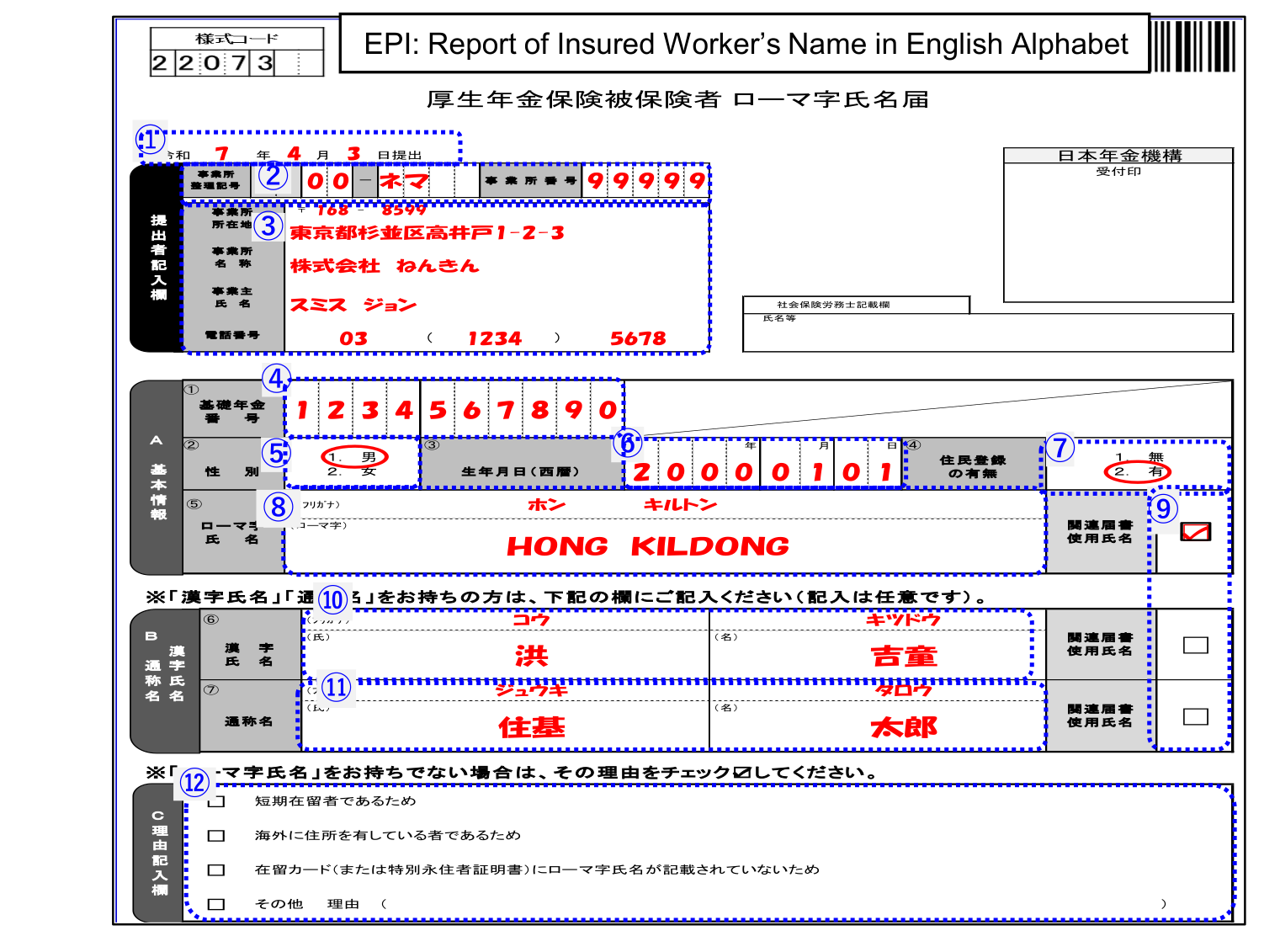
Text from this illustration: Annotated English alphabet name report, source page 11
Text printed on the form, in reading order. The circled numbers are the item numbers the instructions refer to.
EPI: Report of Insured Worker’s Name in English Alphabet
厚生年金保険被保険者 ローマ字氏名届
➀
令和 7 年 4 月 3 日提出
②
事業所整理記号
0 0 -ネマ
事 業 所 番 号 9 9 9 9 9
③
事業所〒168 -8599
提所在地
出
東京都杉並区高井戸1-2-3
者事業所
記
名 称
株式会社 ねんきん
入
欄
事業主
氏 名スミス ジョン
社会保険労務士記載欄氏名等
電話番号
03
(
1234
)
5678
④
①
基礎年金番 号
1 2 3 4 5 6 7 8 9 0
⑤
⑥
A
②
③
年
月
日④
1. 男2. 女
住民登録の有無
基性 別本
生年月日(西暦)
2 0 0 0 0 1 0 1
⑧
情
⑤
(フリガナ)
ホン キルトン
報
ローマ字(ローマ字)氏 名
HONG KILDONG
日本年金機構
受付印
⑦
1. 無2. 有
⑨
関連届書
使用氏名 ☑
⑩
※「漢字氏名」「通称名」をお持ちの方は、下記の欄にご記入ください(記入は任意です)。
⑥
(フリガナ)
コウ
キツドウ
B
(氏)
(名)
漢漢 字氏 名
洪
吉童
通字
⑪
称氏
⑦
名名
(フリガナ)
ジュウキ
タロウ
(氏)
(名)
通称名
住基
太郎
関連届書
使用氏名 ☐
関連届書
使用氏名 ☐
⑫
※「ローマ字氏名」をお持ちでない場合は、その理由をチェック☑してください。
□ 短期在留者であるため
C理由記入欄
□ 海外に住所を有している者であるため
□ 在留カード(または特別永住者証明書)にローマ字氏名が記載されていないため
□ その他 理由(
)
➀ Date of submission (Year in Reiwa era / Month / Day)
➁ Workplace code and number (You can find the code and number on the documents JPS sent you: e.g. EPI contribution invoice)
➂ Address, name and phone number of workplace
➃ Worker’s Basic Pension Number
➄ Worker’s sex (Circle the applicable number: 1. Male, 2. Female.)
➅ Worker’s date of birth (4 digits of Year / Month / Day)
➆ Worker’s Japanese resident registration to the appropriate municipal office (Circle the applicable number: 1. Already registered, 2. Not yet.)
➇ Worker’s name in capital English letters, as printed on his/her Resident Card, Special Permanent Resident Certificate or Resident Registry 住民票
➈ Check
 if the name here is same as the name you enter in Application to Enroll in EPI / EHI.
➉ (Voluntary entry) Worker’s name in KANJI character (family name, given name,) if any registered in Residents Registry 住民票
⑪ (Voluntary entry) Worker’s common name, if any, registered in Residents Registry 住民票
⑫ If the worker doesn’t have any name appropriately registered in English alphabet, check the applicable box for the reason:
□ Short-term resident
□ Address not in Japan
□ Not printed in Residence Card or Special Permanent Resident Certificate
□ Other: specify
Retirement or death of worker
When your worker, including those aged 70 and older, retires or dies, you must submit EPI / EHI: Coverage-end Report and return certificates for health insurance.
Report to be submitted:
EPI / EHI: Coverage-end Report (including Report of retirement or death of workers aged 70 and older) 資格喪失届
Certificate to be returned:
Certificates for health insurance of the worker and his/her dependents: Certificates include health insurance eligibility certificate and health insurance certificate for seniors, if any.
If you can’t return such certificate, you need to submit a note to state the reason 回収不能届 .
By when:
Within 5 days from retirement or death
By whom:
Employer
How to submit:
• Post to the appropriate processing center or JPS branch office in charge
• In person at the JPS branch office in charge
• Online application
Notes
● Date of coverage-end
Technically, EPI / EHI coverage ends on the next day of insured worker’s retirement or death.
● Delayed reporting may affect you
If report is not submitted in time, your EPI / EHI contribution amount may not be updated in time, causing an undue overcharge. Also, it may cause the misuse of certificates for health insurance or My Number Card as the certificate during the insurance gap period, which leads to an incorrect payments of medical benefits and you may need to repay it.
Instruction and sample to fill in the form
Read instruction below to fill in each item from ① to ⑱.
Follow the sample in red ink to enter specific information in the form in Japanese.
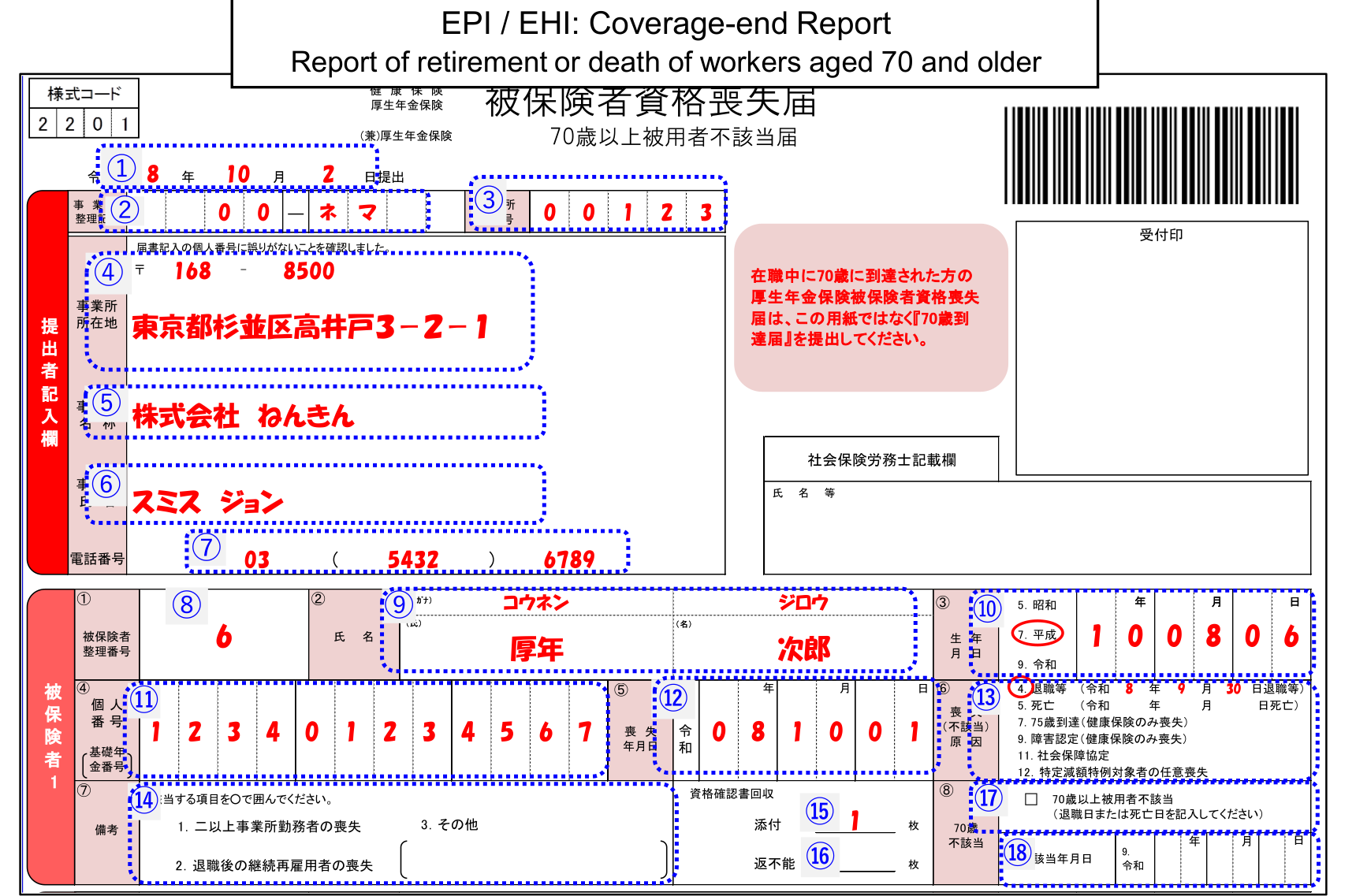
Text from this illustration: Annotated coverage-end report, source page 13
Text printed on the form, in reading order. The circled numbers are the item numbers the instructions refer to.
EPI / EHI: Coverage-end Report
Report of retirement or death of workers aged 70 and older
厚生年金保険被保険者資格喪失届
健 康 保 険
(兼)厚生年金保険
70歳以上被用者不該当届
➀
8 年 10 月 2 日提出
令和
➂
➁
事 業 所整理記号
0 0 ― ネマ
事業所番 号
0 0 1 2 3
受付印
➃
届書記入の個人番号に誤りがないことを確認しました。
〒 168 -8500
在職中に70歳に到達された方の厚生年金保険被保険者資格喪失届は、この用紙ではなく『70歳到達届』を提出してください。
事業所所在地
東京都杉並区高井戸3-2-1
提
出者記入欄
➄
事業所名 称
株式会社 ねんきん
➅
社会保険労務士記載欄
事業主氏 名
スミス ジョン
氏 名 等
➆
電話番号
03
(
5432
)
6789
➇
➈
➉
①
②
(フリガナ)(フリガナ)
コウネン
ジロウ
③
年年
月月
日日
5.昭和
6
(氏)(氏)
(名)(名)
生 年 7.平成月 日
1 0 0 8 0 6
被保険者整理番号
氏 名
厚年
次郎
9.令和
⑬
⑪
⑫
被保険者 1
④
⑤
9.
年
月
日
⑥
4. 退職等(令和 8 年 9 月 30 日退職等)
個 人番 号
5. 死亡(令和年月
日死亡)
喪 失
1 2 3 4 0 1 2 3 4 5 6 7 喪 失令 0 8 1 0 0 1
(不該当)
7. 75歳到達(健康保険のみ喪失)
原 因 9. 障害認定(健康保険のみ喪失)
年月日和
基礎年金番号
11. 社会保障協定
⑭
⑰
12.特定減額特例対象者の任意喪失
⑦
⑮
⑧
該当する項目を○で囲んでください。
資格確認書回収
70歳以上被用者不該当
3.その他
添付
1
(退職日または死亡日を記入してください)
備考
1.二以上事業所勤務者の喪失
枚 70歳不該当
⑱
⑯
年月日
9.
2.退職後の継続再雇用者の喪失
返不能
枚
不該当年月日
令和
① Date of submission (Year in Reiwa era / Month / Day)
② Workplace code (You can find the code on the documents JPS sent you: e.g. EPI contribution invoice)
③ Workplace number (You can find the number on the documents JPS sent you: e.g. EPI contribution invoice)
④ Address of workplace
⑤ Name of workplace
⑥ Full name of employer (family name, given name)
⑦ Phone number of workplace
⑧ Worker’s reference number at workplace
⑨ Full name of worker (family name, given name)
⑩ Worker’s date of birth (Circle the applicable number for Japanese era: 5. Showa, 7. Heisei, 9. Reiwa, and enter Year / Month / Day.)
⑪ Worker’s 12-digit Individual Number or 10-digit Basic Pension Number (Based on the My Number Act, when entering Individual Number, you should verify if worker’s Individual Number itself is correct AND if Individual Number belongs to the worker, by referring to the worker’s My Number Card or Resident Registry 住民票)
⑫ Date of coverage end: Enter next day of retirement or death (Year in Reiwa era / Month / Day)
⑬ Reason for coverage-end (Circle the applicable number: 4. Retirement, 5. Death, 7. Reaching the age of 75 (end of EHI coverage only,) 9. Eligible disability (end of EHI coverage only,) 11. Exemption by social security agreement. Enter date of retirement or death if applicable (Year in Reiwa era / Month / Day).)
⑭ Remarks (Circle the number if applicable: 1. Coverage-end for worker working at two workplaces or more,
2. Coverage-end for worker who is re-employed after retirement)
⑮ Enter how many health insurance eligibility certificates you are returning.
⑯ Enter how many health insurance eligibility certificates you CANNOT return.
⑰ Check
 if worker aged 70 and older retires or dies.
⑱ If ⑰ is applicable, enter date of retirement or death (Year in Reiwa era / Month / Day.)
Insured worker attaining age 70
When an insured worker becomes 70 years old, and continues to work with salary change, you need to submit EPI: Report of Worker Attaining Age 70.
Report to be submitted:
EPI: Report of Worker Attaining Age 70 70歳到達届
When:
From the previous day of the worker’s 70th birthday until 5 days since
By whom:
Employer
How to submit:
• Post to the appropriate processing center or JPS branch office in charge
• In person at the JPS branch office in charge
• Online application
Notes
● Age 70 is end of EPI coverage
Technically, EPI coverage ends on the previous day of the insured worker’s 70th birthday and after that the worker doesn’t need to pay EPI contributions, or the following work period will not be reflected to benefits calculation. However, EHI coverage continues until he/she becomes age 75 or retires.
● We send you the form
We send you the report form, with the worker’s essential information printed, when the worker becomes age 70 and continues to work. You need to complete the form and submit it. However, you don’t need to submit it when the worker’s monthly salary amount (for calculation, refer to ⑮, ⑯and ⑰on P8) as of the previous day of his/her 70th birthday is same as Standard Monthly Remuneration as of two days before the birthday.
● Retirement
When your insured worker aged 70 and older retires or dies, you must submit EPI / EHI: Coverage-end Report (refer to P11.)
Instruction and sample to fill in the form
Read instruction below to fill in each item from ① to ⑭.
Follow the sample in red ink to enter specific information in the form in Japanese.
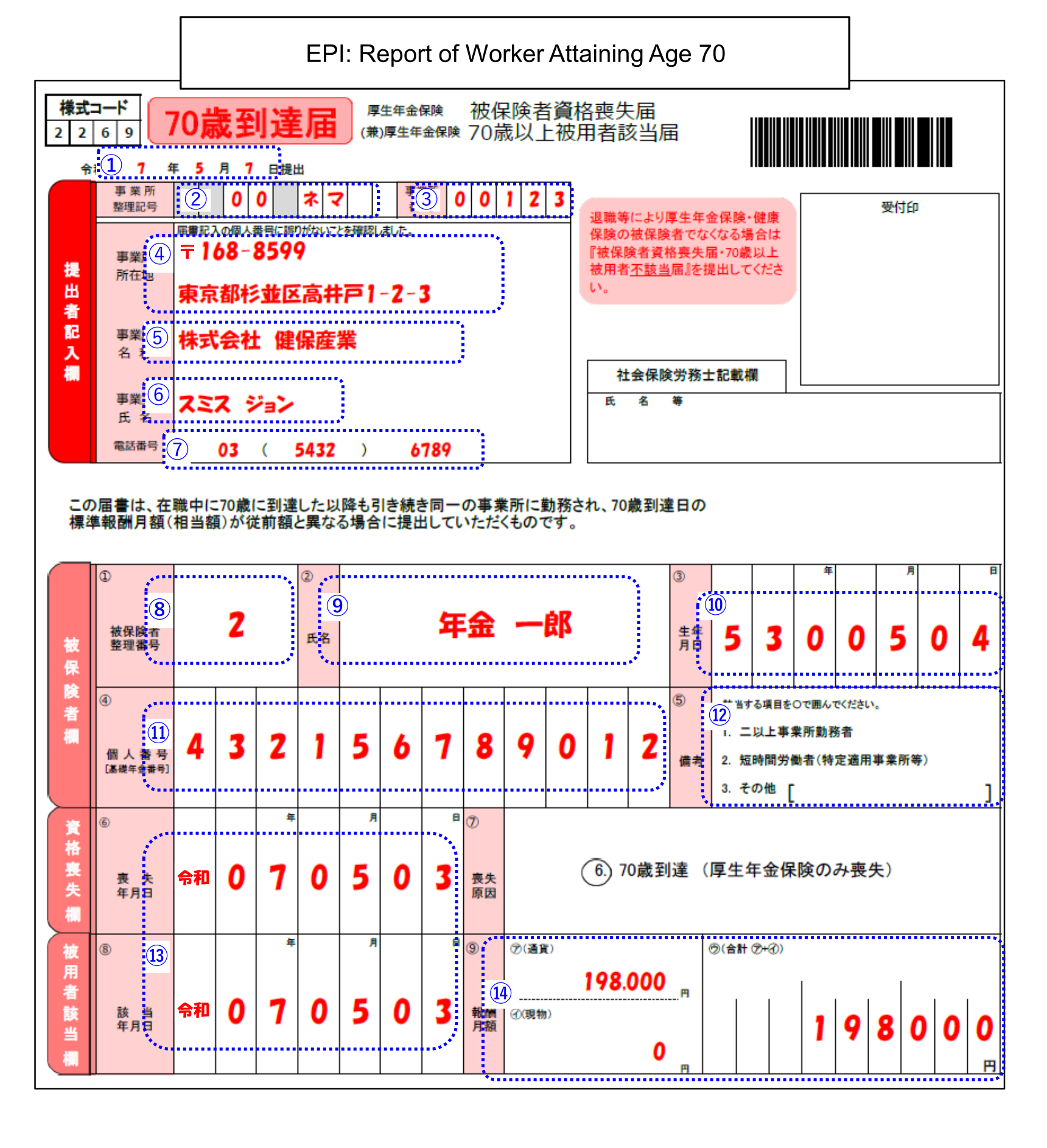
Text from this illustration: Annotated report of worker attaining age 70, source page 15
Text printed on the form, in reading order. The circled numbers are the item numbers the instructions refer to.
EPI: Report of Worker Attaining Age 70
①
➁
➂
➃
〒
➄
➅
➆
⑧
⑨
⑩
⑪
⑫
令和
⑬
令和
⑭
➀Date of submission (Year in Reiwa era / Month / Day)
➁Workplace code (You can find the code on the documents JPS sent you: e.g. EPI contribution invoice)
➂Workplace number (You can find the number on the documents JPS sent you: e.g. EPI contribution invoice)
➃Address of workplace
➄Name of workplace
➅Full name of employer (family name, given name)
➆Phone number of workplace
➇Insured worker’s reference number at workplace
➈Full name of insured worker (family name, given name)
➉Worker’s date of birth (Enter the applicable number for Japanese era: 5. Showa, 7. Heisei, 9. Reiwa, and enter Year / Month / Day.)
⑪Worker’s 12-digit Individual Number or 10-digit Basic Pension Number (Based on the My Number Act, when entering Individual Number, you should verify if worker’s Individual Number itself is correct AND if Individual Number belongs to the worker, by referring to the worker’s My Number Card or Resident Registry 住民票)
⑫Remarks (Circle the number if applicable: 1. Coverage-end for worker working at two workplaces or more, 2. Coverage-end for shorter-hours part-timers (refer to P7,) 3. other.)
⑬Enter previous date to the worker’s 70th birthday.
⑭Amount of monthly remuneration updated on the previous day of 70th birthday. (㋐amount paid by cash in Japanese yen, ㋑amount paid in kind, ㋒sum of ㋐and ㋑.)
Coverage of insured worker’s family members as eligible dependents
In order to cover insured worker’s eligible dependent family members, or report any change of the dependents, the insured worker needs to submit EHI: Report of Dependents (change) via employer.
Report to be submitted:
EHI: Report of Dependents (change) 被扶養者(異動)届
National Pension: Application to Enroll in as Category III Insured Person
Evidence documents (Details in Notes below)
・Proof of relationship to the insured worker
・Proof of dependent’s income
・Proof of financial support
By when:
Within 5 days from the day the family member becomes eligible
By whom:
Insured worker (via employer)
How to submit:
• Post to the appropriate processing center or JPS branch office in charge
• In person at the JPS branch office in charge
• Online application
Notes
● Who is the eligible dependent family member?
• In principle, the dependent must reside in Japan to be eligible.
• When the dependent has any income, he/she is eligible if:
-he/she lives with the insured worker and has an annual income of less than ¥1.3 million* AND less than half of the insured worker’s annual income.
-he/she does not live with the insured worker and has an annual income of less than ¥1.3 million* AND less than the annual financial support amount provided by the insured worker.
* ¥1.8 million if he/she is aged 60 or older or has a certain level of disability, which qualifies for Disability Employees’ Pension benefits.
● Evidence documents (details)
• Proof of relationship to the insured worker
For example:
- Certified copy of the dependent’s Family Registry 戸籍謄本
- Certified copy of the dependent’s Resident Registry住民票, ONLY IF the insured worker and the dependent are registered in the same household, AND the insured worker is the head of household.
You don’t need to submit evidence documents if:
- Individual Number of both the insured worker and the dependent are provided in the report, AND
- You (employer) verify and declare in the report that you’ve confirmed their relationship.
• Proof of dependent’s income
Your insured worker must provide documents to prove his/her dependent’s income regardless of whether he/she has an income or not.
For example;
-Taxable income certificate 課税証明書or non-taxable income certificate 非課税証明書 which can be issued by the municipal office of dependent’s place of residence
-Copy of employment insurance benefit certificate, issued by public employment security office HELLO WORK
You don’t need to submit evidence documents if you verify and declare in the report that they meet conditions as provided in the Income Tax Act.
・Proof of financial support
If the insured worker’s dependent lives separately, the worker must provide documents to prove financial support to the dependent and its amount.
For example;
-The insured worker’s bank statements or equivalent documents if he/she sends money by direct deposit
-Copy of envelopes if the insured worker sends cash by Japan Post registered mail to send cash 現金書留
You don’t need to submit evidence documents if the dependent is under 16 years old, or a student aged 16 and older.
• Additional documents if submission is delayed
If the worker or you report retroactively for more than 60 days from the day the worker’s dependent becomes eligible (i.e. delay in submission,) you need to provide additional supporting documents to ensure the eligibility.
Instruction and sample to fill in the form
Read instruction below to fill in each item from ① to ㊺.
Follow the sample in red ink to enter specific information in the form in Japanese.
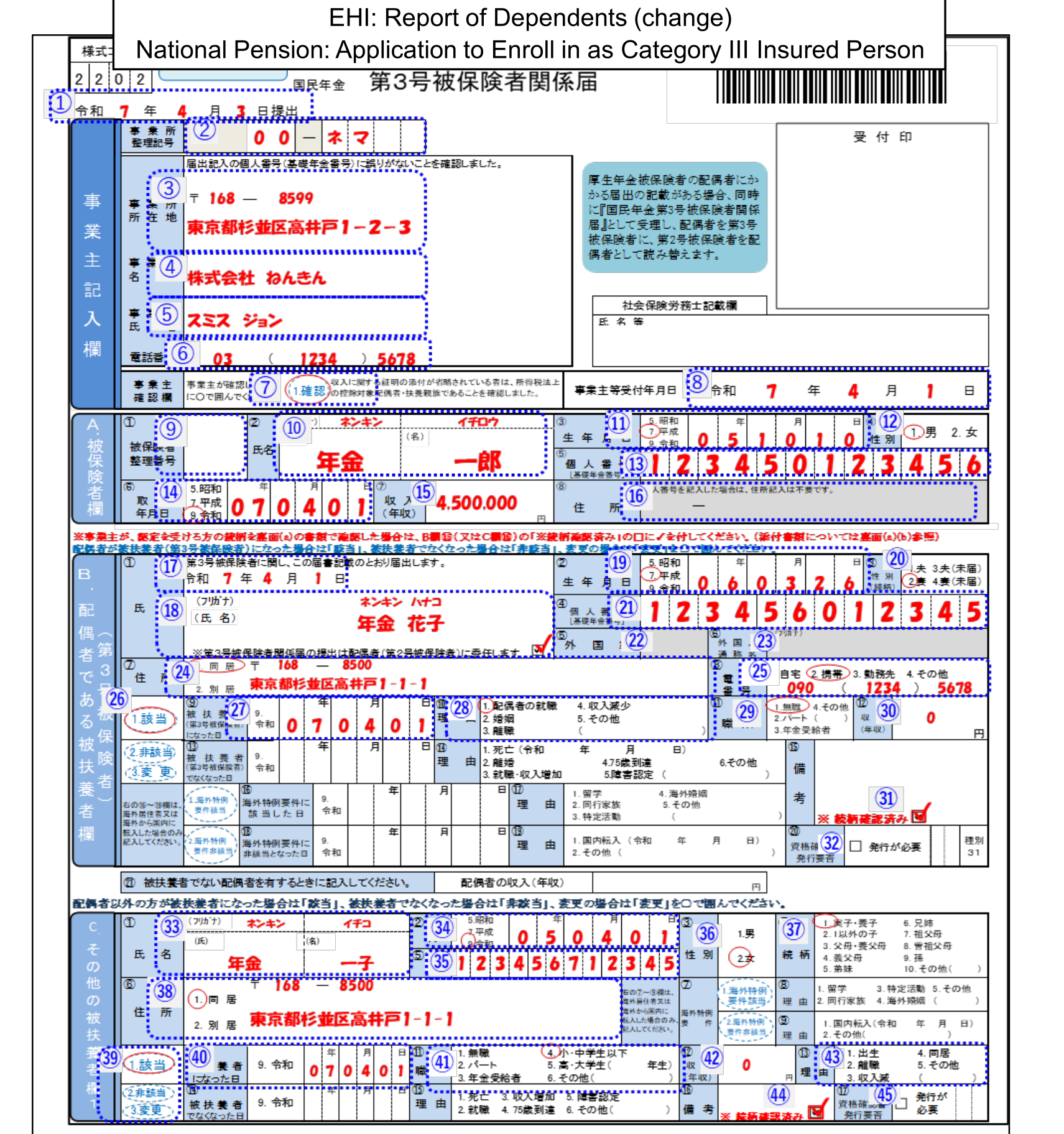
Text from this illustration: Annotated dependents report, source page 19
EHI: Report of Dependents (change)
National Pension: Application to Enroll in as Category III Insured Person
被 扶 養 者 ( 異 動 ) 届
健康保険
①Date of submission (Year in Reiwa era / Month / Day)
②Workplace code (You can find the code on the documents JPS sent you: e.g. EPI contribution invoice)
③Address of workplace
④Name of workplace
⑤Full name of employer (family name, given name)
⑥Phone number of workplace
⑦Circle 1.確認if the employer has confirmed that the worker’s family member is subject to deduction for dependent under the Income Tax Act.
⑧Date the employer received this report from the worker (Year in Reiwa era / Month / Day)
⑨Worker’s reference number at workplace (No need to provide the number if you submit the report with the Application to Enroll in EPI / EHI.)
⑩Full name of worker (family name, given name)
⑪Worker's date of birth (Circle the applicable number for Japanese era: 5. Showa, 7. Heisei, 9. Reiwa, and enter Year / Month / Day, as registered on his/her Resident Registry 住民票.)
⑫Worker’s sex (Circle the applicable number: 1. Male, 2. Female)
⑬Worker’s 12-digit Individual Number or 10-digit Basic Pension Number (if worker enters his/her Individual Number, you as employer should, based on the My Number Act, verify if worker’s Individual Number itself is correct AND if Individual Number belongs to the worker, by referring to the worker’s My Number Card or Resident Registry住民票.)
⑭Date of worker’s enrollment in EPI / EHI
⑮Amount of annual income of worker in Japanese yen
⑯Enter worker’s address as registered on Resident Registry住民票, only when you enter worker’s Basic Pension Number in ⑬.
⑰Date of reporting (to the employer) about Category III insured person (Year in Reiwa era / Month / Day)
⑱Full name of worker’s spouse (family name, given name.) Check
 if the worker’s spouse entrusts the worker to submit the National Pension: Application to Enroll in as Category III Insured Person.
⑲Spouse’s date of birth (Circle the applicable number for Japanese era: 5. Showa, 7. Heisei, 9. Reiwa, and enter Year / Month / Day, as registered on his/her Resident Registry 住民票.)
⑳Relationship to the worker (Circle the applicable number: 1. Husband, 2. Wife, 3. Common-law husband, 4. Common-law wife)
㉑ Spouse’s 12-digit Individual Number or 10-digit Basic Pension Number (If worker enters spouse’s Individual Number, you should verify the Number. Refer to the documents mentioned in ⑬ above. However, if the spouse is not subject to Individual Number assignment, you must attach National Pension: Report of Category III Insured Person’s Name in English Alphabet.)
㉒Nationality of spouse
㉓Legal common name of spouse on Resident Registry住民票
㉔Address of spouse as registered on Resident Registry住民票(Circle the applicable number: 1. Living in same household, 2. Different address, and enter spouse’s address)
㉕ Phone number of spouse (Circle the applicable number for phone: 1. Home, 2. Mobile phone, 3. Work, 4. Other)
㉖ Application (Circle 1. 該当if the spouse is eligible)
㉗ Date when spouse became eligible (Year in Reiwa era / Month / Day)
㉘Reason for becoming eligible (Circle the applicable number: 1. Employment of the worker (i.e. ⑩,) 2. Marriage, 3. Leaving job, 4. Decrease in income, 5. Other)
㉙ Spouse’s occupation (Circle the applicable number: 1. Unemployed, 2. Part-timer, 3. Pensioner, 4. Other)
㉚ Amount of annual income of spouse in Japanese yen
㉛ Remarks (Check
 if worker entered the Individual Number in ⑬ and ㉑, and the employer verified their relationship by Family Registry 戸籍謄本or equivalent official documents.)
㉜ Check
 if spouse needs a Health Insurance Eligibility Certificate to be issued.
㉝ Full name of other respective dependent (family name, given name)
㉞ Date of birth of the dependent (Circle the applicable number for Japanese era: 5. Showa, 7. Heisei, 9. Reiwa, and enter Year / Month / Day, as registered on his/her Resident Registry 住民票.)
㉟ 12-digit Individual Number of the dependent (You should verify his/her Individual Number. Refer to ⑬ above.)
㊱ Sex of the dependent (Circle the applicable number: 1. Male, 2. Female)
㊲ Relationship to the worker (Circle the applicable number: 1. Biological/adopted child, 2. Child other than 1, 3. Parent/adoptive parent, 4. Parent-in-law, 5. Younger brother/sister, 6. Older brother/sister, 7. Grandparent, 8. Great- grandparent, 9. Grandchild, 10. Other)
㊳Address of the dependent as registered on Resident Registry住民票(Circle the applicable number: 1. Living in same household, 2. Different address, and enter the dependent’s address)
㊴ Application (Circle 1. 該当if the dependent is eligible)
㊵ Date the dependent became eligible (Year in Reiwa era / Month / Day)
㊶ Occupation of the dependent (Circle the applicable number: 1. Unemployed, 2. Part-timer, 3. Pensioner, 4. Junior high school student or younger, 5. High school or university student, 6. Other)
㊷ Amount of annual income of the dependent in Japanese yen
㊸ Reason* for becoming eligible (Circle the applicable number: 1. Birth, 2. Leaving job, 3. Decrease in income, 4. Living in same household, 5. Other.) *No need to enter this item if you submit the report with the Application to Enroll in EPI / EHI for worker.
㊹ Remarks (Check
 if worker entered the Individual Number in ⑬ and ㉟, and the employer verified their relationship by Family Registry 戸籍謄本or equivalent official documents.)
㊺Check
 if the dependent needs a Health Insurance Eligibility Certificate to be issued.
Annual reporting of remuneration
Every July, you must report all workers’ remuneration paid in April, May and June. JPS then determines each workers’ Standard Monthly Remuneration (SMR,) which provides for the base for calculation of contribution amount to be paid from September to next August.
Report to be submitted:
EPI / EHI: Remuneration Report (including Remuneration report for workers aged 70 and older) 報酬月額算定基礎届
If you request, JPS sends you, in advance, the report form which includes JPS’s current data on your worker, such as names, date of birth and remuneration.
When:
Annually July 1st - 10th
By whom:
Employer
How to submit:
• Post to the appropriate processing center or JPS branch office in charge
• In person at the JPS branch office in charge
• Online application
Notes
● Who are subject to remuneration report submission?
All workers at the workplace as of July 1st except for the followings:
- Workers you employed (covered by EPI / EHI) on and after June 1st
- Workers whose SMR is to be changed between July and September (Refer to P23.)
● What is Standard Monthly Remuneration (SMR)?
SMR is a base for calculating EPI / EHI insurance contribution and benefits. After you report your worker’s remuneration amount, which includes salary, wages, and allowances, the remuneration amount is classified into prescribed remuneration table to determine SMR respectively for EPI and EHI. However, the bonus or other occasional payments you pay up to 3 times in the preceding one year are not included in the SMR.
● Month of less work days affects SMR determination
While you must report workers’ remuneration (i.e. salary, wage, and allowances,) you also need to report their work days in April, May, and June each. If your worker works on hourly or daily wage, you need to report the days he/she actually worked; if your worker works on monthly or weekly wage, you need to report calendar days regardless of days he/she actually worked.
If work days in a given calendar month are less than 17 days, the remuneration of such month is excluded from calculation for determination of SMR. For example, if a worker’s work days in May only are less than 17 days, remuneration for April and June is subject to calculation for determination of SMR.
For part-timers, however, if his/her actual work days for ALL three months (April, May and June) are less than 17 days, month with 15 or 16 actual work days is subject to calculation.
For shorter-hours part-timers (refer to P7,) month with 11 or more actual work days is subject to calculation.
Instruction and sample to fill in the form
Read instruction below to fill in each item from ① to ㉑.
Follow the sample in red ink to enter specific information in the form in Japanese.
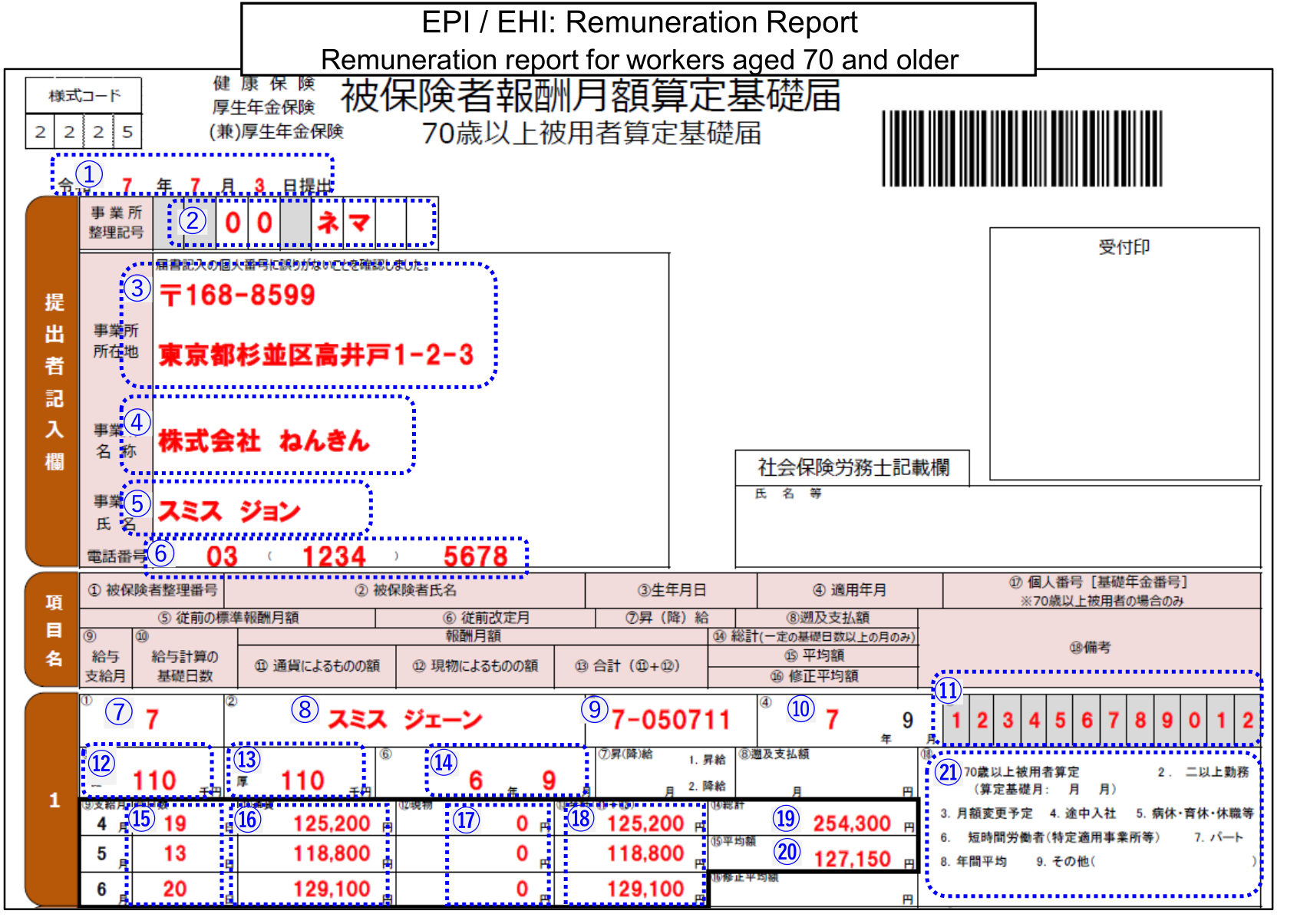
Text from this illustration: Annotated annual remuneration report, source page 22
Text printed on the form, in reading order. The circled numbers are the item numbers the instructions refer to.
EPI / EHI: Remuneration Report
Remuneration report for workers aged 70 and older
➀
➁
➂
➃
➄
➅
➆
⑫
⑮
⑬
➇
⑯
⑭
⑰
➈
⑱
➉
⑪
⑲
⑳
㉑
① Date of submission (Year in Reiwa era / Month / Day)
② Workplace code (You can find the code on the documents JPS sent you: e.g. EPI contribution invoice)
③ Address of workplace
④ Name of workplace
⑤ Full name of employer (family name, given name)
⑥ Phone number of workplace
⑦ Worker’s reference number at workplace
⑧ Full name of worker (family name, given name)
⑨ Worker’s date of birth (enter applicable number for Japanese era: 5. for Showa, 7. for Heisei, 9. for Reiwa, and enter Year / Month / Day.)
⑩ Year in Reiwa era and month when SMR update is to be reflected.
⑪ For worker aged 70 and older, enter his/her 12-digit Individual Number or 10-digit Basic Pension Number (Based on the My Number Act, when entering Individual Number, you should verify if worker’s Individual Number itself is correct AND if Individual Number belongs to the worker, by referring to the worker’s My Number Card or Resident Registry 住民票.)
⑫ Current EHI SMR (in thousand yen)
⑬ Current EPI SMR (in thousand yen)
⑭ Year in Reiwa era and month when the current SMR was determined
⑮ Enter number of work days which are subject to remuneration payment in April, May and June each.
⑯ Amount of remuneration paid in Japanese yen for April, May, and June each
⑰ Amount of remuneration provided in kind for April, May, and June each (If meals, housing, or commuting passes are provided by workplace, convert them to monetary value. For conversion, refer to “Value of In-Kind Wages Determined by the Minister of Health, Labour and Welfare.”)
⑱ Total amount of ⑯ and ⑰ for April, May, and June each
⑲ Total amount of remunerations in ⑱, excluding the amount for the month with less than 17 work days. If part-timer’s actual work days for April, May and June are ALL less than 17 days, enter the total amount of remunerations in ⑱ of the month(s) with 15 or 16 actual work days. For shorter- hour part-timers, enter the total amount of remunerations in ⑱ of the month(s) with 11 actual work days or more (See definition of part-timers and shorter-hours part-timers on P7.)
⑳ Amount obtained by dividing the amount ⑲ by the number of months effective as above.
㉑ Remarks (Circle the number if applicable: 1. Worker aged 70 and older, 2. Working at two workplaces or more, 3. EPI / EHI: Remuneration Change Report to be submitted for July, August or September, 4. Partial payment due to mid-month hiring, 5. Sick leave, maternity/paternity leave, or other leaves, 6. Shorter-hour part-timer, 7. Other part-timer, 8. Calculation using annual average amount, and 9. Other.)
Note: If the average amount of worker’s remuneration paid from April to June is quite different from other months’ remuneration, you may provide annual average amount instead and circle 8.
Change of remuneration
When you raise or reduce monthly fixed payment (MFP) such as basic salary, family allowances, or commuting allowances to worker during the year, and if the change of remuneration meets some conditions, you must submit the report as below to the appropriate JPS branch office or processing center.
JPS then changes his/her SMR and contribution amounts (leading to change in benefits,) which are reflected from the fourth month from the month when updated remuneration was paid.
Report to be submitted:
EPI / EHI: Remuneration Change Report
(including Remuneration change report for workers aged 70 and older) 報酬月額変更届
By when:
Immediately after third monthly payments since payment of updated monthly fixed payments started
By whom:
Employer
How to submit:
• Post to the appropriate processing center or JPS branch office in charge
• In person at the JPS branch office in charge
• Online application
Notes
● Conditions you need to submit the report for SMR
Change in MFP is the primary condition to submit the report. In addition, the following conditions must be met:
- There is a gap of two or more levels of SMR between worker’s current SMR and the SMR calculated based on average remuneration for three months after the change of MFP.
- For each month of the said three months, the worker’s work days subject to remuneration payment are 17 days* or more.
* 11 days for shorter-hour part-timers (refer to P7)
However, following cases are not applicable for SMR change:
- Although the amount of worker’s MFP is raised, the average remuneration for the following three month is lower than his/her current SMR.
- Although the amount of worker’s MFP is reduced, the average remuneration for the following three month is higher than his/her current SMR.
● What is MFP and its change?
MFP refers to the monthly payment items which are usually paid at a fixed amount/rate, such as monthly salary, daily wage, family allowance or housing allowance.
It doesn’t include payments for overtime or incentives, which varies depending on work hours or performance results.
Example of changes:
- Salary raise or reduction
- Changes in payroll system (i.e. switching from daily contract to monthly contract)
- Changes in daily or hourly wages
- Start/change/end of allowances (i.e. family, housing, and commuting allowances)
Instruction and sample to fill in the form
Read instruction below to fill in each item from ① to ㉓.
Follow the sample in red ink to enter specific information in the form in Japanese.
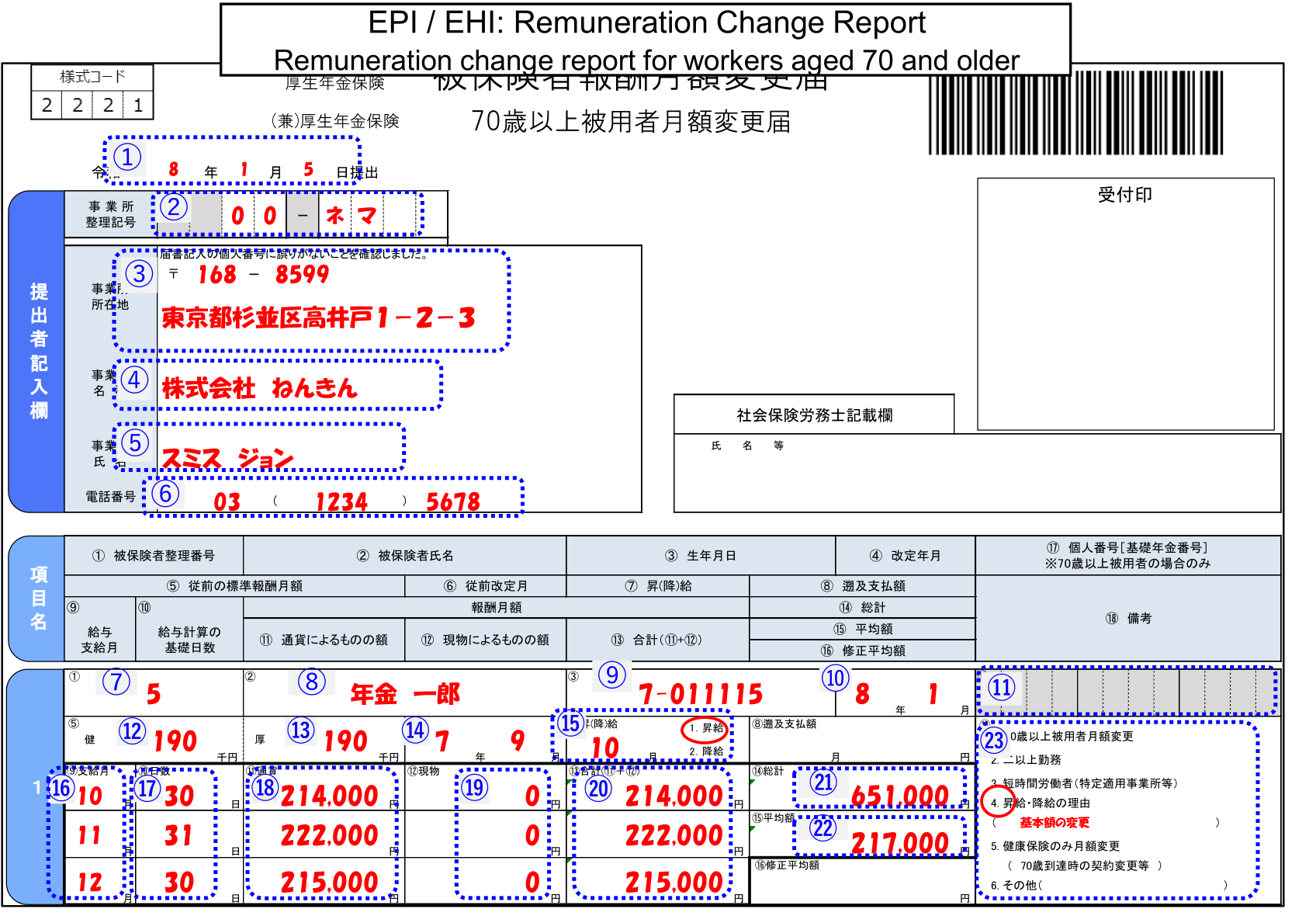
Text from this illustration: Annotated remuneration change report, source page 26
Text printed on the form, in reading order. The circled numbers are the item numbers the instructions refer to.
EPI / EHI: Remuneration Change Report
Remuneration change report for workers aged 70 and older
厚生年金保険被保険者報酬月額変更届
健 康 保 険
➀
令和
事 業 所整理記号
(兼)厚生年金保険
8 年 1 月 5 日提出
➁
0 0 -ネマ
70歳以上被用者月額変更届
受付印
提出者記入欄
➂
届書記入の個人番号に誤りがないことを確認しました。
168 - 8599
〒
事業所
所在地
東京都杉並区高井戸1-2-3
➃
事業所名 称
株式会社 ねんきん
➄
事業主
氏 名スミス ジョン
➅
電話番号
03
(
1234
)
5678
社会保険労務士記載欄
氏 名 等
⑰ 個人番号[基礎年金番号]
① 被保険者整理番号
② 被保険者氏名
③ 生年月日
④ 改定年月
項目名
※70歳以上被用者の場合のみ
⑤ 従前の標準報酬月額
⑥ 従前改定月
⑦ 昇(降)給
⑧ 遡及支払額
⑨
⑩
報酬月額
⑭ 総計
⑱ 備考
給与
給与計算の基礎日数
⑮ 平均額
⑪ 通貨によるものの額
⑫ 現物によるものの額
⑬ 合計(⑪+⑫)
支給月
⑯ 修正平均額
➆
➇
➈
➉
⑪
①
②
③
④
⑰
5
年金 一郎
7-011115
8
1
⑮
⑫
⑬
⑭
年
月
⑤
⑥
⑦昇(降)給
⑧遡及支払額
⑱
㉓
190
190
7
9
1.昇給
1.70歳以上被用者月額変更
健
厚
10
2.降給
⑯
千円
⑱
千円
⑲
年
月
月
㉑
月
円
2. 二以上勤務
⑨支給月
⑰
⑩日数
⑪通貨
⑫現物
⑬合計(⑪+⑫)
⑳
⑭総計
1
3. 短時間労働者(特定適用事業所等)
10
30
214,000
0
214,000
651,000
月
日
円
円
円
㉒
円
4. 昇給・降給の理由
⑮平均額
31
222,000
0
222,000
( 基本額の変更 )
11
217,000
5. 健康保険のみ月額変更
月
日
円
円
円
円
⑯修正平均額
( 70歳到達時の契約変更等 )
12
30
215,000
0
215,000
6. その他( )
月
日
円
円
円
円
① Date of submission (Year in Reiwa era / Month / Day)
② Workplace code (You can find the code on the documents JPS sent you: e.g. EPI contribution invoice)
③ Address of workplace
④ Name of workplace
⑤ Full name of employer (family name, given name)
⑥ Phone number of workplace
⑦ Worker’s reference number at workplace
⑧ Full name of worker (family name, given name)
⑨ Worker’s date of birth (Enter applicable number for Japanese era: 5. for Showa, 7. for Heisei, 9. for Reiwa, and enter Year / Month / Day)
⑩ Year in Reiwa era and month when SMR update is to be reflected (Fourth month of MFP change)
⑪ If the worker is aged 70 and older, enter his/her Individual Number or Basic Pension Number (Based on the My Number Act, when entering Individual Number, you should verify if worker’s Individual Number itself is correct AND if Individual Number belongs to the worker, by referring to worker’s My Number Card or Resident Registry 住民票.)
⑫ Current EHI SMR (in thousand yen)
⑬ Current EPI SMR (in thousand yen)
⑭ Year in Reiwa era and month when current SMR was determined
⑮ Month of salary raise / reduction (Circle the applicable number: 1. Raise, 2. Reduction)
⑯ First, second, and third month the updated salary was paid
⑰ Enter number of work days subject to remuneration payment for each month.
⑱ Amount of remuneration paid in Japanese yen in each month
⑲ Amount of remuneration provided in kind in each month (If meals, housing, or commuting passes are provided by workplace, convert them to monetary value. For conversion, refer to “Value of In-Kind Wages Determined by the Minister of Health, Labour and Welfare.”)
⑳ Total amount of ⑱ and ⑲ for each month
㉑ Total amount of remuneration stated in ⑳
㉒ Amount obtained by dividing ㉑ by 3 (months)
㉓ Remarks (Circle the number if applicable: 1. Worker aged 70 and older, 2. Working at two workplaces or more, 3. Shorter-hours part-timers, 4. Reason for salary raise/reduction, 5. Change of SMR for EHI only, and 6. Other)
Bonus payment
When you pay bonuses to your workers, you must submit EPI / EHI: Bonus Payment Report. JPS then determines Standard Bonus Amount, which provides for the base for calculation of contribution amount and benefits amount.
Report to be submitted:
EPI / EHI: Bonus Payment Report
(including Bonus payment report for workers aged 70 and older) 賞与支払届
By when:
Within 5 days from bonus payment
By whom:
Employer
How to submit:
• Post to the appropriate processing center or JPS branch office in charge
• In person at the JPS branch office in charge
• Online application
Notes
● Standard Bonus Amount (SBA)
SBA is the amount of bonus you pay to workers at intervals of more than 3 months, rounded down to the nearest ¥1,000.
The maximum SBA for the purpose of contribution calculation under EHI is ¥5.73 million in total of bonus payments in one fiscal year (from April 1 to March 31.) The maximum SBA under EPI is ¥1.5 million per month.
● Bonus payment report and Bonus non-payment report
If you reported us your workplace’s planned bonus payment month when you registered your workplace to be covered in EPI / EHI, JPS sends you the report forms of Bonus Payment Report and Bonus Non-payment Report in advance, which already include your data JPS has.
If you paid the bonus, complete and submit Bonus Payment Report. If not, submit Bonus Non-payment Report.
● Bonus payment at the end of coverage
For a worker leaving the workplace, you need to submit bonus payment report for a bonus payment which is made until the date he/she leaves the company. JPS includes the payment to yearly total amount. Yet, you don’t need to pay monthly contribution for the month the worker’s coverage ends.*
* “Month of coverage end” is the month including the next day of the day worker leaves workplace.
Instruction and sample to fill in the form
Read instruction below to fill in each item from ① to ⑮.
Follow the sample in red ink to enter specific information in the form in Japanese.
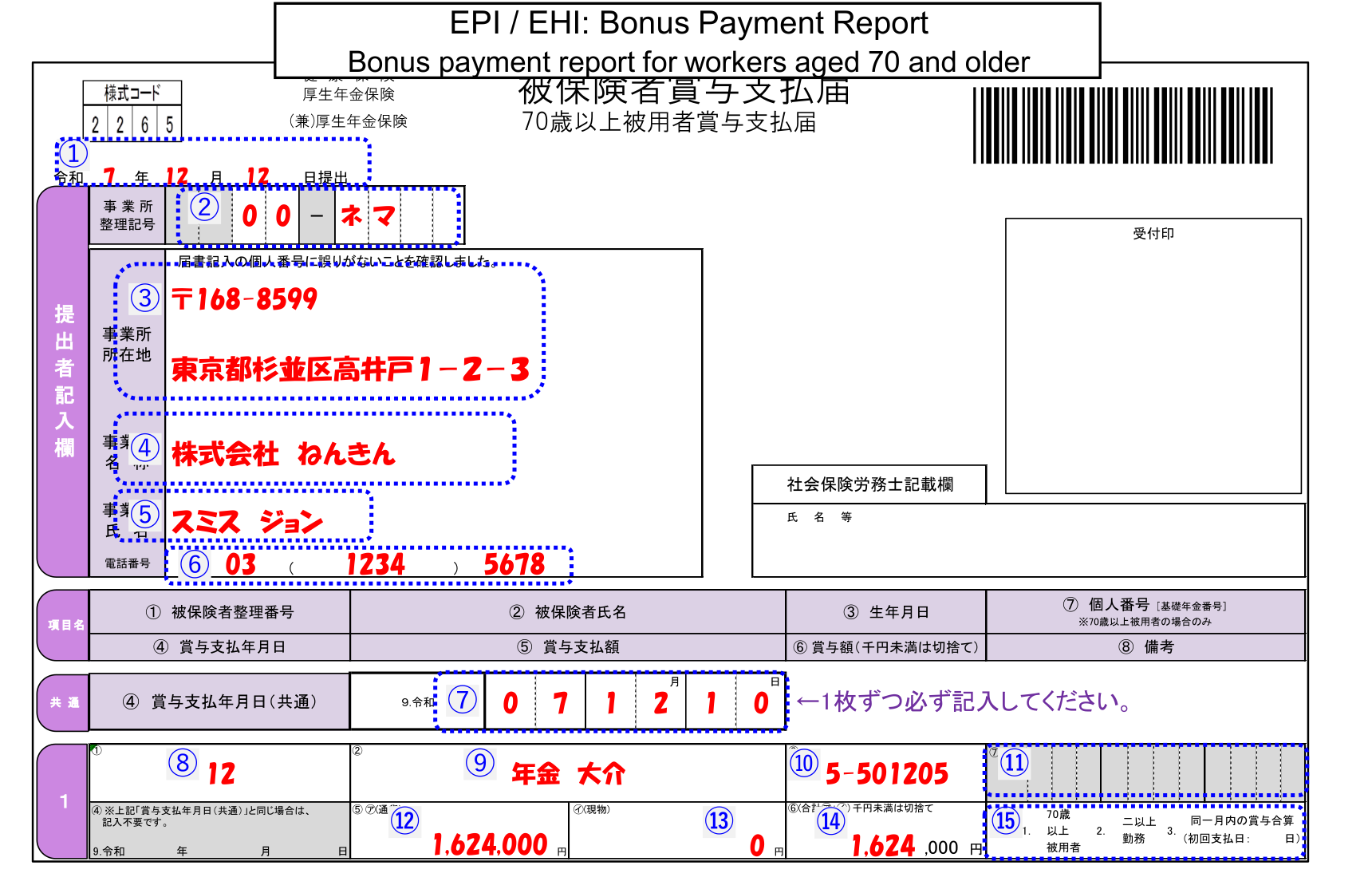
Text from this illustration: Annotated bonus payment report, source page 29
Text printed on the form, in reading order. The circled numbers are the item numbers the instructions refer to.
EPI / EHI: Bonus Payment Report
Bonus payment report for workers aged 70 and older
健 康 保 険厚生年金保険
被保険者賞与支払届
(兼)厚生年金保険
70歳以上被用者賞与支払届
➀
令和 7 年12 月 12 日提出
➁
事 業 所整理記号
0 0 - ネマ
受付印
提出者記入欄
届書記入の個人番号に誤りがないことを確認しました。
➂
〒168-8599
事業所所在地
東京都杉並区高井戸1-2-3
➃
事業所名 称
株式会社 ねんきん
➄
事業主氏 名
電話番号
スミス ジョン
➅
03 (
1234
) 5678
社会保険労務士記載欄
氏 名 等
項目名
① 被保険者整理番号
④ 賞与支払年月日
② 被保険者氏名
③ 生年月日
⑦ 個人番号 [基礎年金番号]
※70歳以上被用者の場合のみ
⑤ 賞与支払額
⑥ 賞与額(千円未満は切捨て)
⑧ 備考
共通
④ 賞与支払年月日(共通)
9.令和
➆
月
日
0 7 1 2 1 0
←1枚ずつ必ず記入してください。
1
①
➇
12
④ ※上記「賞与支払年月日(共通)」と同じ場合は、記入不要です。
9.令和
年
月
➈
②
年金 大介
⑫
⑤ ㋐(通貨)
㋑(現物)
1,624,000 円
日
⑬
➉
⑪
③
⑦
5-501205
⑭
⑮
⑥(合計㋐+㋑) 千円未満は切捨て
70歳
1. 以上 2. 被用者
0 円
1,624 ,000 円
二以上同一月内の賞与合算 3.
勤務 (初回支払日:日)
① Date of submission (Year in Reiwa era / Month / Day)
② Workplace code (You can find the code on the documents JPS sent you: e.g. EPI contribution invoice)
③ Address of workplace
④ Name of workplace
⑤ Full name of employer (family name, given name)
⑥ Phone number of workplace
⑦ Date of bonus payment (Year in Reiwa era / Month / Day)
⑧ Worker’s reference number at workplace
⑨ Full name of worker (family name, given name)
⑩ Worker's date of birth (enter applicable number for Japanese era: 5. for Showa, 7. for Heisei, 9. for Reiwa, and enter Year / Month / Day.)
⑪ If the worker is aged 70 and older, enter his/her Individual Number or Basic Pension Number (Based on the My Number Act, when entering Individual Number, you should verify if worker’s Individual Number itself is correct AND if Individual Number belongs to the worker, by referring to worker’s My Number Card or Resident Registry住民票.)
⑫ Bonus amount paid in Japanese yen
⑬ Bonus provided in kind (If meals, housing, or commuting passes are provided in kind, convert them to monetary value. For conversion, refer to “Value of In-Kind Wages Determined by the Minister of Health, Labour and Welfare.”)
⑭ Total amount of ⑫ and ⑬, rounded down to the nearest ¥1,000
⑮ Remarks (Circle the number if applicable: 1. Worker aged 70 and older, 2. Working at two workplaces or more, and 3. Total amount if two bonus payments or more in one month (Enter the day of first bonus below and total bonus amount in ⑫, ⑬and ⑭.)
Instruction and sample to fill in the form
Read instruction below to fill in each item from ① to ⑩.
Follow the sample in red ink to enter specific information in the form in Japanese.
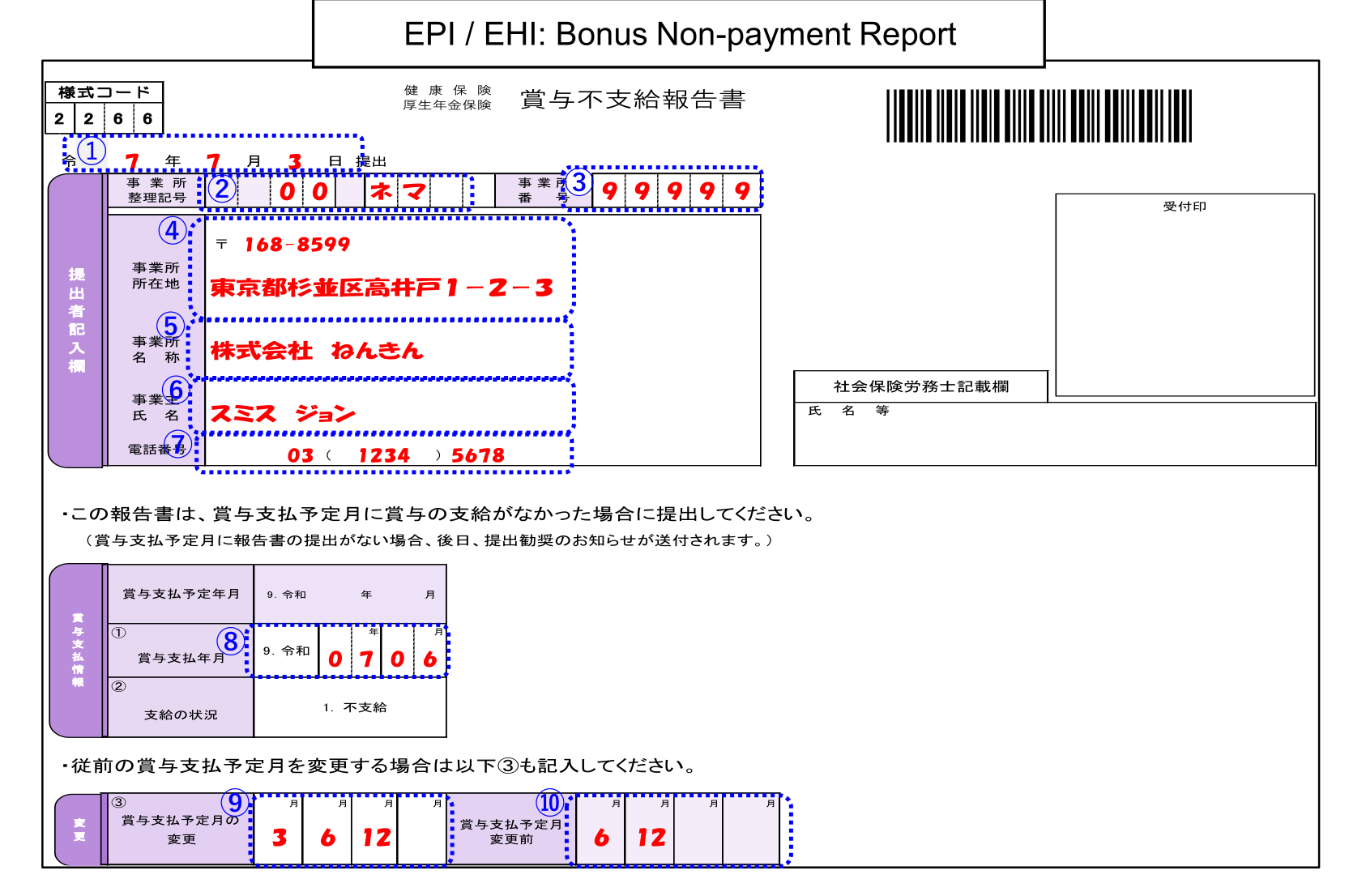
Text from this illustration: Annotated bonus non-payment report, source page 30
Text printed on the form, in reading order. The circled numbers are the item numbers the instructions refer to.
EPI / EHI: Bonus Non-payment Report
様式コード 2 2 6 6
健 康 保 険
厚生年金保険賞与不支給報告書
➀
令和
7 年 7 月 3 日提出
③
②
事 業 所整理記号
0 0 ネマ
事 業 所番 号
9 9 9 9 9
④
〒168-8599
提
事業所所在地
東京都杉並区高井戸1-2-3
出
⑤
者
記
入
事業所
名 称株式会社 ねんきん
欄
⑥
事業主
氏 名スミス ジョン
⑦
電話番号
03 ( 1234 ) 5678
社会保険労務士記載欄
氏 名 等
受付印
・この報告書は、賞与支払予定月に賞与の支給がなかった場合に提出してください。
(賞与支払予定月に報告書の提出がない場合、後日、提出勧奨のお知らせが送付されます。)
賞与支払予定年月 9.令和
年
月
賞
与
支払情報
①
⑧
賞与支払年月
9.令和
年
月
0 7 0 6
②
支給の状況
1. 不支給
・従前の賞与支払予定月を変更する場合は以下③も記入してください。
⑨
⑩
③
月月月月
月月月
変賞与支払予定月の更
賞与支払予定月変更前
3 6 12
6 12
変更
月
① Date of submission (Year in Reiwa era / Month / Day)
② Workplace code (You can find the code on the documents JPS sent you: e.g. EPI contribution invoice)
③ Workplace number (Refer to the same documents mentioned in ② above)
④Address of workplace
⑤ Name of workplace
⑥ Full name of employer (family name, given name)
⑦ Phone number of workplace
⑧ Year in Reiwa era / Month in which the planned bonus payment was NOT made
⑨ New planned month(s) of a year for bonus payment, if you change them
⑩Current planned month(s) of a year for bonus payment, if you change them
Change of workplace name and address ‒ Same JPS branch office
When you change name and/or address of your workplace, you need to submit EPI / EHI: Workplace Name / Address Change Report. If the new address belongs to the area of your current appropriate JPS branch office, follow the procedure below. If the new address belongs to other area, see P33.
| Report to be submitted: | EPI / EHI: Workplace Name / Address Change Report 適用事業所名称/ 所在地変更(訂正) 届 |
|---|---|
| Documents to be attached: | See Notes below |
| By When: | Within 5 days from the change |
| By whom: | Employer |
| How to submit: | • Post to your current processing center or JPS branch office • In person at your current JPS branch office • Online application |
Notes
Document to be attached
For HOJIN corporation
-Certified Copy of Certificate of Corporation Register* 登記簿謄本
If not available, you may provide copy of receipt of utility bills (including electricity, gas and water,) or any certificate or official document which shows the change.
For business operated by individual
For name change
- Copy of receipt of utility bills (including electricity, gas and water)
For address change
- Certified copy of Resident Registry*住民票
If not available, you may provide any certificate or official document which shows the change.
* Date of issue should be within 90 days before submission.
Instruction and sample to fill in the form
Read instruction below to fill in each item from ① to ⑩.
Follow the sample in red ink to enter specific information in the form in Japanese.
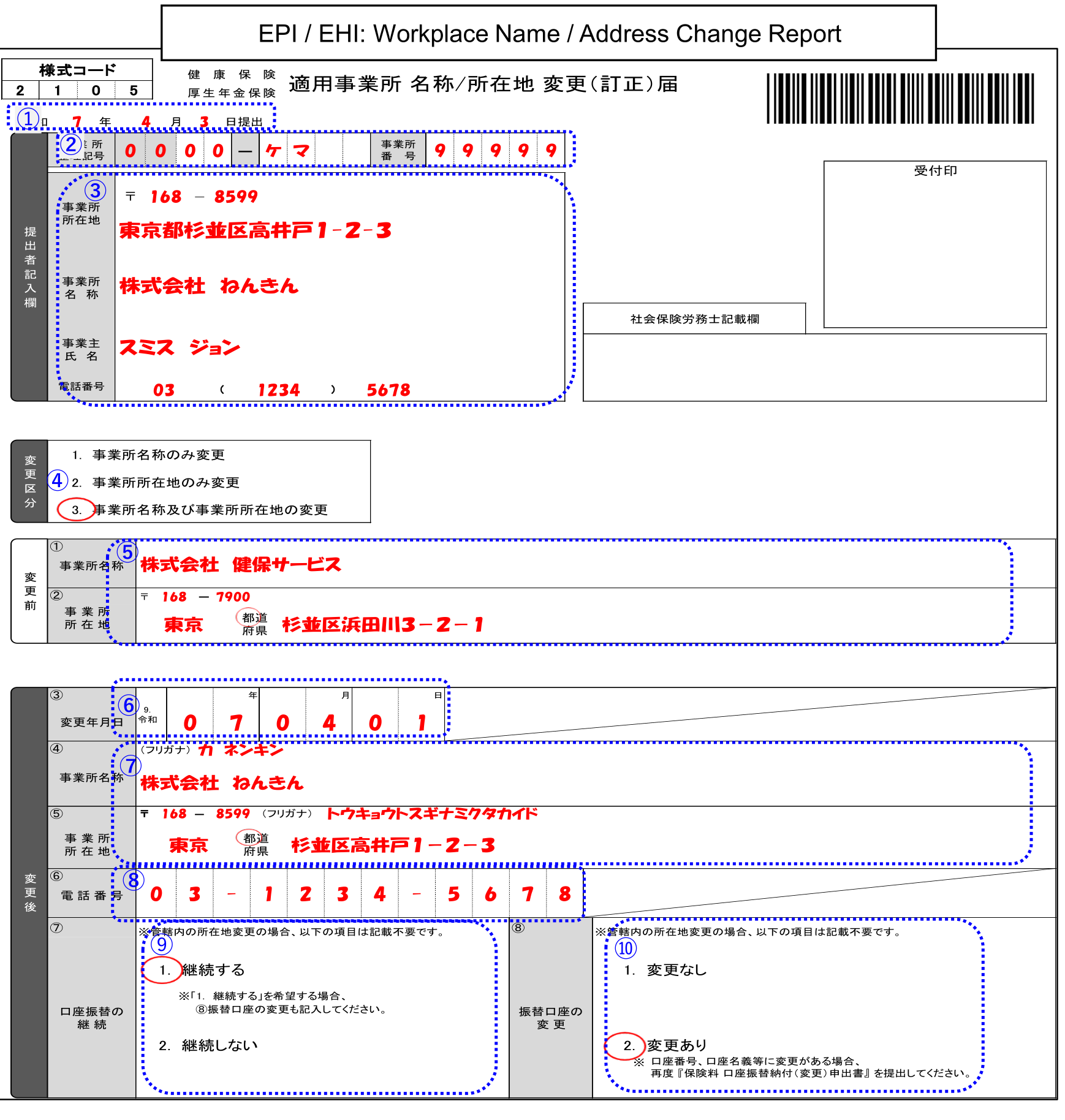
Text from this illustration: Annotated workplace name and address report, source page 32
Text printed on the form, in reading order. The circled numbers are the item numbers the instructions refer to.
EPI / EHI: Workplace Name / Address Change Report
様式コード
健康保厚生年金保険
険 適用事業所 名称/所在地 変更(訂正)届
2 1 0 5
➀
令和 7 年 4 月 3 日提出
②
事 業 所整理記号
事業所番 号
0 0 0 0 ― ケマ
9 9 9 9 9
提
出
者
記
入
欄
③
事業所所在地
〒168 ― 8599
東京都杉並区高井戸1-2-3
事業所名 称
株式会社 ねんきん
社会保険労務士記載欄
受付印
事業主氏 名
スミス ジョン
電話番号
03
(
1234
)
5678
変
更
区
分
1. 事業所名称のみ変更
④
2. 事業所所在地のみ変更
3. 事業所名称及び事業所所在地の変更
変
更
前
⑤
①
事業所名称株式会社 健保サービス
②
事 業 所所 在 地
〒 168 ― 7900
東京
都道
府県杉並区浜田川3-2-1
③
⑥
9. 令和
変更年月日
年
月
日
0 7 0 4 0 1
④
⑦
(フリガナ)カ ネンキン
事業所名称
株式会社 ねんきん
⑤
〒 168 ― 8599 (フリガナ)トウキョウトスギナミクタカイド
事 業 所所 在 地
都道府県
東京
杉並区高井戸1-2-3
⑧
変
⑥
更電話番号 0 3 - 1 2 3 4 - 5 6 7 8
後
⑦
➈
※管轄内の所在地変更の場合、以下の項目は記載不要です。
1. 継続する
⑧
※管轄内の所在地変更の場合、以下の項目は記載不要です。
➉
1. 変更なし
口座振替の継 続
※「1. 継続する」を希望する場合、
⑧振替口座の変更も記入してください。
2. 継続しない
振替口座の変 更
2. 変更あり
※ 口座番号、口座名義等に変更がある場合、
再度 『保険料 口座振替納付(変更)申出書』 を提出してください。
➀ Date of submission (Year in Reiwa era / Month / Day)
➁ Workplace code and number (You can find the code and number on the documents JPS sent you: e.g. EPI contribution invoice.)
③ Workplace information: address, name, full name of employer (family name, given name) and phone number
➃ Information subject to change (Circle the applicable number: 1. Workplace name only, 2. Workplace address only, 3. Both name and address.)
➄ Former name and/or address of workplace
➅ Date of change (Year in Reiwa era / Month / Day)
➆ New name and/or address of workplace
➇ New phone number, if changed: Enter 10-digits number with hyphens or 11-digits mobile phone without hyphen.
➈ (Only for workplace name change) Do you continuously want to use automatic bank account transfer for contribution payment? Circle the applicable number: 1. Yes, 2. No.
➉ If you choose 1. in ⑨ above, do you want to use same bank account for that? Circle the applicable number: 1. Same bank account, 2. Different bank account*
* For bank account change, submit EPI / EHI: Application for Automatic Bank Account Transfer for contribution payments in addition to this report.
Change of workplace name and address ‒ Change of JPS branch office
When you change name or address of your workplace, you need to submit EPI / EHI: Workplace Name / Address Change Report. If the new address belongs to the area of other JPS branch office’s control, follow the procedure below.
| Report to be submitted: | EPI / EHI: Workplace Name / Address Change Report 適用事業所名称/ 所在地変更(訂正) 届 |
|---|---|
| Documents to be attached: | Same as Notes on P30 |
| By When: | Within 5 days from the change |
| By whom: | Employer |
| How to submit: | • Post to the processing center or JPS branch office in charge of former address • In person at the JPS branch office in charge of former address • Online application |
Notes
● When to start procedures with the JPS branch office newly in charge?
Usually, you can start various procedures with new branch office from the 1st day of next month you submitted the change report.
However, if you relocate to other prefecture, or depending on the day you submit the change report, it may take another month to be able to start, i.e. from the 1st day of the two months after the month of submission.
● Change of EHI contribution rate (for EHI by Japan Health Insurance Association)
When you relocate your workplace to other prefecture, there may be change in contribution rate under EHI managed by Japan Health Insurance Association as of the date of change (See ⑥on P34 and P35.)
● Replacing Health Insurance Eligibility Certificate
When you relocate to other prefecture, Health Insurance Eligibility Certificate with the new code of that prefecture will be issued. You need to collect old certificate from the worker if any, and return it to Japan Health Insurance Association.
Instruction and sample to fill in the form
Read instruction below to fill in each item from ① to ⑩.
Follow the sample in red ink to enter specific information in the form in Japanese.
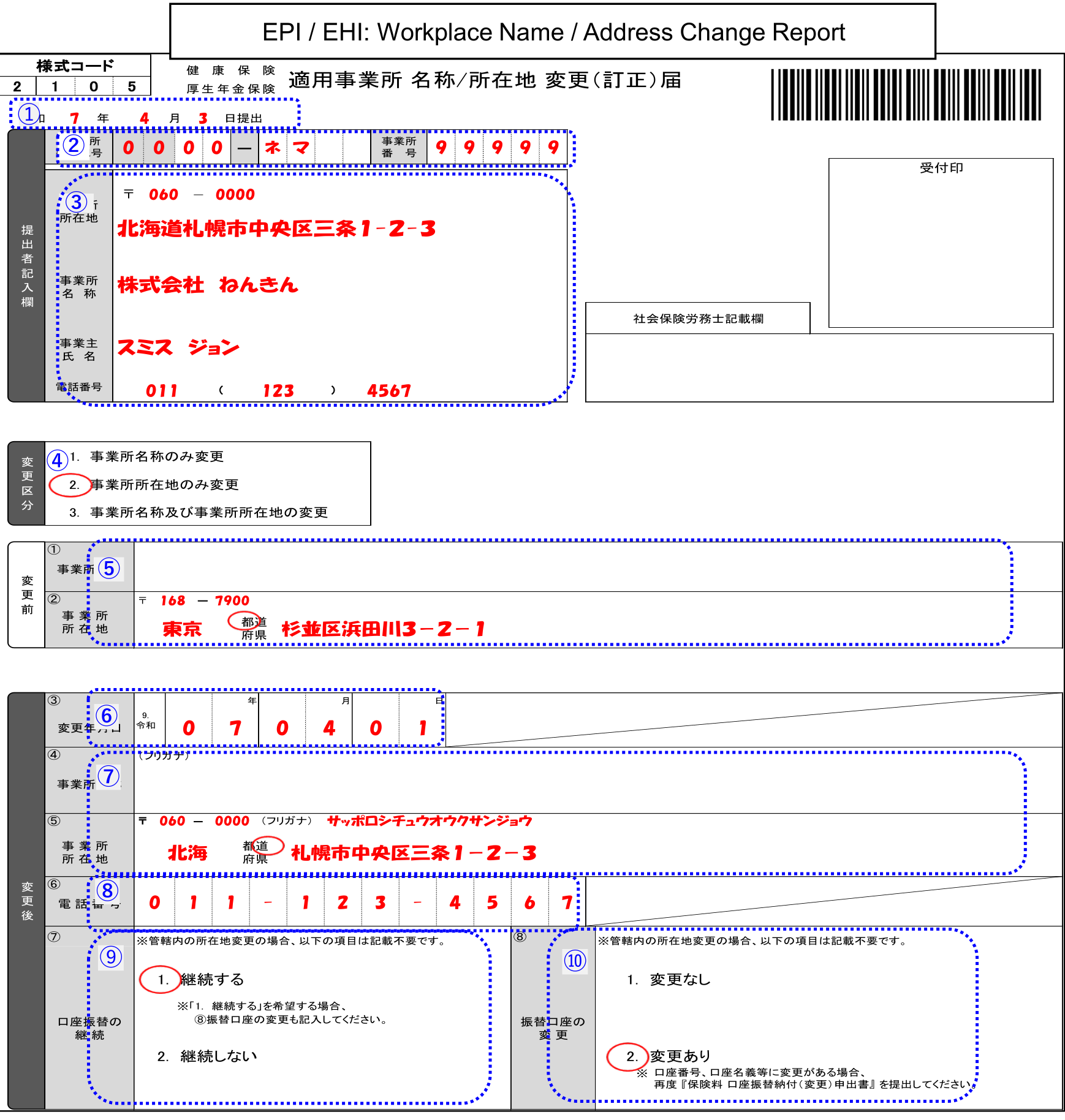
Text from this illustration: Annotated workplace name and address report, source page 35
Text printed on the form, in reading order. The circled numbers are the item numbers the instructions refer to.
EPI / EHI: Workplace Name / Address Change Report
様式コード
健康保厚生年金保険
険 適用事業所 名称/所在地 変更(訂正)届
2 1 0 5
➀
令和 7 年 4 月 3 日提出
②
事 業 所整理記号
0 0 0 0 ― ネマ
事業所番 号
9 9 9 9 9
提
出
者
記
入
欄
③
事業所
所在地
〒 060 ― 0000
北海道札幌市中央区三条1-2-3
事業所名 称
株式会社 ねんきん
社会保険労務士記載欄
受付印
事業主氏 名
スミス ジョン
電話番号
011
(
123
)
4567
変
更
区
分
④
1. 事業所名称のみ変更
2. 事業所所在地のみ変更
3. 事業所名称及び事業所所在地の変更
変
更
前
①
⑤
事業所名称
②
事 業 所所 在 地
〒 168 ― 7900
東京
都道
府県杉並区浜田川3-2-1
③
⑥
変更年月日
9. 令和
0
年
7
0
月
日
4
0
1
④
⑦
事業所名称
(フリガナ)
⑤
〒 060 ― 0000 (フリガナ)サッポロシチュウオウクサンジョウ
事 業 所所 在 地
北海
都道府県
札幌市中央区三条1-2-3
⑧
変
⑥
更電話番号 0 1 1 - 1 2 3 - 4 5 6 7
後
⑦
➈
※管轄内の所在地変更の場合、以下の項目は記載不要です。
1. 継続する
⑧
➉
※管轄内の所在地変更の場合、以下の項目は記載不要です。
1. 変更なし
口座振替の継 続
※「1. 継続する」を希望する場合、
⑧振替口座の変更も記入してください。
2. 継続しない
振替口座の変 更
2. 変更あり
※ 口座番号、口座名義等に変更がある場合、
再度 『保険料 口座振替納付(変更)申出書』 を提出してください。
➀ Date of submission (Year in Reiwa era / Month / Day)
➁ Workplace code and number (You can find the code and number on the documents JPS sent you: e.g. EPI contribution invoice)
③ Workplace information: address, name, full name of employer (family name, given name) and phone number
➃ Information subject to change (Circle the applicable number: 1. Workplace name only, 2. Workplace address only, 3. Both name and address.)
➄ Former name and/or address of workplace
➅ Date of change (Year in Reiwa era / Month / Day)
➆ New name and/or address of workplace
➇ New phone number if changed: Enter 10-digits number with hyphens or 11-digits mobile phone number without hyphen.
➈ Do you continuously want to use automatic bank account transfer for contribution payment? Circle the applicable number: 1. Yes, 2. No
➉ If you chose 1. in ⑨ above, do you want to use same bank account for that? Circle the applicable number: 1. Same bank account, 2. Different bank account*)
* For bank account change, submit EPI / EHI: Application for Automatic Bank Account Transfer for contribution payments in addition to this report.
Change of employer and other information
When there is any change in your workplace’s information as below, you need to report us.
• Employer
• Employer’s name and/or address
• Workplace’s phone number
• Representative (appointment / resignation)
• Labor and Social Security Attorney (delegation / cancellation)
• Reported month of pay raise or of bonus or payment in kind
• Request for advance provision of Remuneration Report forms and/or Bonus Payment Report forms (or for stopping provision)
• Corporate Number
| Report to be submitted: | EPI / EHI: Workplace Information Change Report 事業所関係変更(訂正) 届 |
|---|---|
| Documents to be attached | For Corporate Number change: Copy of Notification of Corporate Number 法人番号指定通知書 Or, print the specific page of National Tax Agency’s Corporate Number webpage, showing the number, name and address |
| By When: | Within 5 days from the change |
| By whom: | Employer |
| How to submit: | • Post to the appropriate processing center or JPS branch office in charge • In person at the JPS branch office in charge • Online application |
Notes
Instruction and sample to fill in the form
Read instruction below to fill in each item from ① to ⑪.
Follow the sample in red ink to enter specific information in the form in Japanese.
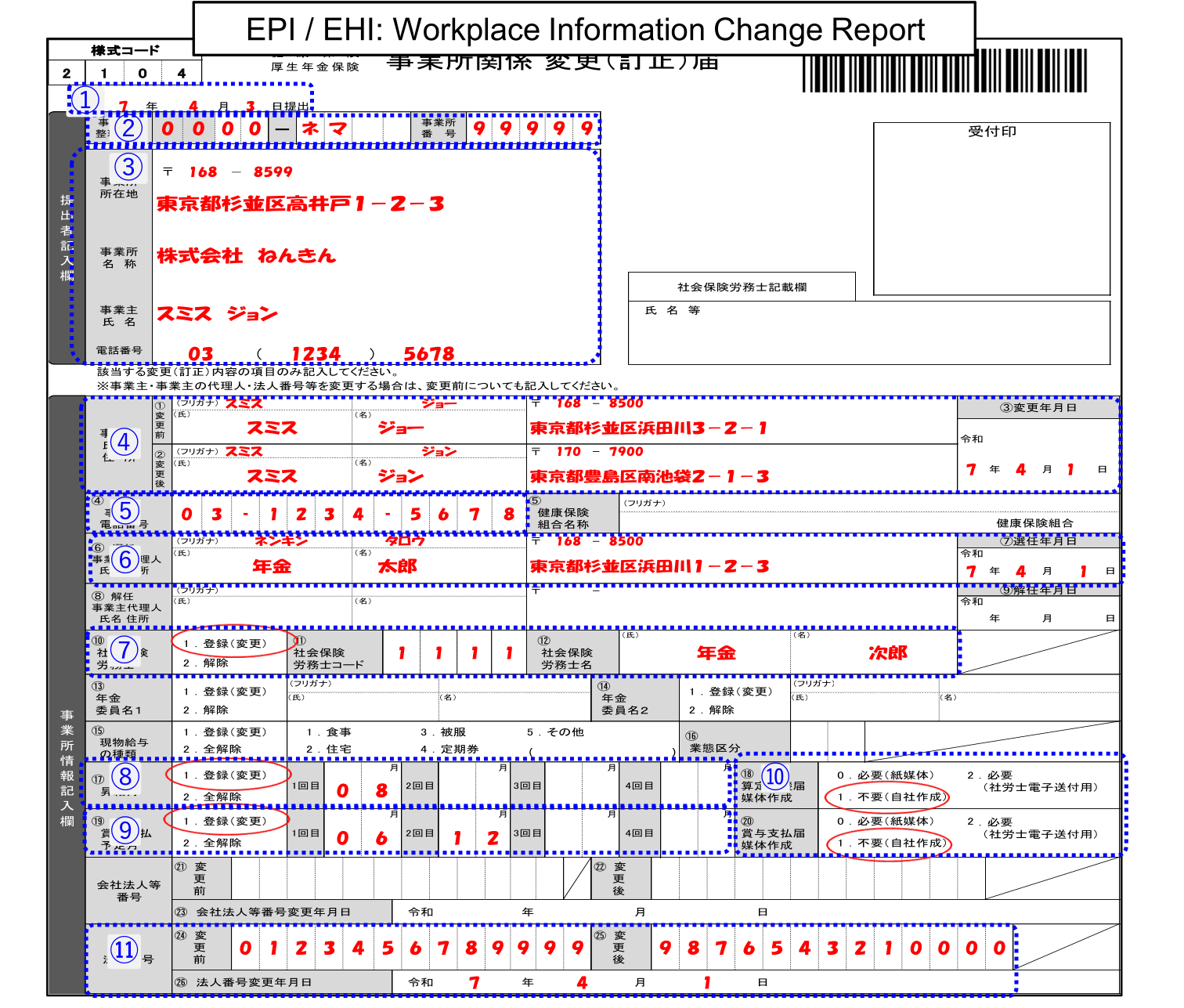
Text from this illustration: Annotated workplace information report, source page 38
Text printed on the form, in reading order. The circled numbers are the item numbers the instructions refer to.
EPI / EHI: Workplace Information Change Report
様式コード
健康保
厚生年金保険険 事業所関係 変更(訂正)届
2 1 0 4
➀
令和
➁
7 年 4 月 3 日提出
事 業 所
0 0 0 0 ― ネマ
事業所番 号
9 9 9 9 9
整理記号
➂
〒 168 ― 8599
事業所
提
所在地
東京都杉並区高井戸1-2-3
出
者
記
事業所名 称
株式会社 ねんきん
入
欄
社会保険労務士記載欄
受付印
事業主氏 名
スミス ジョン
氏 名 等
電話番号
03
( 1234 ) 5678
該当する変更(訂正)内容の項目のみ記入してください。
※事業主・事業主の代理人・法人番号等を変更する場合は、変更前についても記入してください。
① 変(氏)更前
(フリガナ)スミス
ジョー
〒 168 -8500
③変更年月日
➃
(名)
スミス
ジョー
東京都杉並区浜田川3-2-1〒 170 -7900
事業主
令和
氏 名
(フリガナ)スミス
ジョン
住 所
② 変(氏)更後
(名)
7 年 4 月 1 日
スミス
ジョン
東京都豊島区南池袋2-1-3
➄
④
⑤
(フリガナ)
事業所 0 3 ‐ 1 2 3 4 ‐ 5 6 7 8 健康保険
電話番号
組合名称
健康保険組合
➅
(フリガナ) ネンキン
タロウ
〒 168 -8500
⑦選任年月日
⑥ 選任事業主代理人氏名 住所
(氏)
(名)
令和
年金
太郎
東京都杉並区浜田川1-2-3
7 4
年月
1
日
⑧ 解任(氏)事業主代理人氏名 住所
(フリガナ)
〒
-
⑨解任年月日
(名)
令和
年月
日
➆
⑩
⑪
⑫
(氏)
(名)
1 .登録(変更)
年金
次郎
社会保険労務士
社会保険労務士コード(フリガナ)(氏)
1 1 1 1 社会保険
2 .解除
労務士名
⑬
1 .登録(変更)
⑭
1 .登録(変更)
(フリガナ)(氏)
年金
(名)
年金
(名)
事
委員名1 2 .解除
委員名2 2 .解除
業
⑮
1 .登録(変更) 1 .食事 2 .全解除
3 .被服 4 .定期券
5 .その他
所
現物給与
⑯
の種類
➇
2 .住宅
( )
業態区分
➉
情
報
1 .登録(変更)
月
月
月
月 ⑱
0 .必要(紙媒体) 2 .必要
⑰
1回目
2回目
3回目
4回目
算定基礎届媒体作成
(社労士電子送付用)
記昇給月入
2 .全解除
0 8
1 .不要(自社作成)
➈
月
月
月
月 ⑳
欄
⑲
1 .登録(変更)
0 .必要(紙媒体) 2 .必要
賞与支払予定月
1回目
0 6
2回目
1 2
3回目
4回目
賞与支払届媒体作成
(社労士電子送付用)
2 .全解除
1 .不要(自社作成)
㉑ 変更
㉒ 変
更後
会社法人等番号
前
㉓ 会社法人等番号変更年月日
令和
年
月
日
⑪
㉔ 変
㉕ 変
更 0 1 2 3 4 5 6 7 8 9 9 9 9 更 9 8 7 6 5 4 3 2 1 0 0 0 0
法人番号
前
後
㉖ 法人番号変更年月日
令和 7 年
4
月
1
日
➀Date of submission (Year in Reiwa era / Month / Day)
➁ Workplace code and number (You can find the code and number on the documents JPS sent you: e.g. EPI contribution invoice)
➂ Workplace information: address, name, full name of employer (family name, given name) and phone number
Below, fill in only applicable section.
➃ Change of employer: Enter former employer’s full name and address in the top block, new employer’s full name and address in the bottom block, and the date of change (Year in Reiwa era / Month / Day)
➄ New phone number with hyphen (-)
➅ New representative’s full name (family name, given name,) address and the date of appointment (Year in Reiwa era / Month / Day)
➆ Change of Labor and Social Security Attorney: Circle the applicable number: 1. Registration / Change, or 2. Resignation, and enter the Attorney’s code and full name (family name, given name.)
➇ Change of month of pay raise (Circle the applicable number: 1. Registration / Change, or 2. Cancellation, and enter month of pay raise.)
➈ Change of bonus month (Circle the applicable number: 1. Registration / Change, or 2. Cancellation, and enter bonus month.)
➉ Change in receiving report forms in advance: Circle the applicable number as below in top block for remuneration report and the bottom block for bonus payment report.
0. Need paper report forms sent in advance
1. No need of report forms sent
2. Need e-report form sent in advance, to delegate LSS Attorney
⑪ Change in Corporate Number (Enter former number and new number, and the date of change (Year in Reiwa era / Month / Day).)
Closing company or discontinuing business
When you close, discontinue or suspend your business and your workplace is no longer subject to EPI / EHI coverage, you need to submit EPI / EHI: Workplace Coverage-end Report.
| Report to be submitted: | EPI / EHI: Workplace Coverage-end Report 適用事業所全喪届 |
|---|---|
| Documents to be attached | (1) Certified copy of corporation register 登記簿謄本which states that your workplace has been closed (Issued by Legal Affairs Bureau) OR (2) Employer’s copy of Employment Insurance: report of workplace closure 雇用保険適用事業所廃止届(Issued at public employment security office HELLO WORK) For other documents, see Notes below. |
| By When: | Within 5 days from the change |
| By whom: | Employer |
| How to submit: | • Post to the appropriate processing center or JPS branch office in charge • In person at the JPS branch office in charge • Online application |
Notes
● Other supporting documents
If you cannot provide either (1) or (2) above, you may provide one of following documents instead, which can be issued by tax office, or official document to support the evidence.
• Copy of notification of closure of a salary paying office 給与支払事務所等の廃止届
• Copy of notification of change: corporate tax 法人税異動届or copy of notification of change: consumption tax 消費税異動届
● When you end voluntary coverage of workplace
You must submit EPI / EHI: Voluntary Coverage-end Report 任意適用取消申請書 to us. Contact the JPS branch office in charge for details.
Instruction and sample to fill in the form
Read instruction below to fill in each item from ① to ⑦.
Follow the sample in red ink to enter specific information in the form in Japanese.
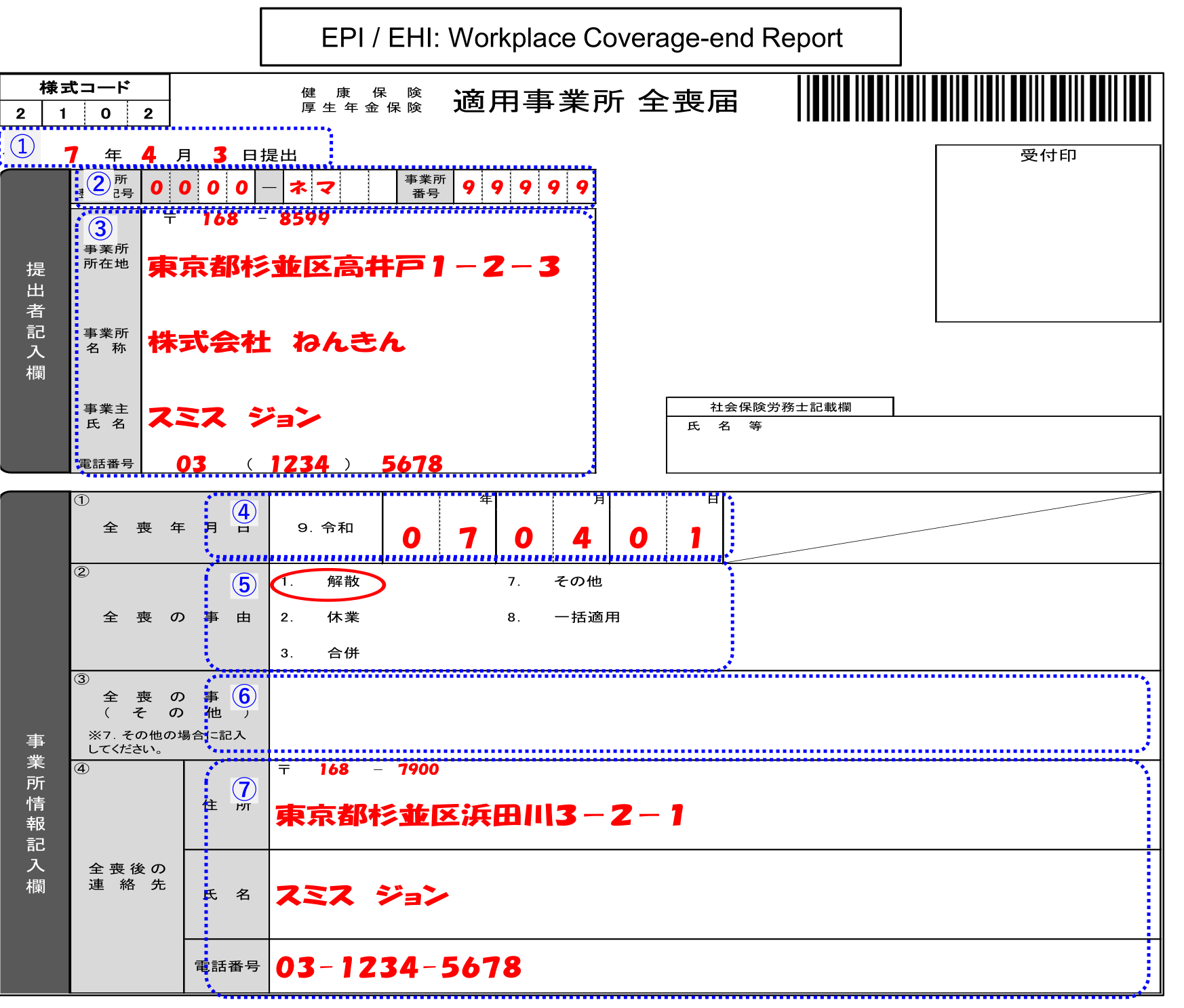
Text from this illustration: Annotated workplace coverage-end report, source page 40
Text printed on the form, in reading order. The circled numbers are the item numbers the instructions refer to.
EPI / EHI: Workplace Coverage-end Report
様式コード 2 1 0 2
厚生年金保険 適用事業所 全喪届
健康保険
➀
7 年 4 月 3 日提出
令和
②
事業所整理記号
0 0 0 0 ― ネマ
事業所番号
9 9 9 9 9
③
〒 168 -8599
事業所所在地
提出者記入欄
東京都杉並区高井戸1-2-3
事業所
名 称株式会社 ねんきん
受付印
事業主
氏 名スミス ジョン
社会保険労務士記載欄
氏名等
電話番号
03 ( 1234 ) 5678
①
④
全喪年月日
9.令和
年
月
日
0 7 0 4 0 1
②
⑤
1.解散
全喪の事由 2.休業
7.その他
8.一括適用
3.合併
③
⑥
全喪の事(その他)
由
事業所情報記入欄
※7.その他の場合に記入してください。
④
⑦
住所
〒 168 - 7900
東京都杉並区浜田川3-2-1
全喪後の連絡先
氏名
スミス ジョン
電話番号
03-1234-5678
➀ Date of submission (Year in Reiwa era / Month / Day)
➁ Workplace code and number (You can find the code and number on the documents JPS sent you: e.g. EPI contribution invoice)
➂ Workplace information: address, name, full name of employer (family name, given name) and phone number.
➃ Date of next day business ended.
➄ Reason for coverage-end (Circle the applicable number: 1. 解散: Liquidation, 2. 休業: Business suspension, 3. 合併: Merger, 7. その他: Other than 1-3 and 8, 8. 一括適用: Coverage consolidation with other workplace
➅ Enter the detail reason if you circle 7. in ➄
➆ Contact person’s address, name and phone number (we may need to call you to clarify about the report.)
Maternity leave: exemption from contribution payments
When your insured worker takes maternity leave, contribution payments of both you and the worker may be exempted for a certain period of the leave before and after childbirth. You need to submit an application for exemption.
| Report / Application to be submitted: | EPI / EHI: Report of Maternity Leave (change / end) (Application for contribution exemption) 産前産後休業取得者申出書/ 変更(終了)届 |
|---|---|
| By when | As soon as possible during the maternity leave (If delayed more than one month after the end of the leave, you need to submit evidence documents.) |
| By whom: | Employer |
| How to submit: | • Post to the appropriate processing center or JPS branch office in charge • In person at the JPS branch office in charge • Online application |
Notes
● Which month’s contribution may be exempted?
Contribution payments may be exempted, upon application, for the period of maternity leave taken between 42 days before childbirth (98 days for multiple pregnancies) and 56 days after childbirth.
Technically, the contribution payment will be exempted from the month the worker starts the maternity leave, to the month previous to the month when the following day of the maternity leave ends. For example, if the maternity leave ends on May 18, contribution payment shall be exempted until April. If it ends on May 31, it shall be exempted until May.
● Exemption for employers’ maternity leave
Employers also can apply for contribution exemption for maternity leave. However, employers’ childcare leave is not subject to contribution exemption.
Instruction and sample to fill in the form
Read instruction below to fill in each item from ① to ⑮.
Follow the sample in red ink to enter specific information in the form in Japanese.
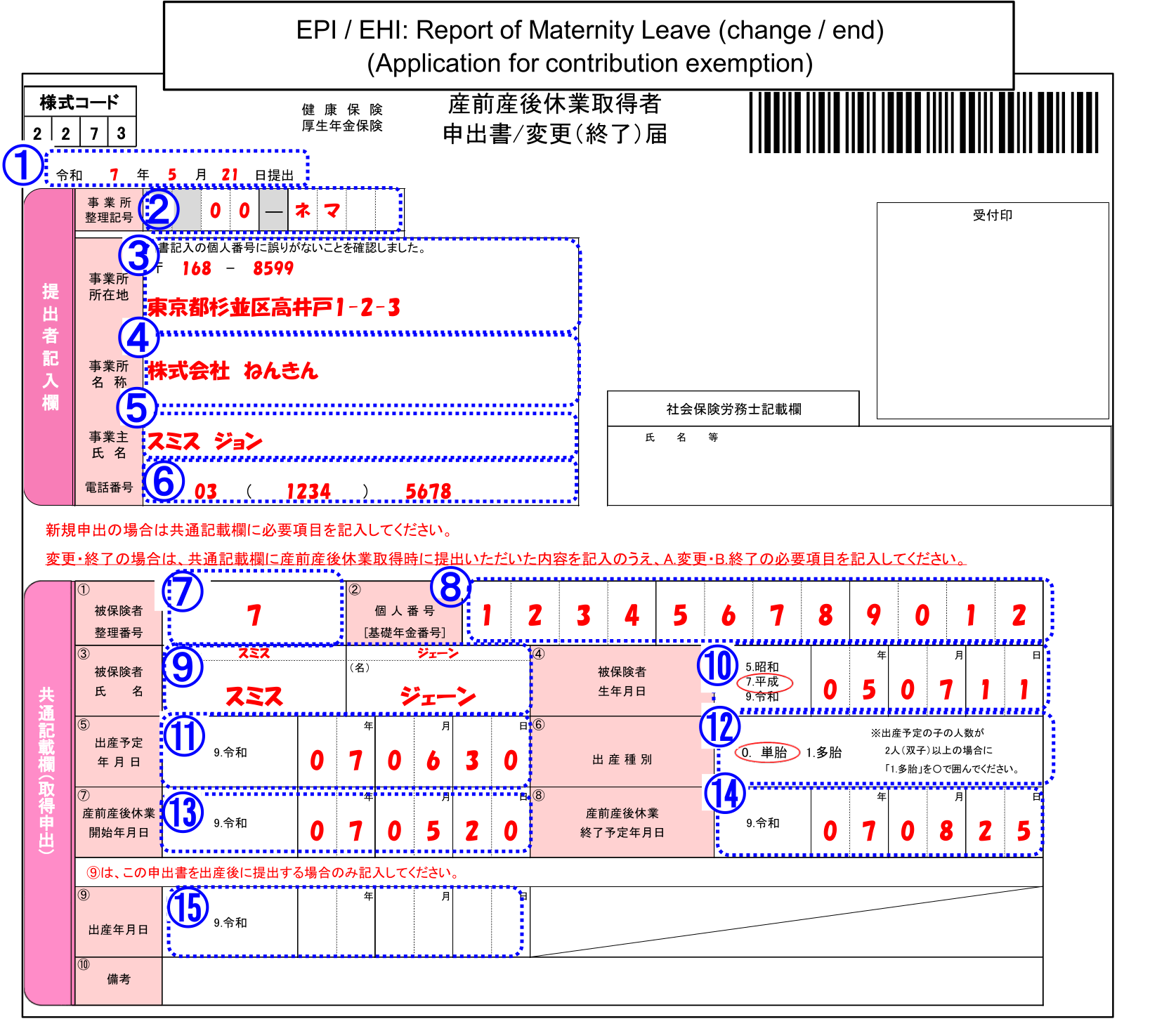
Text from this illustration: Annotated maternity leave report, source page 42
Text printed on the form, in reading order. The circled numbers are the item numbers the instructions refer to.
EPI / EHI: Report of Maternity Leave (change / end) (Application for contribution exemption) 産前産後休業取得者
様式コード
健 康 保 険厚生年金保険
2 2 7 3
申出書/変更(終了)届
➀
令和 7 年 5 月 21 日提出
②
事 業 所
0 0 ― ネマ
整理記号
③
届書記入の個人番号に誤りがないことを確認しました。
〒 168 -8599
事業所
提所在地出
東京都杉並区高井戸1-2-3
④
者
記入名 称欄
事業所
株式会社 ねんきん
⑤
社会保険労務士記載欄
事業主氏 名
スミス ジョン
氏 名 等
⑥
電話番号
03 ( 1234 ) 5678
受付印
新規申出の場合は共通記載欄に必要項目を記入してください。
変更・終了の場合は、共通記載欄に産前産後休業取得時に提出いただいた内容を記入のうえ、A.変更・B.終了の必要項目を記入してください。
⑧
⑦
①
②
被保険者
7
個 人 番 号
1 2 3 4 5 6 7 8 9 0 1 2
整理番号
[基礎年金番号]
③
⑨
(フリガナ)スミス(氏)
ジェーン
④
⑩
年
月
日
(名)
5.昭和
被保険者
被保険者生年月日
7.平成
0 5 0 7 1 1
氏 名
スミス
ジェーン
9.令和
共通記載欄(
⑫
⑤
⑪
日⑥
年
月
※出産予定の子の人数が
出産予定年 月 日
9.令和
0. 単胎 1.多胎
2人(双子)以上の場合に
0 7 0 6 3 0
出 産 種 別
「1.多胎」を〇で囲んでください。
⑭
⑦
⑬
年
月
日⑧
年
月
日
取得
産前産後休業開始年月日
産前産後休業終了予定年月日
9.令和
0 7 0 5 2 0
9.令和
0 7 0 8 2 5
申
出
) ⑨は、この申出書を出産後に提出する場合のみ記入してください。
⑮
⑨
年
月
日
出産年月日
9.令和
⑩
備考
➀ Date of submission (Year in Reiwa era / Month / Day)
➁ Workplace code (You can find the code on the documents JPS sent you: e.g. EPI contribution invoice)
➂ Address of workplace
➃ Name of workplace
➄ Full name of employer (family name, given name)
➅ Phone number of workplace
➆ Worker’s reference number at workplace
➇ Worker’s 12-digit Individual Number or 10-digit Basic Pension Number (Based on the My Number Act, when entering Individual Number, you should verify if worker’s Individual Number itself is correct AND if Individual Number belongs to the worker, by referring to the worker’s My Number Card or Resident Registry 住民票.)
⑨ Full name of worker (family name, given name)
➉ Worker’s date of birth (Circle the applicable number for Japanese era: 5. Showa, 7. Heisei, 9. Reiwa, and enter Year / Month / Day.)
⑪ Due date of the childbirth (Year in Reiwa era / Month / Day)
⑫ Type of pregnancy (Circle the applicable number: 0. Single pregnancy, 1. Multiple pregnancies)
⑬ Date maternity leave starts (Year in Reiwa era / Month / Day)
⑭ Date maternity leave ends (Year in Reiwa era / Month / Day)
⑮ Enter date of childbirth, only if you submit the report after birth (Year in Reiwa era / Month / Day)
After maternity leave: change in remuneration
When your insured worker’s remuneration is changed after the maternity leave and the worker requests change of Standard Monthly Remuneration (SMR,) you need to report us the change, irrespective of the rules of Remuneration Change Report (refer to P23.)
| Report to be submitted: | EPI / EHI: Remuneration Change Report after Maternity Leave 産前産後休業終了時報酬月額変更届 |
|---|---|
| By When: | Immediately after SMR change is confirmed |
| By whom: | Insured worker (via employer) |
| How to submit: | • Post to the appropriate processing center or JPS branch office in charge • In person at the JPS branch office in charge • Online application |
Notes
● Change of SMR: conditions and reflection schedule
The worker’s SMR may be changed when the following two conditions are met:
1. When there is a difference of more than one level between the worker’s current SMR and the SMR based on the average remuneration of the three months starting from the month which includes following day maternity leave ends.
2. When the total work days (i.e. days subject to remuneration payments) are more than 17 days* in at least one month out of said three months in 1. above.
* For part-timers whose actual work days for all the three months are less than 17, any month with 15 or 16 actual work days will be considered. For shorter-hours part-timers, any month with 11 actual work days or more will be considered. Please refer to Notes in P7 for the definition of part-timers and shorter-hours part- timers.
The worker’s revised SMR, if applicable, will be reflected starting from the fourth month. For example, if an insured worker’s maternity leave ends on October 31, SMR is calculated based on remuneration of November, December and January, and revised SMR is reflected to the contribution amount from February.
Instruction and sample to fill in the form
Read instruction below to fill in each item in the form from ① to ㉚. Follow the sample in red ink to enter specific information in Japanese.
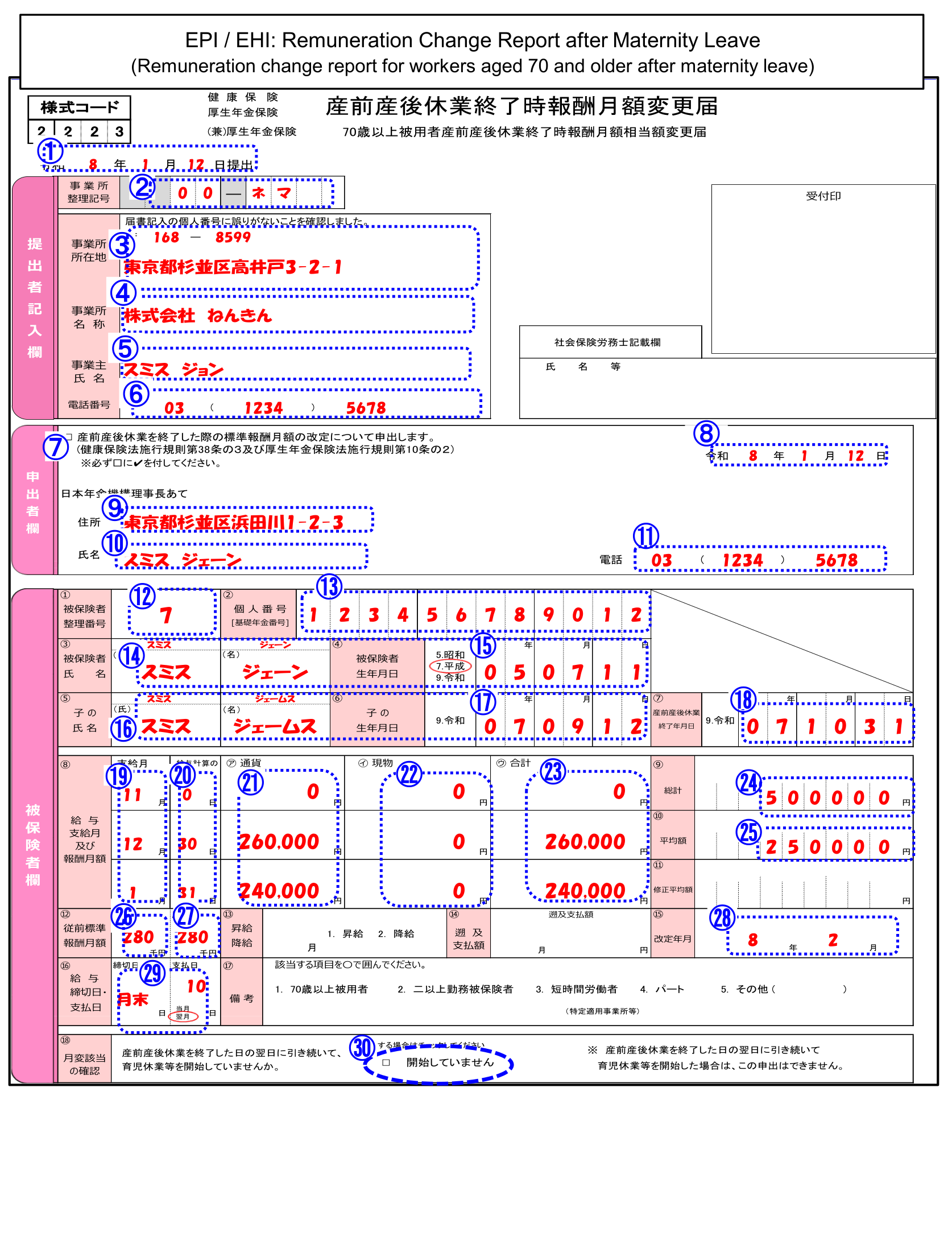
Text from this illustration: Annotated remuneration report after maternity leave, source page 44
Text printed on the form, in reading order. The circled numbers are the item numbers the instructions refer to.
EPI / EHI: Remuneration Change Report after Maternity Leave
(Remuneration change report for workers aged 70 and older after maternity leave)
健 康 保 険 産前産後休業終了時報酬月額変更届
様式コード 2 2 2 3
厚生年金保険
(兼)厚生年金保険
70歳以上被用者産前産後休業終了時報酬月額相当額変更届
➀
令和 8 年 1 月 12 日提出
②
事 業 所
0 0 ― ネマ
整理記号
受付印
届書記入の個人番号に誤りがないことを確認しました。
提事業所出
③
〒 168 — 8599
所在地
東京都杉並区高井戸3-2-1
者
④
記事業所入
株式会社 ねんきん
名 称
⑤
社会保険労務士記載欄
欄
事業主氏 名
スミス ジョン
氏 名 等
⑥
電話番号
03
1234
5678
(
)
⑧
産前産後休業を終了した際の標準報酬月額の改定について申出します。
⑦
(健康保険法施行規則第38条の3及び厚生年金保険法施行規則第10条の2)
令和 8 年 1 月 12 日
※必ず□に✔を付してください。
申
出日本年金機構理事長あて者
⑨
住所東京都杉並区浜田川1-2-3
欄
⑪
⑩
氏名
スミス ジェーン
電話 03 ( 1234 )
5678
⑬
⑫
① 被保険者整理番号
②
7
個 人 番 号
1 2 3 4 5 6 7 8 9 0 1 2
[基礎年金番号]
⑮
③
⑭
スミス
ジェーン
④
年
月
日
被保険者氏 名
(氏)
(名)
被保険者生年月日
5.昭和
スミス
ジェーン
7.平成
0 5 0 7 1 1
9.令和
⑰
⑱
⑤
スミス
ジェームス
⑥
年
月
日 ⑦
年
月
日
(氏)
(名)
子 の氏 名
子 の生年月日
産前産後休業
⑯
スミス
ジェームス
9.令和
0 7 0 9 1 2
9.令和
0 7 1 0 3 1
終了年月日
⑧
支給月給与計算の ㋐ 通貨
㋑ 現物
㋒ 合計
㉓
⑨
⑲
⑳
㉒
㉑
㉔
11
0
0
0
0
総計
5 0 0 0 0 0
月
日
円
円
円
⑩
被
給 与支給月及び
㉕
保
260,000
0
260,000
12
30
平均額
2 5 0 0 0 0
険報酬月額者
月
日
円
円
円
⑪
欄
1
31
240,000
0
240,000
修正平均額
月
㉗
日
円
円
円
⑫
㉖
⑬ 昇給降給
⑭
遡及支払額
⑮
㉘
健
厚
従前標準報酬月額
280 280
1. 昇給 2. 降給
遡 及支払額
8
2
改定年月
月
月
円
年
月
千円
千円
⑯
締切日
㉙
支払日
⑰
該当する項目を〇で囲んでください。
給 与
締切日・支払日
10
1. 70歳以上被用者 2. 二以上勤務被保険者 3. 短時間労働者 4. パート 5. その他 ( )
月末
備 考
日
当月翌月
日
(特定適用事業所等)
円
円
円
⑱
月変該当
の確認
㉚
該当する場合はチェックしてください
産前産後休業を終了した日の翌日に引き続いて、育児休業等を開始していませんか。
開始していません
※ 産前産後休業を終了した日の翌日に引き続いて育児休業等を開始した場合は、この申出はできません。
① Date of submission (Year in Reiwa era / Month / Day)
② Workplace code (You can find the code on the documents JPS sent you: e.g. EPI contribution invoice.)
③ Address of workplace
④ Name of workplace
⑤ Name of employer (family name, given name)
⑥ Phone number of workplace
⑦ Check
 as declaration of worker to apply for change.
⑧ Date employer received this report from worker (Year in Reiwa era / Month / Day)
⑨ Address of worker
⑩ Full name of worker (family name, given name)
⑪ Phone number of worker
⑫ Worker’s reference number at workplace
⑬ Worker’s 12-digit Individual Number or 10-digit Basic Pension Number (Based on the My Number Act, when entering Individual Number, you should verify if the worker’s Individual Number itself is correct AND if Individual Number belongs to the worker, by referring to the worker’s My Number Card or Resident Registry 住民票.)
⑭ Full name of worker (family name, given name)
⑮ Worker’s date of birth (Circle the applicable number for Japanese era: 5. Showa, 7. Heisei, 9. Reiwa, and enter Year / Month / Day, as registered on his/her Resident Registry 住民票. )
⑯ Full name of new born baby (family name, given name)
⑰ Date of birth of the baby (Year in Reiwa era / Month / Day)
⑱ Date maternity leave ends (Year in Reiwa era / Month / Day)
⑲ Enter applicable first, second, and third month after maternity leave.
⑳ Total number of work days subject to remuneration payment for each month
㉑ Amount of remuneration paid in Japanese yen in each month
㉒ Amount of remuneration provided in kind in each month (If meals, housing, or commuting passes are provided by workplace, convert them to monetary value. For conversion, refer to “Value of In-Kind Wages Determined by the Minister of Health, Labour and Welfare.”)
㉓ Total amount of ㉑and ㉒for each month
㉔ Total amount of remunerations in ㉓, excluding the amount for the month with less than 17 work days. If part-timer’s actual work days for applicable first, second and third month are ALL less than 17 days, enter the total amount of remunerations in ㉓ of the month(s) with 15 or 16 actual work days. For shorter-hour part-timers, enter the total amount of remunerations in ㉓ of the month(s) with 11 actual work days or more (See definition of part-timers and shorter-hours part-timers on P7.)
㉕ Amount obtained by dividing the amount ㉔ by the number of months effective as above.
㉖ Current EHI SMR (in thousand Japanese yen)
㉗ Current EPI SMR (in thousand Japanese yen)
㉘ Year in Reiwa era and month when SMR update is to be reflected
㉙ Salary calculation date and pay day in a month: For pay day, circle 当月for this month, or 翌月for next month.
㉚ Check
 to confirm that worker does not take childcare leave consecutively after the maternity leave ends.
Childcare leave: exemption from contribution payments
When your insured worker takes childcare leave, contribution payments of both you and the worker may be exempted. You need to submit an application for exemption.
| Report / Application to be submitted: | EPI / EHI: Report of Childcare Leave (initial / extension / end) (Application for contribution exemption) 育児休業等取得者申出書(新規・延長)/終了届 |
|---|---|
| By when | As soon as possible during the childcare leave (If delayed more than one month after the end of the leave, you need to submit evidence documents.) |
| By whom: | Employer |
| How to submit: | • Post to the appropriate processing center or JPS branch office in charge • In person at the JPS branch office in charge • Online application |
Notes
● Which term is subject to exemption?
You can apply for the exemption of contribution of both the worker and you when your worker takes a childcare leave according to the “Act on Childcare Leave, Caregiver Leave, and Other Measures for the Welfare of Workers Caring for Children or Other Family Members.” Employers, not subject to this Act, cannot be the applicant.
Specifically, the following cases are subject to application for exemption:
(1) Childcare leaves to provide parental care for a child aged under 12 months
(2) Childcare leaves to provide parental care for a child aged between 12 and 18 months
(3) Childcare leaves to provide parental care for a child aged between 18 and 24 months
(4) A leave associated with the childcare leave system to provide parental care for a child aged between 12 (18 for the case of (2), and 24 for the case of (3)) and 36 months.
(5) A leave for a worker who doesn't take maternity leave after childbirth, but takes a leave to provide childcare at childbirth (e.g. male worker) besides a childcare leave. Worker may take the leave for up to 4 weeks, during 8 weeks after childbirth (may be divided into two separate periods.)
Instruction and sample to fill in the form
Read instruction below to fill in each item from ① to ⑲.
Follow the sample in red ink to enter specific information in Japanese.
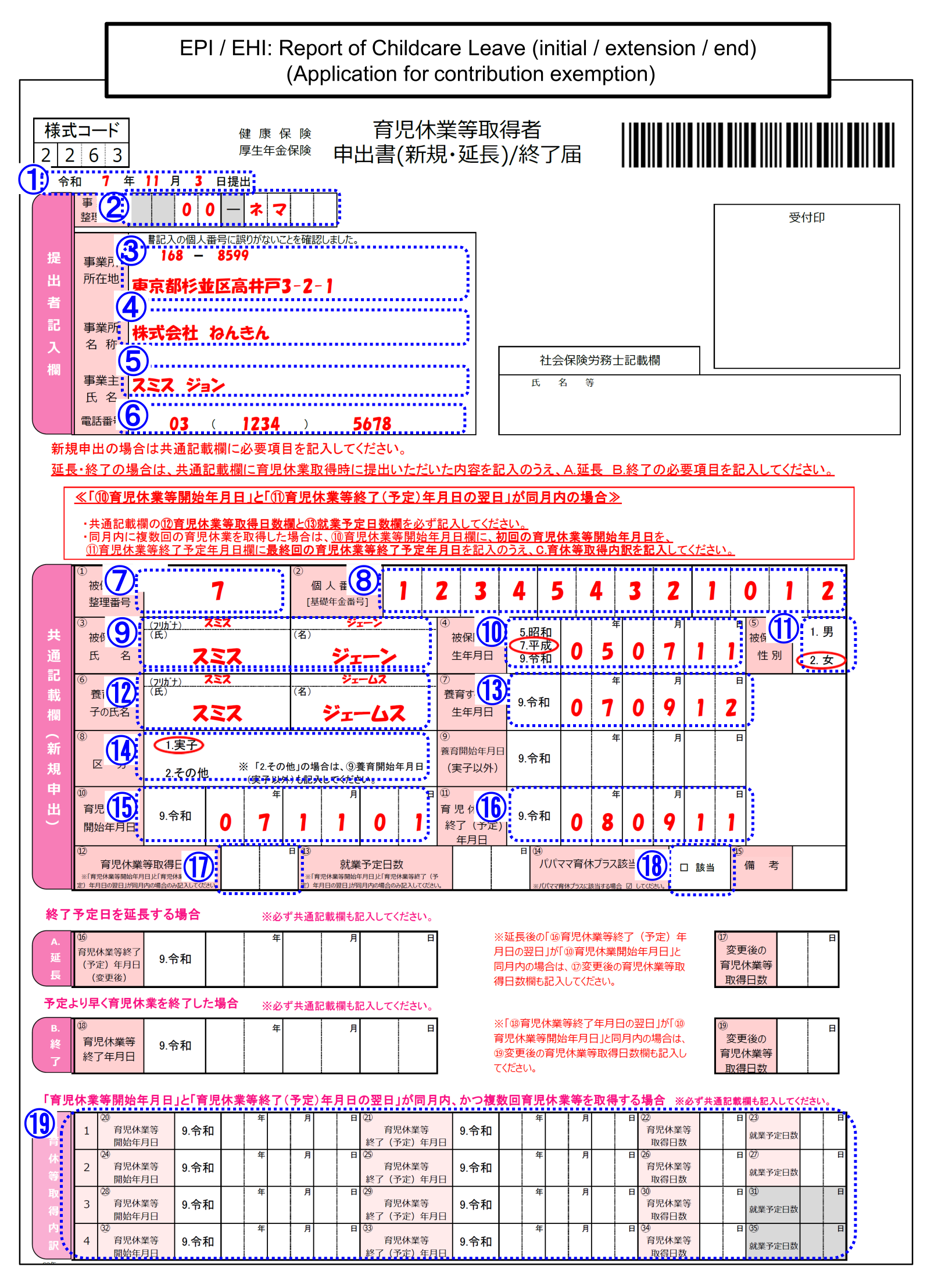
Text from this illustration: Annotated childcare leave report, source page 47
Text printed on the form, in reading order. The circled numbers are the item numbers the instructions refer to.
EPI / EHI: Report of Childcare Leave (initial / extension / end)
(Application for contribution exemption)
➀
➁
➂
④
⑤
⑥
➆
➇
➈
➉
⑪
⑫
⑬
⑭
⑮
⑯
⑰
⑱
⑲
➀Date of submission (Year in Reiwa era / Month / Day)
➁Workplace code (You can find the code on the documents JPS sent you: e.g. EPI contribution invoice)
➂Address of workplace
④Name of workplace
⑤ Name of employer (family name, given name)
⑥Phone number of workplace
⑦Worker’s reference number at workplace
⑧Worker’s 12-digit Individual Number or 10 digit Basic Pension Number (Based on the My Number Act, when entering Individual Number, you should verify if worker’s Individual Number itself is correct AND if Individual Number belongs to the worker, by referring to the worker’s My Number Card or Resident Registry 住民票)
⑨Full name of worker (family name, given name)
⑩Worker’s date of birth (Circle the applicable number for Japanese era: 5. Showa, 7. Heisei, 9. Reiwa, and enter Year / Month / Day.)
⑪Sex of worker (Circle the applicable number: 1. Male, 2. Female)
⑫Full name of new born baby (family name, given name)
⑬Date of birth of the baby (Year in Reiwa era / Month / Day)
⑭Relationship (Circle the applicable number: 1. Biological child, 2. Adopted or others)
⑮Date childcare leave starts (Year in Reiwa era / Month / Date)
⑯Date childcare leave ends (Year in Reiwa era / Month / Date)
⑰Number of days only if the childcare leave starts and ends in a same month.
⑱Check
 if worker uses Paternal-Maternal Leave Plus* system
⑲If worker takes short-term childcare leave more than one time, and each leave starts and ends within a same month, provide each leave’s date of start, date of end, number of days of leave and number of days to be worked in the month.
* Paternal-Maternal Leave Plus: A system that allows the childcare leave period to be extended until the child reaches 14 months of age, provided that both the father and the mother take childcare leave. Each parent is entitled to up to one year of leave, including the mother’s maternity leave.
After childcare leave: change in remuneration
When your insured worker’s remuneration is changed after the childcare leave and the worker requests change of Standard Monthly Remuneration (SMR,) you need to report us the change, irrespective of the rules of Remuneration Change Report (refer to P23.)
| Report to be submitted: | EPI / EHI: Remuneration Change Report after Childcare Leave 育児休業終了時報酬月額変更届 |
|---|---|
| By when | Immediately after SMR change is confirmed |
| By whom: | Insured worker (via employer) |
| How to submit: | • Post to the appropriate processing center or JPS branch office in charge • In person at the JPS branch office in charge • Online application |
Notes
● Change of SMR: conditions and reflection schedule
The worker’s SMR may be changed when the following two conditions are met:
1. When there is a difference of more than one level between the worker’s current SMR and the SMR based on the average remuneration of the three months starting from the month which includes following day childcare leave ends.
2. When the total work days (i.e. days subject to remuneration payments) are more than 17 days* in at least one month out of said three months in 1. above.
* For part-timers whose actual work days for all the three months are less than 17, any month with 15 or 16 actual work days will be considered. For shorter- hours part-timers, any month with 11 actual work days or more will be considered. Please refer to Notes in P7 for the definition of part-timers and shorter-hours part-timers.
Please note that you may not report the remuneration change if the worker consecutively takes maternity leave from the next day the childcare leave ends.
The worker’s revised SMR, if applicable, will be reflected starting from the fourth month. For example, if an insured worker’s childcare leave ends on October 31, SMR is calculated based on remuneration of November, December and January, and revised SMR is reflected to the contribution amount from February.
Instruction and sample to fill in the form
Read instruction below to fill in each item from ① to ㉚.
Follow the sample in red ink to enter specific information in Japanese.
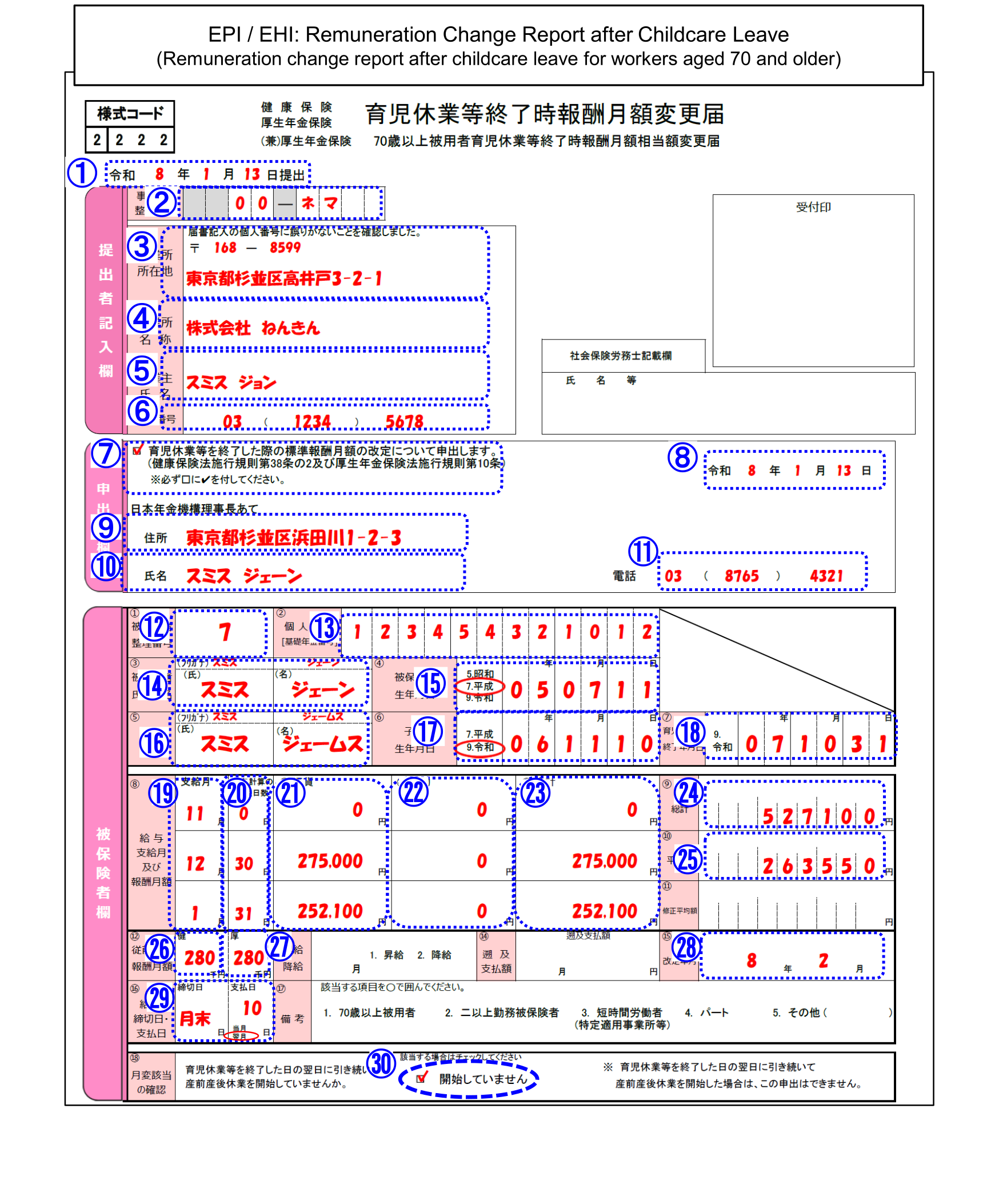
Text from this illustration: Annotated remuneration report after childcare leave, source page 50
Text printed on the form, in reading order. The circled numbers are the item numbers the instructions refer to.
EPI / EHI: Remuneration Change Report after Childcare Leave
(Remuneration change report after childcare leave for workers aged 70 and older)
①
②
③
④
⑤
⑥
⑦
⑧
⑨
⑩
⑪
⑫
⑬
⑭
⑮
⑯
⑰
⑱
⑲
⑳㉑
㉒
㉓
㉔
㉕
㉖
㉗
㉘
㉙
㉚
① Date of submission (Year in Reiwa era / Month / Day)
② Workplace code (You can find the code on the documents JPS sent you: e.g. EPI contribution invoice.)
③Address of workplace
➃ Name of workplace
⑤ Name of employer (family name, given name)
⑥ Phone number of workplace
⑦ Check
 as declaration of worker to apply for change.
⑧ Date employer received this report from worker (Year in Reiwa era / Month / Day)
⑨ Address of worker
⑩ Full name of worker (family name, given name)
⑪ Phone number of worker
⑫ Worker’s reference number at workplace
⑬ Worker’s 12-digit Individual Number or 10-digit Basic Pension Number (Based on the My Number Act, when entering Individual Number, you should verify if the worker’s Individual Number itself is correct AND if Individual Number belongs to the worker, by referring to the worker’s My Number Card or Resident Registry 住民票.)
⑭ Full name of worker (family name, given name)
⑮ Worker’s date of birth (Circle the applicable number for Japanese era: 5. Showa, 7. Heisei, 9. Reiwa, and enter Year / Month / Day, as registered on the Resident Registry 住民票.)
⑯ Full name of new born baby (family name, given name)
⑰ Date of birth of the baby (Circle the applicable number for Japanese era: 7. Heisei, 9. Reiwa, and enter Year / Month / Day.)
⑱ Date childcare leave ends (Year in Reiwa era / Month / Day)
⑲ Enter applicable first, second, and third month after childcare leave.
⑳ Total number of work days subject to remuneration payments for each month
㉑ Amount of remuneration paid in Japanese yen for each month
㉒ Amount of remuneration provided in kind in each month (If meals, housing, or commuting passes are provided by workplace, convert them to monetary value. For conversion, refer to “Value of In-Kind Wages Determined by the Minister of Health, Labour and Welfare.”)
㉓ Total amount of ㉑and ㉒for each month
㉔ Total amount of remunerations in ㉓, excluding the amount for the month with less than 17 work days. If part-timer’s actual work days for applicable first, second and third months are ALL less than 17 days, enter the total amount of remunerations in ㉓ of the month(s) with 15 or 16 actual work days. For shorter-hour part-timers, enter the total amount of remunerations in ㉓ of the month(s) with 11 actual work days or more (See definition of part-timers and shorter-hour part-timers on P7.)
㉕ Amount obtained by dividing the amount ㉔ by the number of months effective as above.
㉖ Current EHI SMR (in thousand Japanese yen)
㉗ Current EPI SMR (in thousand Japanese yen)
㉘ Year in Reiwa era and month when SMR update is to be reflected
㉙ Salary calculation date and pay day in a month: For pay day, circle 当月for this month, or 翌月for next month.
㉚ Check
 to confirm that worker does not take maternity leave consecutively after the childcare leave ends.
SMR special treatment for childcare period
If the amount of Standard Monthly Remuneration (SMR) becomes lower while the worker takes care of child under age 3, you may apply for special treatment to maintain the current SMR during the period of childcare. It aims to secure the value in worker’s future pension benefits amount, which otherwise would be impacted by actual lower SMR because of the childcare.
| Report / Application to be submitted: | EPI: Application / End Report for SMR Special Treatment for Childcare Period 養育期間標準報酬月額特例申出書・終了届 |
|---|---|
| Evidence documents (Details in Notes below) | Certified copy of worker’s Family Registry (whole or excerpt) and Certified copy of worker’s Resident Registry |
| By when | As soon as insured worker claims |
| By whom: | Insured worker (via employer), or the former worker |
| How to submit: | • Post to the appropriate processing center or JPS branch office in charge • In person at the JPS branch office in charge • Online application |
Notes
● SMR special treatment to secure future EPI benefits, not for EHI
This special treatment aims to protect future EPI benefits from being negatively impacted by lower SMR deriving from childcare. Please note that this treatment does not apply to EHI benefits.
● Evidence documents (details)
・Proof of relationship between the worker and the child
For example
- Certified copy of the worker’s Family Registry 戸籍謄本 or certification of information on worker’s Family Registry 戸籍記載事項証明書
- (If the worker is the head of the household) Certified copy of worker’s Resident Registry including the child’s information
Please note that you don’t need to submit these documents if you (the employer) confirmed their relationship, based on evidence such as the Certified copy of the worker’s Family Registry, and checked
 in the report form (See ⑲on P52.)
・Proof of worker’s childcare (age and address)
For example
-Certified copy of worker’s Resident Registry 住民票 including the child’s information
Please note that you don’t need to submit the documents if Individual Number for both the worker and the child are entered in the report form (See ⑫and ⑱on P52.)
Instruction and sample to fill in the form
Read instruction below to fill in each item from ① to ㉓.
Follow the sample in red ink to enter specific information in Japanese.
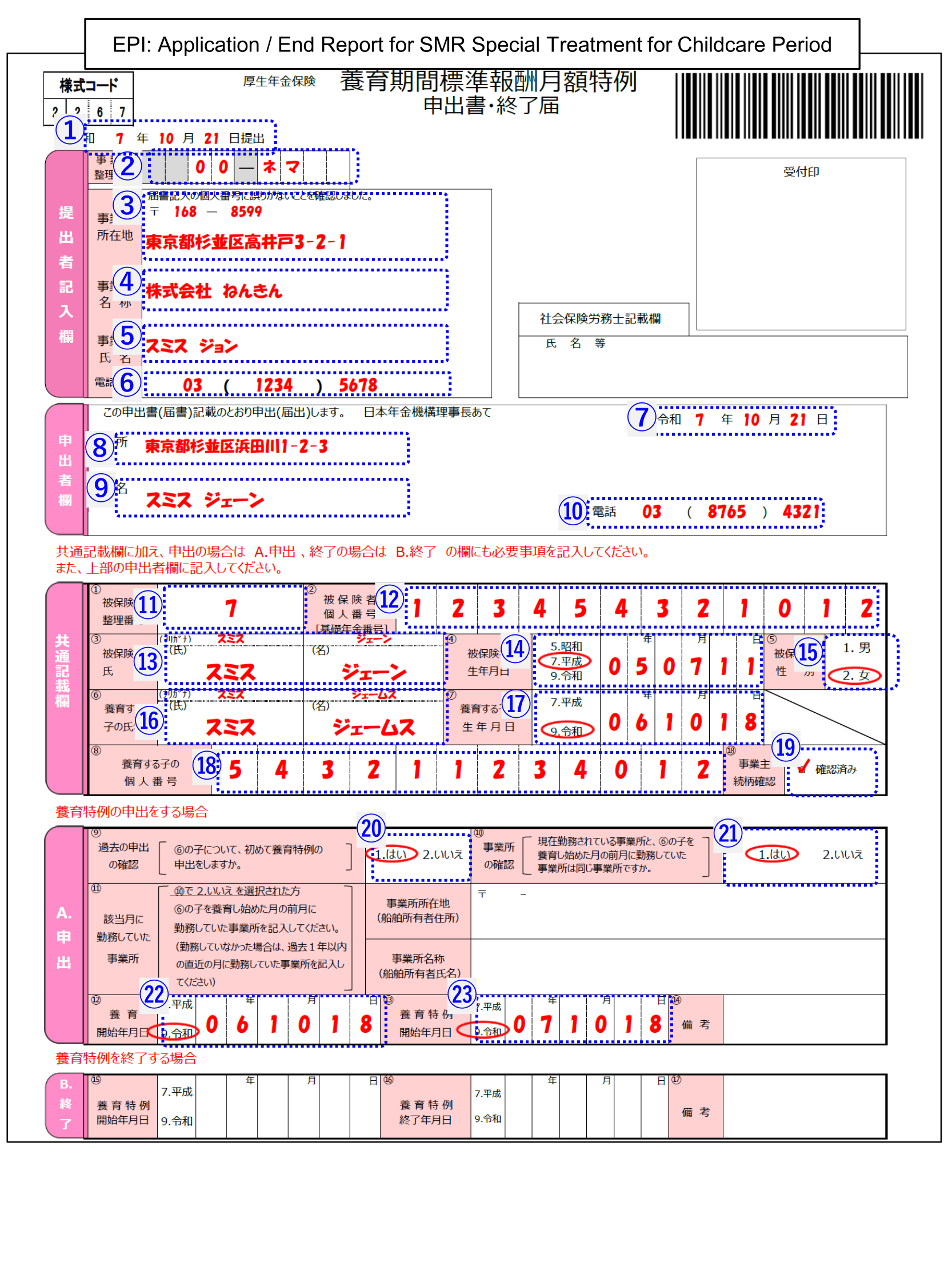
Text from this illustration: Annotated special treatment report for childcare, source page 53
Text printed on the form, in reading order. The circled numbers are the item numbers the instructions refer to.
EPI: Application / End Report for SMR Special Treatment for Childcare Period
①
②
③
④
⑤
⑥
⑧
⑨
⑦
⑩
⑪
⑬
⑯
⑱
⑫
⑭
⑰
⑮
⑲
⑳
㉑
㉒
㉓
① Date of submission (Year in Reiwa era / Month / Day)
② Workplace code (You can find the code on the documents JPS sent you: e.g. EPI contribution invoice.)
③ Address of workplace
④ Name of workplace
⑤ Full name of employer (family name, given name)
⑥ Phone number of workplace
⑦Date employer received this report from worker, or learned worker’s intension to submit this report. Or, date the worker submits this report to JPS branch office or processing center after his/her resignation from workplace.
⑧ Address of worker
⑨ Full name of worker (family name, given name)
⑩ Phone number of worker
⑪ Worker’s reference number at workplace
⑫ Worker’s 12-digit Individual Number or 10-digit Basic Pension Number (Based on the My Number Act, when entering Individual Number, you should verify if worker’s Individual Number itself is correct AND if Individual Number belongs to the worker, by referring to the worker’s My Number Card or Resident Registry 住民票.)
⑬ Full name of the worker (family name, given name)
⑭ Worker’s date of birth (Circle the applicable number for Japanese era: 5. Showa, 7. Heisei, 9. Reiwa, and enter Year / Month / Day as registered on the Resident Registry 住民票.)
⑮ Worker’s sex (Circle the applicable number: 1. Male, 2. Female)
⑯ Full name of the child being cared for (family name, given name)
⑰ Date of birth of the child (Circle the applicable number for Japanese era: 7. Heisei, 9. Reiwa, and enter Year / Month / Day.)
⑱ 12-digit Individual Number of the child
⑲ Check
 if the employer verifies the relationship between worker and the child with an evidence such as certified (or extract) copy of Family Register戸籍謄本.
⑳ Circle 1.(Yes) if it is the first time for worker to apply for SMR special treatment. Circle 2.(No) if worker used SMR special treatment for the same child.
㉑ Circle 1.(Yes) if the worker was working for current workplace in the previous month when he / she started caring for the child in ⑯. Circle 2.(No) if the worker was working for different workplace in the previous month when he / she started caring for the child in ⑯.
㉒ Enter date to start caring the child in ⑯(Circle the applicable number for Japanese era: 7. Heisei, 9. Reiwa, and enter Year / Month / Day.)
㉓ Enter date when any of the event below is applicable relating to the child in ⑯: (Circle the applicable number for Japanese era: 7. Heisei, 9. Reiwa, and enter Year / Month / Day.)
• Date worker was registered for EPI coverage while caring for the child under age 3.
• Following date of the end of childcare leave for the child under age 3.
• Following date of the end of maternity leave for the child under age 3.
• Following date of the end of SMR special treatment which was applied to other child while caring for the child in ⑯
Practical Guide to Pay Employees’ Pension Insurance and Other Contributions
Overview of contribution payment
The Japan Pension Service (JPS) branch office collects insurance contributions of Employees’ Pension Insurance (EPI) and Employees’ Health Insurance (EHI.) The employer of a workplace is responsible by law to pay by the due date the total contribution of the employer’s share and the insured worker’s (including employer) share which the employer deducts from their monthly salary and bonuses. The due date for payment of monthly contribution is the last day of the following month, e.g., the due date of payment of contribution for April is the last day of May. (If the last day of the month is a holiday, the due date is the first business day after the last day of the month.)
Practically, the employer needs to deduct the contribution amount (worker‘s share) from worker’s current month’s salary; the amount is calculated based on the previous month’s Standard Monthly Remuneration (SMR): e.g., you deduct the contribution for the month of April from the salary paid in May. For bonus, the contribution amount which is calculated based on Standard Bonus Amount (SBA) needs to be deducted from the bonus.
Around the 20th of each month, JPS sends to the employers the notice (invoice) of contribution to be paid, i.e., a contribution payment notice or a contribution payment notice/receipt notice. The amount of contribution is calculated based on the reports which are previously submitted by the employer, regarding the worker’s enrollment/end of insurance coverage, SMR and SBA.
Note: Postal condition could cause delays, especially when you use mail forwarding service. If necessary, please contact the appropriate*1 JPS branch office, e.g., to request for a reissue.
*1 “The appropriate” branch office is the one responsible for local operation of the area.
How to pay insurance contributions
You (employer) have some options to pay the contributions as follows:
1. Automatic bank account transfer
To apply for payment by automatic bank account transfer, you need to:
(1) Make sure that your bank*2 is on the “list of banks which offers the service for EPI or National Pension contributions payments.” To assure, ask your bank*2 branch if it offers this service.
(2) Fill in the necessary information in the “Application for Automatic Bank Account Transfer (Change).”
(3) Ask your bank*2 to confirm that the bank information entered in the application is correct.*3
(4) Submit the application to the appropriate JPS processing center or branch office by post. You also may submit it to JPS branch office by visit.
*2 Corporation’s bank (or other legal person’s bank) in case for corporation (or other legal person)
*3 You can skip process(3) if you nominate an online bank (with no physical branch).
2. Payment at banks
You can pay at banks using “contribution payment notice (invoice).” (Don’t tear the notice apart.)
3. Electronic payment (Pay-easy)
You can find numbers you need for electronic payment on the contribution payment notice; collecting institution number is 00500, payment number is shown in 16 digits, and confirmation number is shown in 6 digits.
Enter these information as requested, and pay.
• Internet banking - Payment via the Internet
• Mobile banking - Payment via a mobile phone
• ATM (with Pay-easy service) - Payment at ATM at banks
• Telephone banking - Payment guided by instruction over telephone
Important points
• To use Internet banking, mobile banking, or telephone banking, you need to have a contract for e-payment with your bank*2 in advance.
• JPS e-payment system operates 24 hours for 365 days a year in principle. You can find the information of occasional out-of-service, i.e., for systems maintenance on our website.
• Please note that the e-payment doesn’t provide receipts. If you eventually need ones, you may need to pay at a bank.
Contribution payment notice (invoice)
Every month JPS branch office sends you contribution payment notice (invoice) which calls you to pay monthly contributions for Employees’ Pension Insurance, Employees’ Health Insurance, Seamen’s Insurance, and Child and Childcare contributions.
Sample of the invoice is shown below.
When you pay contributions at a bank, you need to use the whole set of the invoice; do not tear into parts.
Sample of a contribution payment notice (invoice) as of March 2025 (subject to change in the future)
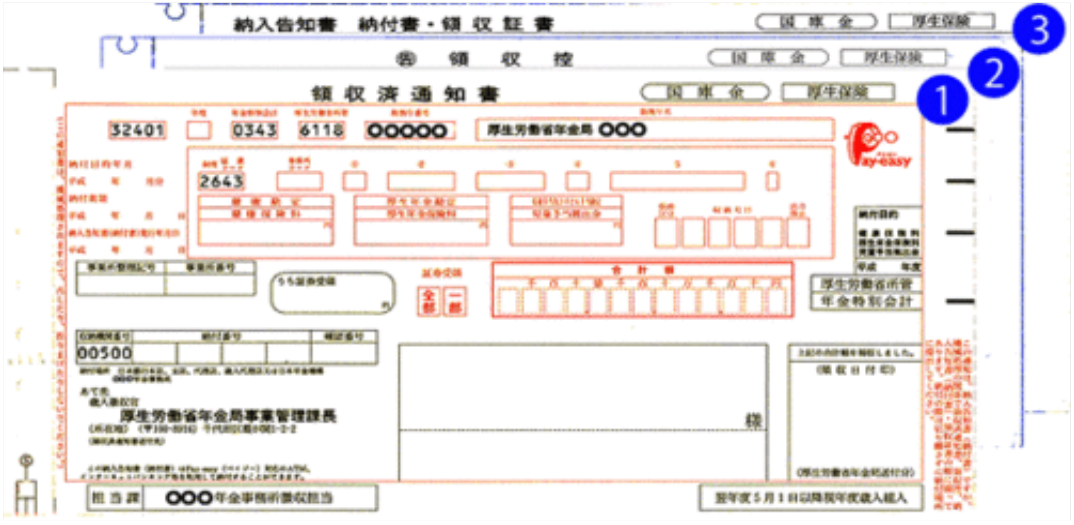
❶ “Receipt”
❷ “Receipt copy”
❸ “Contribution payment notice (invoice)”
Note: JPS branch office sends you the invoice around 20th every month. Postal condition could cause delays, especially when you use mail forwarding service. If necessary, please contact the appropriate JPS branch office, e.g., to request for a reissue of invoice.
How to calculate contributions
1. How to calculate your workplace's total contribution amount
First, you calculate each worker’s contribution amount by multiplying their SMR or SBA by the certain contribution rate determined by each system. The result of all amount, rounded down to the nearest 1 yen, if applicable, is the amount your workplace needs to pay.
See sample of calculation table on the last page.
2. How to calculate worker’s share and deduct from their salary
You need to collect the worker’s share of EPI/EHI contribution by deduction from their salary.
The amount to be collected is half of the amount obtained by multiplying the worker’s SMR by the insurance contribution rate.
⇒ Amount to be collected = Worker’s SMR × Insurance contribution rate ÷ 2
If the calculation results with a fraction of less than 1 yen, round it off to in accordance with the calculation rules in (1) and (2) below.
See sample of calculation table on the last page.
Note 1: For bonus, calculate the amount with SBA instead of SMR, and collect from them by deduction from bonus.
Note 2: Calculate the worker’s share of contribution amount for bonus by multiplying SBA by contribution amount and split by half. Do not use quick reference table for monthly contribution amount.
(1) Calculation if you deduct the worker’s share from their salary (bonus)
If the calculation of a worker’s share results in an amount with fraction, the fraction equal to or less than 50/100 yen shall be rounded down to the nearest 1 yen; the fraction more than 50/100 yen shall be rounded up to the nearest 1 yen.
Example of amount to be deducted:
12,345.50 yen ⇒ rounded down to 12,345 yen
12,345.51 yen ⇒ rounded up to 12,346 yen
(2) Calculation if you collect worker’s share in cash
For cases you cannot deduct from their salary, you need to collect worker’s share in cash as below:
If the calculation of a worker’s share results in an amount with fraction, the fraction less than 50/100 yen shall be rounded down to the nearest 1 yen; the fraction equal to or more than 50/100 yen shall be rounded up to the nearest 1 yen.
Example of amount to be collected in cash:
12,345.49 yen ⇒ rounded down to 12,345 yen
12,345.50 yen ⇒ rounded up to 12,346 yen
Note: Regardless of (1) and (2) above, an employer and the workers may conclude a special agreement on how to round off fractions in contribution amount calculation.
3. Calculation of the employer’s share
The amount of employer’s share is the balance between the total contribution amount for the workplace (as also indicated on the invoice we send you) and the total amount of workers’ share (calculated as instructed in 2. above.)
Please note that in principal, the employer should pay half the amount obtained by multiplying the worker’s SMR by the contribution rate. In practice, however, because of rounding in calculation of each worker’s share, the amount of employers share and total amount of workers’ share do not necessarily match.
See sample of calculation table below.
Sample of calculation table for EPI contribution (summarizing the instructions above)
Sample for EPI contribution rate at 18.3 %
Explains: Worker's share (Rounded) column
If you deduct worker’s share of EPI contribution from their monthly salary (and no special agreement with workers is in place), calculate the worker’s share (half of contribution amount) with rounding the fraction if any: fraction of equal or less than 50/100 yen is to be rounded down, and fraction of more than 50/100 yen is to be rounded up, to the nearest 1 yen.
(Unit: Yen)
| SMR or SBA | Amount of EPI contribution | 1 / 2 amount of EPI contribution | Worker's share (Rounded) | Employer’s share | |
|---|---|---|---|---|---|
| Worker A | 110,000 | 20,130.00 | 10,065.00 | 10,065 | |
| Worker B | 134,000 | 24,522.00 | 12,261.00 | 12,261 | |
| Worker C | 150,000 | 27,450.00 | 13,725.00 | 13,725 | |
| Worker D | 118,000 | 21,594.00 | 10,797.00 | 10,797 | |
| Worker E | 118,000 | 21,594.00 | 10,797.00 | 10,797 | |
| Worker F | 98,000 | 17,934.00 | 8,967.00 | 8,967 | |
| Total | 728,000 | 133,224.00 | 66,612.00 | 66,612 | 66,612 |
| Amount of EPI contribution for your workplace | 133224 |
Explains: Amount of EPI contribution for your workplace, Amount of EPI contribution
JPS branch office informs you the amount after rounding down the total figure.
Explains: Total, Employer’s share
The amount of employer’s share is calculated by subtracting the total amount of worker’s share from the amount notified in the contribution payment notice. (Due to rounding involved with calculation, the amount of employer’s share may not exactly half of the contribution amount.)
133,224 yen - 66,612 yen = 66,612 yen ….Employer's share