Japan Pension Service · Employer guide
Employees’ pension and health insurance: employer overview
Published by Japan Pension Service. HTML edition by Foreigners in Japan. This is an unofficial reproduction; the original PDF is authoritative.
Original PDF on nenkin.go.jp ↗About this publication: Foreigners in Japan
An employer’s introduction to Employees’ Pension Insurance and Employees’ Health Insurance: which workplaces and workers must be covered, what each scheme provides, and the employer’s part in enrolment.
Who this is for
For employers and payroll staff, including those checking whether part-time workers, staff on probation or non-Japanese employees must be enrolled. Employees can also use it to see the workplace insurance their employer arranges.
What it covers
- Employees’ pension and health insurance: check which workplaces and workers are covered.
- Workplace insurance benefits: read the pamphlet’s explanation of the two insurance systems and their benefits.
- Enrolment and contributions: the employer’s applications, how contributions are calculated and how they are shared with employees.
Helpful next steps
- Find the employer’s registration and reporting procedures
Continue to the official manual for workplace registration, hiring and other staff changes.
Official publication: original wording
英語
To Employers

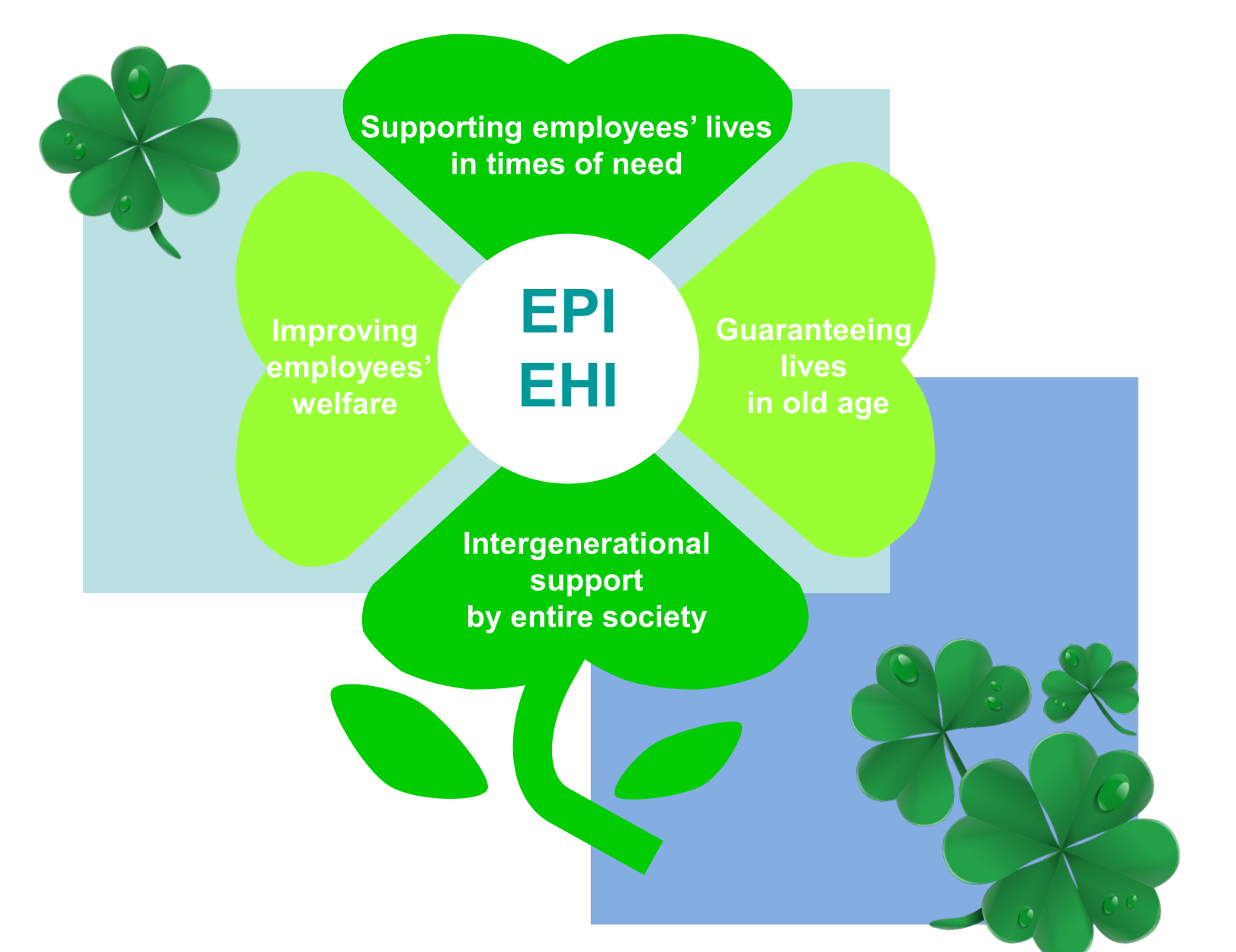
Enrollment of employees in EPI and EHI supports their lives.
Text from this illustration: Employees’ pension and health insurance illustration, source page 1
Supporting employees’ lives in times of need
Improving employees’ welfare
EPI EHI
Guaranteeing lives in old age
Intergenerational support by entire society
Feel free to contact any JPS branch office for further information.
JPS systematically promotes and extends coverage to the workplaces with the workers who shall be insured by EPI and EHI. The goals are to prevent people from failing to receive pension or receiving low benefits and to ensure fair contribution among employers.

Text from this illustration: Web search box with “Japan Pension Service” and a 検索 (search) button, source page 1
Japan Pension Service
https://www.nenkin.go.jp/international/
Japan Pension Service is responsible for public pension operation.

Mandatory Coverage
It is mandatory for these following types of workplaces to be covered by EPI and EHI. They are referred to as “Mandatorily Covered Workplace.”

Text from this illustration: Mandatory coverage illustrations, source page 2
All “HOJIN” corporations*
(with 1 worker or more)
Business operated
by individual **
(with 5 workers or more on regular basis)
* Private school Hojin, however, shall be covered by the EPI and health insurance program provided by Private School Mutual Aid system instead of EHI.
** Excluding workplaces engaged in certain type, such as service, agriculture, forestry, fishing and livestock industry.
Note: A workplace other than mandatorily covered workplace may be covered by EPI and EHI as a “voluntarily covered workplace” if it meets certain criteria.
Insured Persons
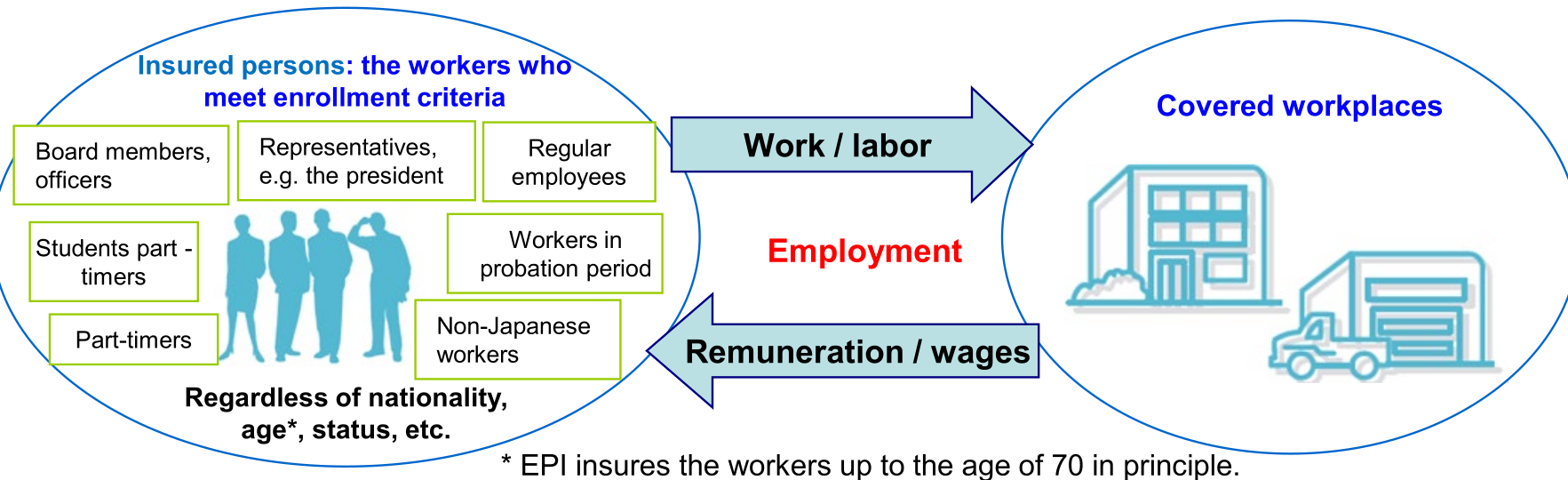
Each Mandatorily Covered Workplace shall introduce EPI and EHI, and all employees there also shall be insured by EPI and EHI.
Those employees are referred to as “insured persons.”
Text from this illustration: Insured persons and covered workplaces diagram, source page 2
Insured persons: the workers who meet enrollment criteria
Board members, officers
Representatives, e.g. the president
Regular employees
Students part - timers
Workers in probation period
Non-Japanese workers
Part-timers
Regardless of nationality, age*, status, etc.
Work / labor
Employment
Remuneration / wages
Covered workplaces
* EPI insures the workers up to the age of 70 in principle.
EPI/EHI enrollment criteria
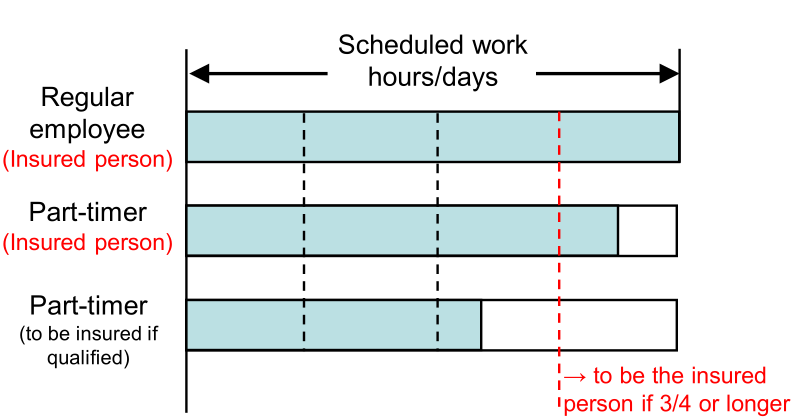
Regular employees, officers and representatives shall be the insured persons. Part-time workers whose scheduled work hours per week and scheduled work days per month are not less than three-fourths of those of regular employees engaged in the same task at the same workplace also shall be the insured persons. Even the workers whose scheduled work hours/days are less than three-fourths of those of regular employees may be insured if they meet certain criteria, i.e. working for a company with more than 50 workers, and 20 work hours or more per week.
Text from this illustration: Work schedule comparison chart, source page 2
Scheduled work hours/days
Regular employee
(Insured person)
Part-timer
(Insured person)
Part-timer
(to be insured if qualified)
→to be the insured person if 3/4 or longer
Pension beneficiaries
If you employ a person younger than age 70 who is receiving Old-age Employees’ Pension (including specially provided OEP) benefits, he/she shall be the insured person if he/she meets the enrollment criteria. Please note that his/her Old-age Employees’ Pension benefits while at work may be suspended in whole or in part, depending on his/her monthly sum of income from their salary, bonus and entitled pension benefits.
Non-Japanese worker
Regardless of workers’ nationality, all workers shall be the insured persons as long as they meet the enrollment criteria.
Probation period
Irrespective of legitimate employment contract in place, or worker’s consent, a worker who meets the enrollment criteria shall be the insured person from the start of his/her probation period.
Enrollment Procedures
Employers need to file an application for EPI / EHI registration and enrollment.

Text from this illustration: Enrollment procedure diagram, source page 3
Registration of workplaces
Application for workplace coverage
Enrollment of workers as the insured persons
Application to enroll in EPI /EHI
The insured persons’ dependents
Report of dependents (change)
For details of application procedures and forms, please contact any JPS branch office.
Forms are available at : https://www.nenkin.go.jp/
Employees’ Pension Insurance Benefits
When a person who is/was insured under EPI becomes old, disabled or dies, Employees’ Pension Insurance system pays pension benefits or lump-sums payments through benefits claim.
Old Age <Old-age Employees’ Pension>
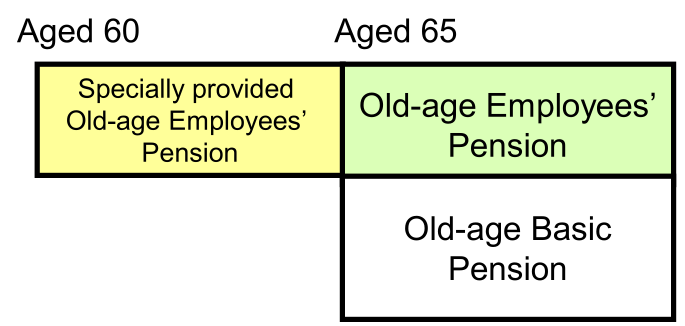
Old-age Employees’ Pension is paid in addition to Old-age Basic Pension if the person who was insured under EPI meets these following requirements:
(1) Aged 65 or older ( It is possible to start benefits as early as aged 60, or later than aged 65. )
(2) With at least one month of EPI insured period; and
(3) Meet a certain insured period required to receive Old-age Basic Pension
Text from this illustration: Old-age pension eligibility diagram, source page 3
Aged 60
Aged 65
Specially provided Old-age Employees’ Pension
Old-age Employees’ Pension
Old-age Basic Pension
Those who meet the following requirements may also receive Specially- provided Old-age Employees’ Pension from aged 60 until 65 ( pensionable age depends on their date of birth and sex ).
(1) Aged 60 or older
(2) With at least one year of EPI insured period; and
(3) Meet a certain insured period required to receive Old-age Basic Pension
Disability <Disability Employees' Pension>
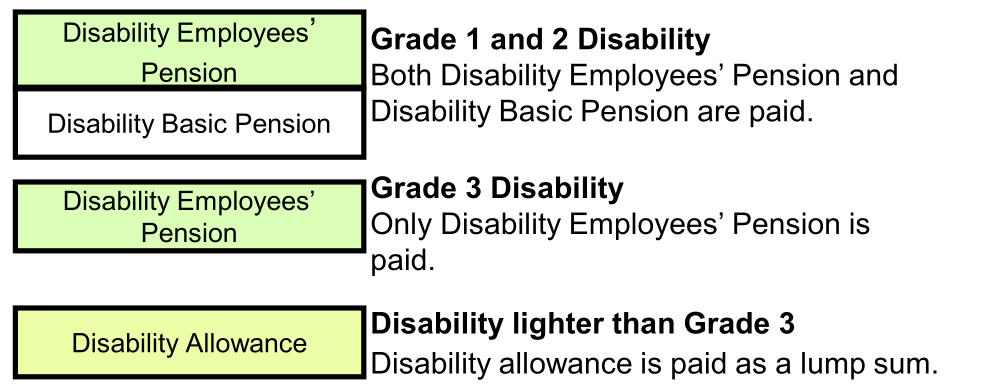
Benefits are paid to the persons with disability caused by sickness or injury and have the first medical examination of the disease while they have been insured under EPI. Benefits are paid based on specified disability grade.
Note: The persons need to have paid insurance contributions to fulfill a certain portion of their insured period.
Text from this illustration: Disability benefits diagram, source page 3
Disability Employees’ Pension
Disability Basic Pension
Grade 1 and 2 Disability
Both Disability Employees’ Pension and Disability Basic Pension are paid.
Disability Employees’ Pension
Grade 3 Disability
Only Disability Employees’ Pension is paid.
Disability Allowance
Disability lighter than Grade 3
Disability allowance is paid as a lump sum.
Death <Survivors’ Employees’ Pension>
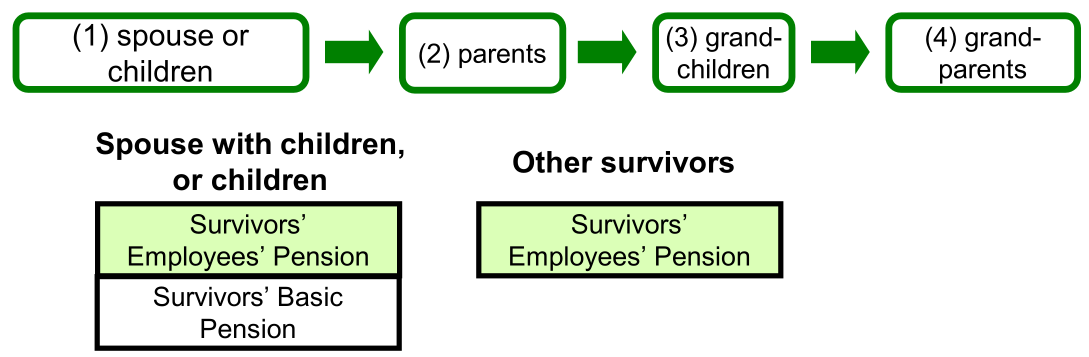
Survivors’ Employees’ Pension is paid to the survivors who have depended on the deceased person’s income, when the person dies while he/she has been covered under EPI, or when the person dies because of sickness or injury that started while covered under EPI and dies within 5 years from the date of its first medical examination.
Note: The persons need to have paid insurance contributions to fulfill a certain portion of their insured period.
● The priority order of the survivors to receive Survivors’ Employees’ Pension ( with some limits such as age etc. ).
● Survivors’ Basic Pension is also paid to his/her spouse with children or children. ( with some limits such as age etc. ).
Text from this illustration: Survivors’ pension diagram, source page 3
(1) spouse or children
(2) parents
(3) grand- children
(4) grand- parents
Spouse with children, or children
Survivors’ Employees’ Pension
Survivors’ Basic Pension
Other survivors
Survivors’ Employees’ Pension
Employees’ Health Insurance Benefits
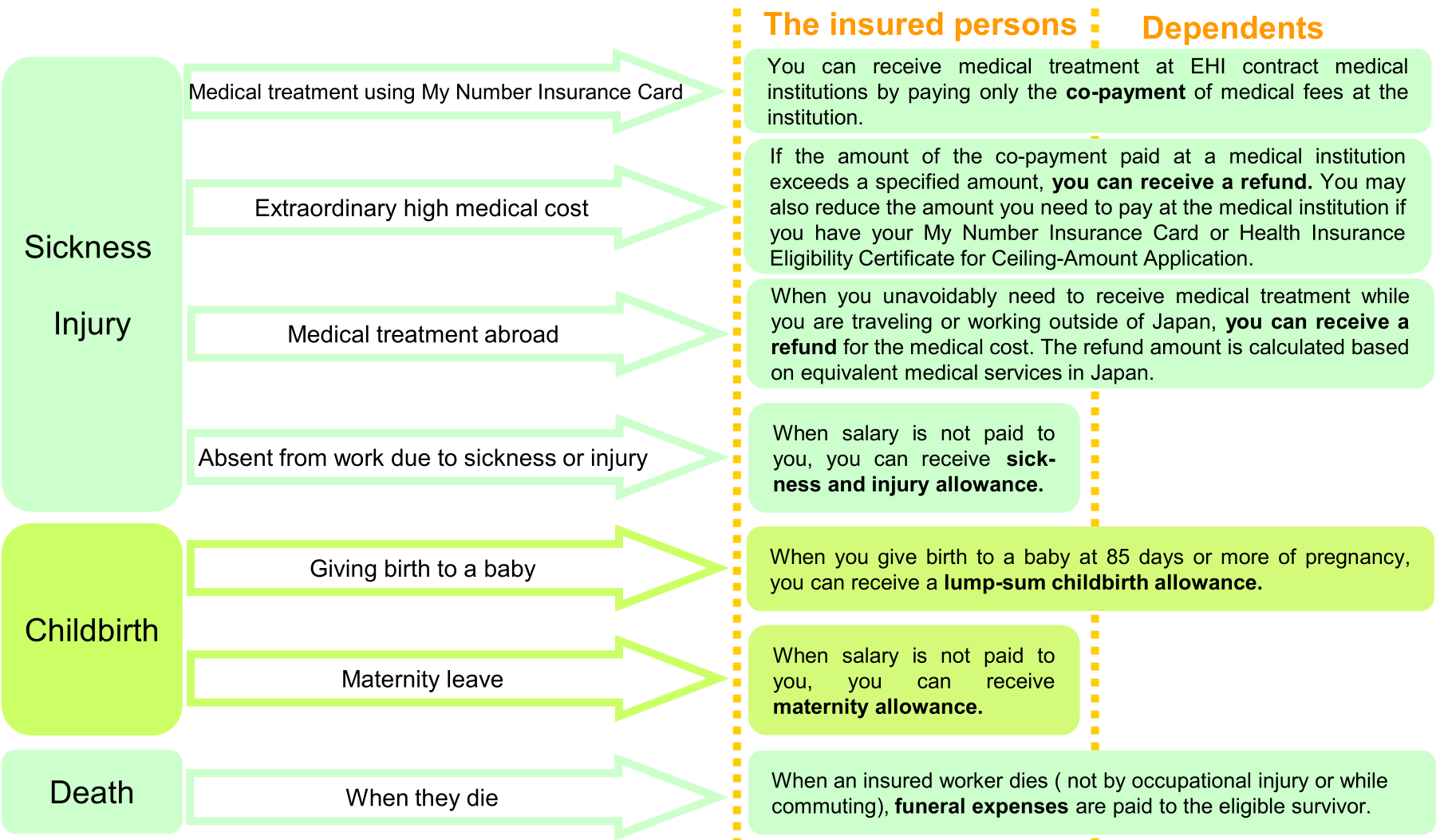
EHI provides medical care benefits and allowances through claim, when the insured persons or their economically-dependent family members become sick or injured (except for employment injury, multiple employment factor injury, and commuting injury.)
Text from this illustration: Employees’ health insurance benefit diagram, source page 4
The insured persons
Dependents
Sickness
Injury
Medical treatment using My Number Insurance Card
You can receive medical treatment at EHI contract medical institutions by paying only the co-payment of medical fees at the institution.
Extraordinary high medical cost
If the amount of the co-payment paid at a medical institution exceeds a specified amount, you can receive a refund. You may also reduce the amount you need to pay at the medical institution if you have your My Number Insurance Card or Health Insurance Eligibility Certificate for Ceiling-Amount Application.
Medical treatment abroad
When you unavoidably need to receive medical treatment while you are traveling or working outside of Japan, you can receive a refund for the medical cost. The refund amount is calculated based on equivalent medical services in Japan.
Absent from work due to sickness or injury
When salary is not paid to you, you can receive sick- ness and injury allowance.
Childbirth
Giving birth to a baby
When you give birth to a baby at 85 days or more of pregnancy, you can receive a lump-sum childbirth allowance.
Maternity leave
When salary is not paid to you, you can receive maternity allowance.
Death
When they die
When an insured worker dies ( not by occupational injury or while commuting), funeral expenses are paid to the eligible survivor.
Note: To receive EHI benefits, you need to satisfy eligibility requirements.
For application for EHI benefits or consultation, contact the prefectural branch office of Japan Health Insurance Association.
For benefits details, application forms and procedures, visit : https://www.kyoukaikenpo.or.jp/
Contribution Amount
Contribution amount of EPI and EHI for an insured person is calculated by multiplying the insurance rates below by the amount of individual insured person’s standard monthly remuneration which is determined by the remuneration the insured person has received.
Contribution amount for bonuses for an insured person is calculated by multiplying the same insurance rates by the insured person’s standard bonus amount.
■ Standard Monthly Remuneration Amount
○For EPI
Level 1 (88,000 yen) to Level 32 (650,000 yen)
○For EHI managed by Japan Health Insurance Association
Level 1 (58,000 yen) to Level 50 (1,390,000 yen)
■ Standard Bonus Amount
The amount of bonus rounded down to the nearest 1,000 yen
■ Insurance Rates (Rates are subject to change.)
○For EPI
183.00/1,000
○For EHI managed by Japan Health Insurance Association
Rates are set by each prefecture. For details, please contact prefectural branch offices of Japan Health Insurance Association.
○Child and childcare contributions
Please refer to “Table of EPI contribution amount” at JPS website. They are set annually.
The contribution amount for each insured person is evenly shared by the employer and the insured person. The employer needs to pay the total amount of contribution.
The employer also needs to pay whole amount of the child and childcare contributions (no share on the insured persons) which partially finances children’s allowance expenditures.
For details, please contact any JPS branch office.