Japan Pension Service · Employer payment guide
Overdue workplace insurance contributions: what happens next
Published by Japan Pension Service. HTML edition by Foreigners in Japan. This is an unofficial reproduction; the original PDF is authoritative.
Original PDF on nenkin.go.jp ↗About this publication: Foreigners in Japan
Missed a workplace insurance payment or received a demand letter? This Japan Pension Service leaflet sets out what follows for employers: reminders, the demand, asset investigation and seizure, payment plans and the penalty.
Who this is for
For employers and payroll staff with unpaid Employees’ Pension Insurance or other workplace contributions. It concerns employer contributions only. Individuals who cannot pay National Pension contributions should see the exemption publications.
What it covers
- Late workplace insurance payments: understand reminders, demand letters and payment guidance.
- Collection of unpaid contributions: read about asset investigations, seizure and the sale of seized assets.
- Penalties and payment support: find the explanations of penalties, payment plans and grace arrangements.
Helpful next steps
- Check grace arrangements for overdue contributions
Read the official grace-arrangement conditions and discuss your situation with the JPS office responsible for your account.
Official publication: original wording
What will follow if you don’t pay insurance contribution by due date
Contribution payments -Due date and payment options-
As an employer of workplace, you are responsible, by law, for paying the insurance contributions for Employees’ Pension Insurance (EPI,) Employees’ Health Insurance (EHI,) Seamen’s Insurance, and Child and Childcare contributions.
Due date for the monthly payment is the end of the following month. When you pay, you can opt for automatic bank account transfer or payment using a contribution invoice.
Encouragement of payment
If you fail to pay the contributions by due date, Japan Pension Service (JPS) branch office encourages you to recover the unpaid amounts soon, by phone call / sending reminder letters / visiting your workplace.
In addition, EPI contribution payment call center may call you on behalf of JPS branch office to prompt your payment.
Demand*1
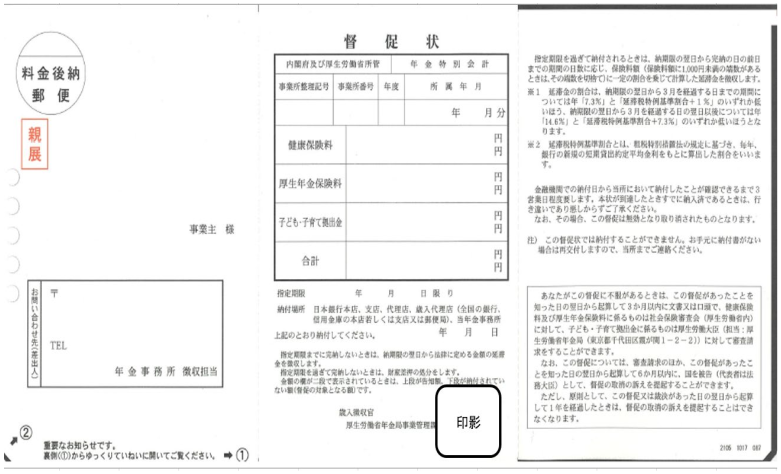
If you do not pay contributions by due date, we send you a demand letter 督促状, while we continuously urge you to pay, by phone and other means.
If you still do not pay by due date specified in the demand letter, we proceed to seize your assets*2 and convert them to monetary values by selling, in order to pay the debt.
Depending on situation of your business, however, we may allow you to pay the contribution in an installment plan / suspend asset seizure even after the due date of the demand letter, ONLY if you complete all payments early (Even so, we shall charge you penalty: See Penalty in the backside.)
*1 Demand is a legitimate operation leading to enforcement such as asset seizure.
*2 Corporation’s assets (or other legal person’s assets) in case for corporation (or other legal person)
Sample of a demand letter as of March 2025 (subject to change in the future)

Enforcement after demand
If you still do not pay the contribution after the due date of the demand letter we will investigate your assets*2, followed by asset seizure and conversion of seized asset for sales.
For some cases, we may entrust the enforcement operation to the National Tax Agency.
(1) Payment guidance
We (JPS branch office) require you to make a payment plan which allows you to pay outstanding amount at the earliest possible time. Considering the situation of your business, we approve the plan including its monthly payment amount.
Please note that, if you meet certain conditions, such that paying the contributions at one time may risk your business continuity, you may apply for grace system, which allows you to pay on the installment plan.
The grace system also includes suspension of seized asset conversion for sales (you need to apply for it within 6 months from the due date of payment.) Please note that this grant entails exemption of part of the penalty on the contribution during the grace period.
(2) Asset investigation
We shall investigate your (corporation’s / other legal person’s) bank deposit, accounts receivable in your business partners (if necessary,) land/buildings and other items.
(3) Asset seizure and conversion for sales
Based on the investigation results, we seize your assets*2. Among the seized assets, bank deposit, account receivable and such are immediately used for the debt payment. If necessary, we sell the seized land/buildings and other items at public sale, to convert them to monetary values.
(4) JPS entrusts its operations to the National Tax Agency
If workplaces, with a large amount of outstanding contributions, intentionally do not follow our payment guidance, we may entrust enforcement operation to National Tax Agency.
Penalty
If you make payment after the due date specified in a demand letter, penalty shall be imposed to your outstanding contributions; its amount is calculated by multiplying the number of days you took to pay the contributions*3, contribution amount (rounded down to the nearest 1,000 yen) and specific rates.
*3 Number of days from the following day of the ORIGINAL due date to the previous day of the date you actually pay.
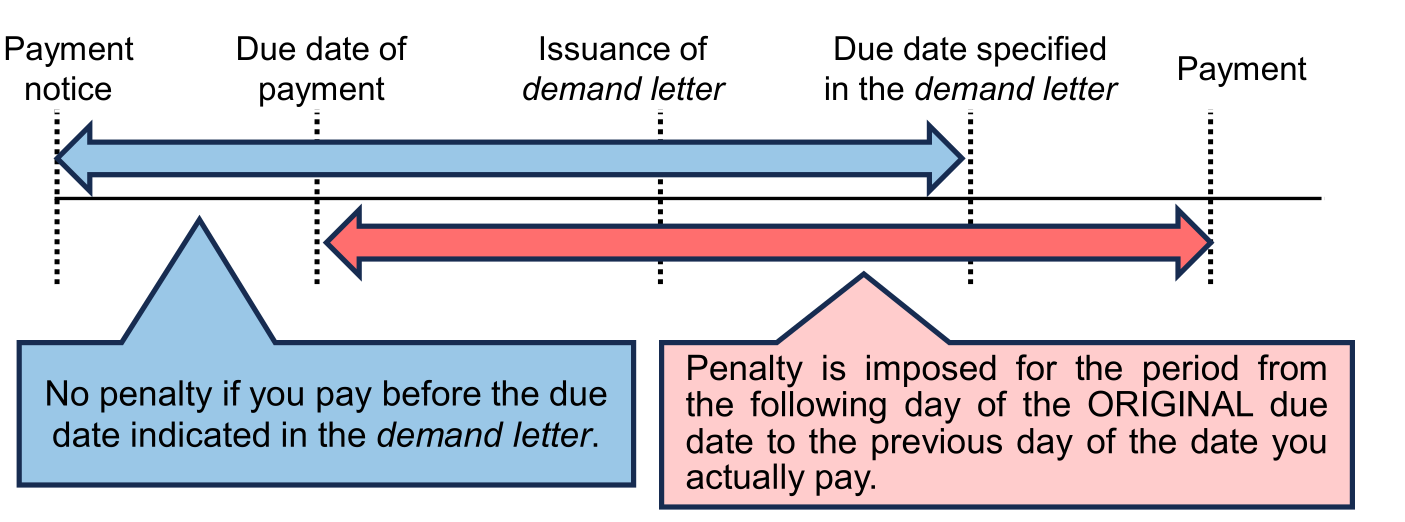
Text from this illustration: Penalty calculation timeline, source page 2
Payment notice
Due date of payment
Issuance of demand letter
Due date specified in the demand letter
Payment
No penalty if you pay before the due date indicated in the demand letter.
Penalty is imposed for the period from the following day of the ORIGINAL due date to the previous day of the date you actually pay.