Government handbook · original text
Entry and residence
7th edition · rules as of October 2024 · the latest in English. A newer 8th edition ↗ exists in Japanese only.
Reproduced from the Immigration Services Agency, Guidebook on Living and Working, 2025 edition, under the Government of Japan Standard Terms of Use; the PDF is the authoritative version: open the PDF ↗
Our guides for the same procedures
The handbook is the official background, as of October 2024. These guides turn it into current steps, checked against today’s official pages.
- Your first 14 days in Japan: registration and essentialsYour first two weeks as a new resident: register your address within 14 days, join health insurance and pension unless covered at work, then phone and bank.
- Japan residence statuses: work, study and family routesHow Japan's statuses of residence are grouped, what each lets you do, and where to find the official ISA page for the status that fits your plans.
- Certificate of Eligibility (COE): how to applyApply for a Certificate of Eligibility at an immigration bureau in Japan before you travel. No fee, 1 to 3 months to process, valid 3 months.
- Applying for a Japan visa after your COE: next stepsApply for your visa at the Japanese embassy or consulate once you have a COE. The fee is about 15,000 yen and you must arrive within 3 months.
- Arriving in Japan: immigration, customs and residence cardsWhat happens at immigration, customs and quarantine when you arrive to live in Japan. Then register your address within 14 days of settling.
- Residence cards in Japan: updates, renewal and replacementCarry your residence card, report changes to immigration within 14 days, and renew, replace or return the card. Most procedures are free.
- Renewing or changing residence status in Japan: how to applyExtend your period of stay or change your status at the regional immigration office or online, on or before the last day of your current period of stay.
- Permanent residence in Japan: eligibility and applicationApply at your regional immigration office to change your status to Permanent Resident. The fee is 200,000 yen if approved, and processing takes 4 to 6 months.
- Japanese citizenship by naturalization: eligibility and stepsApply in person at the Legal Affairs Bureau to become a Japanese national. You need 5 years' continuous address in Japan, and there is no fee.
- Help for foreign residents in Japan: find who to contactFind a free or official helpline in your own language, sorted by problem: residence, legal, work, consumer, violence, tax and more.
- Leaving Japan permanently: tax, accounts and documentsA checklist, in order, for ending your residence in Japan. File the moving-out notification before you leave and hand in your residence card at departure.
- Japan re-entry permits: travel abroad and returnLeave on the Special Re-entry Permit for trips of 1 year or less. For longer trips, get a re-entry permit first: 4,000 yen single, 7,000 yen multiple.
- Japan working holiday visa: eligibility, work and taxWho can come to Japan on a working holiday from the 33 partner countries and regions, aged 18 to 30, where to apply and how your wages are taxed.
- Japan Engineer/Humanities visa: jobs and eligibilityCheck if your job fits the Engineer/Humanities status, meet the education and pay conditions, and submit the documents for your employer's category.
- Japan spouse visa: application, renewal and work rightsApply for a spouse status at the regional immigration office or online. Know the documents, the fees and the 14-day notice if the marriage ends.
- Japan Highly Skilled Professional visa: points and routesHow the Highly Skilled Professional status works: the 70-point test, its benefits and conditions, and the shorter route to permanent residence.
- Japan Dependent visa: bringing your spouse or childrenBring your spouse and children to Japan on Dependent status, prove you can support them, and report divorce or death within 14 days.
- Japan Specified Skilled Worker (SSW) visa: tests and eligibilityLearn what Specified Skilled Worker (i) and (ii) let you do, the fields and tests, whether your family can come, and how to change employer.
- Japan Business Manager visa: eligibility and applicationThe Business Manager status since October 16, 2025: an office, full-time staff, 30 million yen or more, Japanese at B2 level and an expert-evaluated plan.
- Japan digital nomad visa: eligibility and how to applyStay up to 6 months on the digital nomad status to work remotely for clients abroad. You need 10 million yen or more a year and private insurance.
- Protection in Japan: refugee and complementary statusApply at your regional immigration office for refugee or complementary protection recognition. No fee and no time limit. Standard processing is 6 months.
- Overstaying in Japan: procedures and options for adviceWhat happens when your period of stay has run out, how the departure order and deportation work, and how long you may be unable to return.
- Employment for Skill Development: Japan's 2027 systemEmployment for Skill Development replaces Technical Intern Training on April 1, 2027. Learn the period, fields, Japanese tests and rules on changing employer.
- Domestic violence in Japan: your spouse residence statusIf you are in danger, call 110. Needing refuge from a spouse's violence may count as a justifiable reason that protects your status of residence.
Ask about entry and residence
Answers from this chapter’s guides and its sources onlyOriginal text, page by page
This is an unofficial HTML reproduction of the official PDF, made by Foreigners in Japan. The PDF is the source: if a table, list or picture looks wrong here, or you need the exact layout, open the original page.
Printed page 1
PDF page 16 ↗Chapter 1 Procedures for Entry/Residence

1 Residence Card
A residence card is an ID for foreign residents in Japan. It shows your identification information, the period you can stay in Japan (period of stay) and the activities that you can conduct in Japan (your status of residence), and so on.
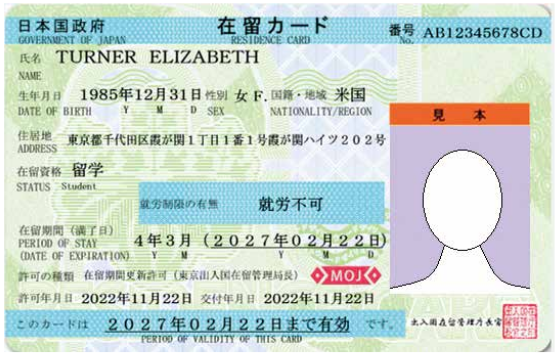
• A person who is 16 years and over needs to carry his / her residence card at all times.
• It can also be used as an ID card for municipal procedures, contracts, etc.
Persons to Whom a Residence Card Is Issued
A residence card is issued to a person who stays in Japan over three months. (Such person is called “mid-to-long-term resident”.)
Six cases where a residence card is not issued
i. A person granted permission to stay for three months or less
ii. A person granted “Temporary Visitor” status of residence
iii. A person granted “Diplomat” or “Official” status of residence
iv. A person who has one of the following “Designated Activities” statuses of residence
• Staff members and his/her families of the Japanese office of the Taiwan-Japan Relations Association (Taipei Economic and Cultural Representative Office in Japan, etc.).
• Staff members and his/her families of the Permanent General Mission of Palestine in Japan who have “Designated Activities” status of residence
• Digital Nomad (a person who stays in Japan for the purpose of international remote work, etc.) and his/her spouse/children
v. A special permanent resident
vi. A person with no status of residence
Printed page 2
PDF page 17 ↗1-1 Issuance of Residence Card
A residence card is mainly issued at the following time
i When a new landing permit is given at Narita Airport, Haneda Airport, Chubu Airport, Kansai Airport, New Chitose Airport, Hiroshima Airport, and Fukuoka Airport
➡ A residence card is issued at the airport.
ii When a new landing permit is given at an airport or a port not mentioned above
➡ After entering Japan, submit a “Notification of Place of Residence (Moving In Notification)” to the municipality in which you live. After that your Residence Card will be delivered to your house by mail.
iii When you receive permission for extension of the period of stay.
➡ Please apply for extension of period of stay (cf. 2-1) at the Regional Immigration Services Office before your period of stay expires. A new residence card will be issued if your application is permitted.
iv When you receive permission for change of the status of residence
➡ If you need to change your status of residence, please apply for change of status of residence at the Regional Immigration Services Office (cf. 2-2). A new residence card will be issued if your application is permitted.
v When you receive permission for acquisition of status of residence
➡ If a child is born in Japan without Japanese nationality and wishes to continue his/her stay in Japan beyond 60 days after he or she is born, it is necessary to apply for acquisition of his/her status of residence at the Regional Immigration Services Office within 30 days from the date of birth (cf. 2-4). A new residence card will be issued if his/her application is permitted.
1-2 Moving in Notification
A person who has had been issued his/her Residence Card need to register his/her address / place of residence (file moving-in notification) within 14 days after his/her residence has been determined.
As his/her Residence Card (in the case of 1-1 i) or passport (in the case of 1-1 ii) is required to file the said notification, please make sure to bring either of them.
See: Chapter 2-1, 1-1 Notification of Address
1-3 Loss of Residence Card
You need to apply for reissuance of your residence card at the Regional Immigration Services Office within 14 days of the day when the loss is found.
Necessary Documents
• Passport
• A photograph (4 cm long × 3 cm wide, taken within six months, not required for persons under the age of 16)
Printed page 3
PDF page 18 ↗• Documentation that proves reasons for loss of the Residence Card (Certificate of Lost Property Report, Report of Theft, Disaster Victim Notification, etc.)
• An application for reissuance of a Residence Card
See the following URL for details:
https://www.moj.go.jp/isa/applications/procedures/nyuukokukanri10_00010.html

1-4 Return of Residence Card
You need to return your residence card to the Regional Immigration Services Office in the following circumstances:
Leaving Japan Re-entry Nonreserving
(leaving Japan after finishing your activities)
• Please return your residence card to an Immigration officer at an airport or seaport when you leave Japan.
• When a family member or someone you live with died
• If you left Japan with re-entry permission and special re-entry permission but did not return to Japan within the validity period of the re-entry permission and special re-entry permission
• When you were naturalized as a Japanese citizen
In the cases above, please return your residence card within 14 days by either of the following methods.

• Bring the residence card to the nearest Regional Immigration Services Office.
• Send the residence card by mail
To: Online Inspection Department Odaiba Branch Office, Tokyo Regional Immigration Services Office Tokyo Port Joint Government Building 9F, 2-7-11 Aomi, Koto-ku, Tokyo 135-0064 (Please write “Return of the Residence Card” on the front of the envelope)
See the following URL for details:
https://www.moj.go.jp/isa/applications/procedures/nyuukokukanri10_00020.html

Printed page 4
PDF page 19 ↗2 Procedures relating to status of residence
2-1 Extension of period of stay (renewal of period of stay)
If you wish to continue your stay in Japan beyond your currently authorized period of stay, you need to apply for an extension of period of stay at a Regional Immigration Services Office.
Necessary Documents
• Passport
• Residence Card (if you have already been issued one)
• A photograph (4 cm long × 3 cm wide, taken within six months, not required for persons under the age of 16)
• An application form for extension of period of stay and documentation that specifies your planned activities, etc.
https://www.moj.go.jp/isa/applications/procedures/16-3.html

2-2 Change of status of residence (Change of purpose of residence)
If you wish to stay in Japan and change your present purpose of residence, you need to apply for change of status of residence at a Regional Immigration Services Office.
Necessary Documents
• Passport
• Residence Card (If you have already been issued one)
• A photograph (4 cm long × 3 cm wide, taken within six months, not required for persons under the age of 16)
• An application form for change of status of residence and documentation that specifies your planned activities in Japan etc.
https://www.moj.go.jp/isa/applications/procedures/16-2.html

○Search by status of residence○
https://www.moj.go.jp/isa/applications/status/index.html

Printed page 5
PDF page 20 ↗2-3 Permission for permanent residence
Those who wish to reside permanently in Japan need to apply for permanent residence. If permanent residence is granted, you can engage in any activity in Japan and stay in Japan as long as you like. Furthermore, you do not have to carry out procedures to extend your period of stay or change your status of residence.
Necessary Documents
• Passport
• Residence Card
• A photograph (4 cm long × 3 cm wide, taken within six months, not required for persons under the age of 16)
• An application form for Permanent Residence
• Other necessary documents
See the following URL for details:
https://www.moj.go.jp/isa/applications/procedures/16-4.html

2-4 Permission to acquire status of residence (If you gave birth to a child in Japan)
If a child is born in Japan without Japanese nationality and wishes to continue his/her stay in Japan beyond 60 days from his/her birth, it is necessary to apply for acquisition of his/her status of residence at a Regional Immigration Services Office within 30 days from the date of birth.
* As a birth certificate (Shussei todoke kisai jikou shoumeisho, or “Certificate of Entry items in Birth Notification”) and other documents (see the following for details) are required, please register a birth at an office of municipality before applying for acquisition of a status of residence at a Regional Immigration Services Office.
See: Chapter 4 2-1 Notification of a birth.
Necessary Documents
• Passport (if one has already been issued)
• An application form for permission to acquire status of residence
• Certificate of entry items in birth notification (It is available at office of municipality) or other documents that proof birth
• Documentation that specifies the child’s planned activity in Japan https://www.moj.go.jp/isa/applications/procedures/16-10.html

• A copy of your Certificate of Residence or Certificate of entry items in Resident Register (You can get it at office of municipality)
Printed page 6
PDF page 21 ↗2-5 Permission to engage in activities other than those permitted under the status of residence previously granted
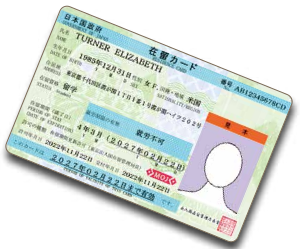
If you wish to work with a status of residence that does not permit you to work (status of residence of “Student”, “Dependent” and so on), or to engage in activities other than those permitted under the status of residence previously granted, you need to apply for permission to engage in activities other than those permitted under the status of residence previously granted at a Regional Immigration Services Office. (See Chapter 3-1 1-1 to confirm which activities are permitted under your status of residence.)

Necessary Documents
• Passport
• Residence Card
• An application form for permission to engage in activities other than those permitted under the status of residence previously granted
• Documents to certify the activity by which you intend to earn income or receive remuneration
See the following URL for details:
https://www.moj.go.jp/isa/applications/procedures/16-8.html

2-6 Notification to Regional Immigration Services Office
If you have one of the statuses of residence below, and if something changes regarding the organization you are affiliated with, you need to notify the Regional Immigration Services Office of that change.
(1) Notification of the accepting organization
| Status of Residence requiring notifications | Professor, Highly Skilled Professional (i)(c), Highly Skilled Professional(ii) (limited to cases of engaging in the activities listed in (ii) (c)), Business Manager, Legal/ Accounting Services, Medical Services, Instructor, Intra-company Transferee, Technical Intern Training, Student or Trainee |
|---|---|
| Matters to be notified | • Change of the name of the accepting organization • Change of the location of the accepting organization • Extinguishment of the accepting organization • Left from the accepting organization • Transfer from the accepting organization |
| Notification period | You are required to notify within 14 days. |
See the following URL for details:
https://www.moj.go.jp/isa/applications/procedures/nyuukokukanri10_00014.html

Printed page 7
PDF page 22 ↗(2) Notification of the organization of affiliation
| Status of residence requiring notifications | Highly Skilled Professional (i)(a), Highly Skilled Professional (i)(b), Highly Skilled Professional (ii) (limited to cases of engaging in the activities listed in (ii)(a) or (b)), Researcher, Engineer/Specialist in Humanities/International Services, Nursing Care, Entertainer (limited to cases of engaging in activities based on a contract with a public or private organization in Japan), Skilled Labor, Specified Skilled Worker |
|---|---|
| Matters to be notified | • Change of the name of the organization of affiliation • Change of the location of the organization of affiliation • Extinguishment of the organization of affiliation • Termination of the contract with the organization of affiliation • Conclusion of a contract with a new organization of affiliation |
| Notification Period | You are required to notify within 14 days. |
See the following URL for details:
https://www.moj.go.jp/isa/applications/procedures/nyuukokukanri10_00015.html

(3) Notification of relationship with spouse
| Status of residence requiring notifications | Dependent, Spouse of Japanese National or Spouse of Permanent Resident who has a status of a spouse |
|---|---|
| Matters to be notified | • Divorce your spouse • Bereavement of your spouse |
| Notification Period | You are required to notify within 14 days. |
See the following URL for details:
https://www.moj.go.jp/isa/applications/procedures/nyuukokukanri10_00016.html

Electronic notification by internet is possible for these notifications, other than bringing to the service counter and mailing.
See the following URL for details of electronic notification:
https://www.moj.go.jp/isa/publications/materials/i-ens_index.html

Printed page 8
PDF page 23 ↗Key Point: Preferential treatment for highly-skilled foreign professionals
Foreign nationals who are expected to contribute to the economic growth of Japan with their advanced capabilities and qualities are preferentially treated with regard to their activities and period of stay.
This is a points-based system where points for foreign nationals are calculated based on their “academic background,” “professional career,” “annual income,” etc.. When foreign nationals apply for a status of residence in this system at Regional Immigration Services Offices and get 70 points or more in total, they are admitted as “Highly- Skilled Foreign Professionals” and are given the following preferential treatment.
• Permission to engage in activities covering multiple statuses of residence
• 5 years stay
• Relaxation of requirements for permanent residence concerning the period of stay in Japan and so on
See the following URL for details:
https://www.moj.go.jp/isa/publications/materials/newimmiact_3_index.html

A new system called "the Japan System for Special Highly-Skilled Professionals" (J-Skip) was introduced in April, 2023. It applicants meet specific academic background requirement, professional career requirement, and exceed specific annual income, they are regarded as "Special Highly-Skilled Professional" and are eligible for additional preferential treatment. This is a separated system from the point-based highly-skilled foreign professional system above.
See the following URL for details:
https://www.moj.go.jp/isa/publications/materials/nyuukokukanri01_00009.html

3 Re-entry Permission (re-enter Japan with currently admitted status of residence)
If a foreign national in Japan wishes to temporarily leave and return to Japan within authorized period, he/she can re-enter Japan with his/her currently authorized status of residence and period of stay unchanged by using a re-entry permit.
(1) Special re-entry permission (returning to Japan within 1 year)
If the foreign nationals return to Japan within 1 year (or until the date of expiration of period of stay when the date of expiration comes earlier than 1 year from the date of departure), re-entry permission procedure at Regional Immigration Services Office will be exempted as long as they have Residence Card and valid Passport. When leaving Japan, please fill out the ED card for re-entry and present it to the immigration inspector together with your passport (and residence card).
Printed page 9
PDF page 24 ↗(2) Re-entry permission (returning to Japan after more than 1 year)
If foreign nationals apply for a re-entry permit at a Regional Immigration Services Office nearby, they can re-enter into Japan with their currently admitted status of residence and period of stay (up to 5 years at the maximum. Or up to the date of expiration when the date of expiration of the period of stay comes earlier than 5 years). When leaving Japan, please fill out the ED card for re-entry and present it to the immigration inspector together with your passport (and residence card).
See the following URL for details:
https://www.moj.go.jp/isa/applications/procedures/16-5.html

4 Refugee and Other Recognition Procedures
Japan is a member of the Convention relating to the Status of Refugees and Protocol relating to the Status of Refugees and recognizes refugees as defined in the Convention, as well as persons under complementary protection as defined in the Immigration Control Act. We are committed to providing prompt and secure protection to refugees or persons under complementary protection.
4-1 Definition of Refugees
The term “Refugee” is those to whom Article 1 of the Convention relating to the Status of Refugees and the Protocol relating to the Status of Refugees applies and defined as follows:
• A person who, owing to well-founded fear of being persecuted for reasons of race, religion, nationality, membership of a particular social group or political opinion, is outside the country of his nationality and is unable or, owing to such fear, is unwilling to avail himself of the protection of that country etc.
4-2 Definition of Persons under Complementary Protection
Persons under complementary protection are defined as follows.
• A person who is not a refugee under the Refugee Convention (see 4-1) but meets all requirements other than being at risk of "persecution for reasons of race, religion, nationality, membership of a particular social group, or political opinion."
Printed page 10
PDF page 25 ↗4-3 Application for Recognition of Refugee Status or Eligibility for Complementary Protection
• Application for recognition of refugee status or eligibility for complementary protection is a system for those who have fled their home countries (See: 4-1) and seek protection from Japan. A foreign national residing in Japan can apply for this status. Foreigners who are recognized as refugees are issued with a Certificate of Recognition of Refugee Status, and those who are recognized as persons under complementary protection are issued with a Certificate of Recognition of eligibility for complementary protection. In either case, as a general rule, the status of residence of “Long-Term Resident” will be granted.
• A foreign national who has been recognized as a refugee, based on his/her application, will receive a refugee travel document in place of a passport.
• A foreign national and his/ her family recognized as a refugee or a person under complementary protection can benefit from the Settlement Support Program, which includes Japanese language education, guidance for living in Japan and job placement.
See the following URL for details:
https://www.moj.go.jp/isa/applications/procedures/16-6.html

4-4 Request for Administrative Review
A foreign national who has an objection to a disposition denying recognition as a refugee or a person under complementary protection may submit a request to the Minister of Justice for an administrative review.
When the Minister of Justice makes a determination on the request, the Minister must hear the opinions of the refugee examination counselors who have an academic background in law or international affairs.
See the following URL for details:
About Request for Administrative Review
https://www.moj.go.jp/isa/refugee/procedures/nanmin_00001.html#midashi04
5 Deportation Order etc.
5-1 Major Grounds for Deportation
• Remaining in Japan after the period of stay (Please note that even a stay for just one day beyond your authorized period will constitute overstaying and subject you to deportation.)
• Engaging in an activity that is not permitted under your status of residence, and receiving remuneration without permission to engage in an activity other than those permitted under the status of residence previously granted
• Receiving a certain criminal punishment
Printed page 11
PDF page 26 ↗5-2 If You Are Deported
If you are deported, in principle, you will not be allowed to enter Japan for 5 or 10 years. If you are deported due to receiving a certain criminal punishment or some other particular grounds, you will not be allowed to enter Japan anymore.
Even in cases where deportation has been finalized, the period of denial of landing may be shortened to one year upon application if the applicant is permitted to leave the country at his/ her own expense.
5-3 Departure Order System
If all of the following requirements are met, an overstayer will be allowed to leave Japan through simple procedures without being detained.
When you leave Japan by the departure order system, in principle, you will not be allowed to enter Japan for one year.
Requirements for the Departure Order System
Those subject to the departure order system need to fulfill the following requirements.
(1) Either (a) or (b) must be satisfied.
(a) Before the investigation of the violation began, the foreign national voluntarily presented himself/herself at a Regional Immigration Services Office with the intention of departing Japan.
(b) After the investigation of the violation has started, the foreign national has expressed his/ her intention to leave Japan promptly to the immigration inspector or immigration control officer before receiving the notification of recognition by the immigration inspector.
(2) There is no reason for deportation other than illegal overstay.
(3) The foreign national has not been sentenced to imprisonment or imprisonment without work in Japan for certain crimes such as theft.
(4) The foreign national has never been deported or has never left Japan under a departure order
(5) The foreign national is expected to leave Japan promptly.
5-4 Special Permission to Stay in Japan
Even if subject to deportation procedures, special permission to stay in Japan may be granted by the Minister of Justice in consideration of the situation for which the foreign national has settled down in Japan, his/her family situation, etc.
Printed page 12
PDF page 27 ↗6 Contact for information about Procedures for Immigration and Residence
Regional offices of Immigration and Residence Control
| Sapporo Regional Immigration Services Bureau | Sapporo 3rd Joint Government Building 12-chome Odori-nishi Chuo-ku, Sapporo-shi Hokkaido 060-0042 | 0570-003259 (IP/ from overseas: 011-211-5701) | |
|---|---|---|---|
| Sendai Regional Immigration Services Bureau | Sendai Second Legal Affairs Joint Government Building 1-3-20, Gorin Miyagino-ku, Sendai-shi, Miyagi 983-0842 | TEL 0570-022259 (IP/ from overseas: 022-256-7025) | |
| Tokyo Regional Immigration Services Bureau | 5-5-30, Konan Minato-ku, Tokyo 108-8255 | TEL 0570-034259 (IP/from overseas: 03-5796-7234) | |
| Tokyo Regional Immigration Services Bureau Yotsuya Branch Office | Yotsuya Tower 13F, 14F, 1-6-1, Yotsuya, Shinjuku-ku, Tokyo 160-0004 | TEL 0570-011000 | |
| Status of Residence Registration Office | Notices related to overseeing agency,notices by the overseeing agency | TEL 03-5363-3032 (main number) | |
| Online Inspection Department | Status of Residence Online Application Procedures | TEL 03-5363-3030 | |
| Information Processing Department | Examination Record Management | TEL 03-5363-3039 | |
| Narita Airport Branch | Second Terminal Building 6th floor 1-1 Aza-Furugome, Furugome Narita-shi Chiba 282-0004 | TEL 0476-34-2222 (main number) TEL 0476-34-2211 | |
| Haneda Airport Branch | 2-6-4 CIQ Building Haneda Airport Ota-ku Tokyo 144-0041 | TEL 03-5708-3202 | |
| Yokohama Branch | 10-7 Torihama-cho, Kanazawa-ku, Yokohama-shi Kanagawa 236-0002 | TEL0570-045259 (IP/from overseas: 045-769-1729) | |
| Nagoya Regional Immigration Services Bureau | 5-18 Shoho-cho, Minato-ku, Nagoya-shi, Aichi 455-8601 | TEL 0570-052259 (IP/ from overseas: 052-217-8944) | |
| Chubu Airport Branch | 1-1 CIQ Building 3rd floor CENTRAIR Tokoname-shi, Aichi 479 - 0881 | TEL 0569-38-7410 (main number) | |
| Osaka Regional Immigration Services Bureau | 1-29-53 Minami-kohoku, Suminoe-ku, Osaka-shi, Osaka 559-0034 | TEL 0570-064259 (IP/ from overseas: 06-4703-2050) | |
| Kansai Airport Branch | Senshukukonaka 1, Tajiri-cho, Sennan-gun, Osaka 549-0011 | TEL 072-455-1453 (main number) | |
| Kobe Branch | Kobe Regional Joint Government Building 29 Kaigan-dori, Chuo-ku, Kobe-shi, Hyogo 650-0024 | TEL 078-391-6377 (main number) | |
| Hiroshima Regional Immigration Services Bureau | Hiroshima Legal Affairs General Office Building 2-31 Kamihatchobori, Naka-ku, Hiroshima-shi, Hiroshima 730- 0012 | TEL 082-221-4411 (main number) | |
| Takamatsu Regional Immigration Services Bureau | Takamatsu Legal Affairs Joint Government Building (General Affairs Division, Enforcement Department) 1-1 Marunouchi, Takamatsu-shi, Kagawa 760-0033 | TEL 087-822-5852 (main number) | |
| Takamatsu Regional Immigration Services Bureau Hamanocho Branch Office | Hamanomachi Branch Office (Judging Section) 72-9 Hamanocho, Takamatsu-shi, Kagawa 760-0011 | TEL 087-822-5851 (main number) | |
| Fukuoka Regional Immigration Services Bureau | Fukuoka First Legal Affairs General Office Building 3-5-25 Maizuru, Chuo-ku, Fukuoka-shi, Fukuoka 810-0073 | TEL 092-717-5420 (main number) | |
| Naha Branch | Naha First Regional Joint Government Building 1-15-15 Higawa, Naha-shi, Okinawa 900-0022 | TEL 098-832-4185 (main number) | |
| Higashi-Nihon Immigration Center | 1766-1 Kuno-cho, Ushiku-shi, Ibaraki 300-1288 | TEL 029-875-1291 (main number) | |
| Omura Immigration Center | 644-3 Kogashima-machi, Omura-shi, Nagasaki 856-0817 | TEL 0957-52-2121 (main number) | |
Printed page 13
PDF page 28 ↗Foreign Residents Support Center (FRESC)
| Foreign Residents Support Center | Yotsuya Tower 13F, 1-6-1, Yotsuya, Shinjuku-ku, Tokyo 160- 0004 | TEL 0570-011000 (IP/from overseas: 03-5363-3013) |
|---|
Foreign Resident General Information Center, etc (for foreign residents consultation)
| Visit consultation | The immigration control offices in the various regions mentioned above. (Except for Tokyo Regional Immigration Services Office Yotsuya Branch Office, each Airport Branch Office and each Immigration Control Center) |
|---|---|
| Telephone consultation | TEL 0570-013904 (IP/PHS/from overseas: 03-5796-7112) |
7 Information Transmission from Immigration Services Agency
7-1 Immigration Services Agency’s Official Website
The Immigration Services Agency’s Official website provides guidance on the procedures for immigration and residence, etc. In addition to Japanese, we provide machine translated information in over 100 languages.
Immigration Services Agency’s Official website:
https://www.moj.go.jp/isa/index.html

*Fees for immigration procedures will be revised on April 1, 2025.
https://www.moj.go.jp/isa/01_00518.html

7-2 Immigration Services Agency’s Official Social Media, etc.
The Immigration Services Agency opened various types of social media, etc. to provide guidance on new systems and transmit information that would be useful for daily life of foreign residents.
Immigration Services Agency’s X (formerly Twitter) account:

Immigration Services Agency’s Facebook account:
https://www.facebook.com/ImmigrationServicesAgency.MOJ/
Printed page 14
PDF page 29 ↗Immigration Services Agency’s Instagram account:
https://www.instagram.com/isa__Japan/

Email distribution service:
https://www.moj.go.jp/isa/publications/publications/mail-service.html

Regional Immigration Services Bureaus’ X (formerly Twitter) accounts provide information on how busy their service counters are.
Regional Immigration Services Bureaus’ accounts:
https://www.moj.go.jp/isa/publications/publications/nyuukokukanri01_00184.html

7-3 Portal site to support foreign residents living in Japan
This is a website that informs foreigners of what is necessary and important to live in Japan safely and comfortably.
Information from the government, written in various languages, can be found on the site.
Portal site to support foreign residents living in Japan:
https://www.moj.go.jp/isa/support/portal/index.html

7-4 Videos for the Daily Life Orientation
We have created videos for the Daily Life Orientation that introduce Japanese lifestyle rules and other information to help foreign nationals who are considering living in Japan or who already live in Japan to join Japanese society smoothly.
These videos introduce basic information and rules necessary for living in Japan, such as lifestyle rules, work, and taxes, in multiple languages.
Videos for the Daily Life Orientation:
https://www.moj.go.jp/isa/support/coexistence/04_00078.html