Government handbook · original text
Education and Japanese learning
7th edition · rules as of October 2024 · the latest in English. A newer 8th edition ↗ exists in Japanese only.
Reproduced from the Immigration Services Agency, Guidebook on Living and Working, 2025 edition, under the Government of Japan Standard Terms of Use; the PDF is the authoritative version: open the PDF ↗
Our guides for the same procedures
The handbook is the official background, as of October 2024. These guides turn it into current steps, checked against today’s official pages.
- Learning Japanese in Japan: classes, levels and testsFind free and low-cost ways to learn Japanese for daily life, work out your level, and choose a test if you need one.
- Choosing a school in Japan: public, private and other routesCompare public, private, international, evening junior high and special needs schools in Japan, and decide which route to look into.
- Public school enrollment in Japan: documents and placementAsk your municipal office and board of education to place your child aged 6 to 15 in a public school. Tuition and textbooks are free.
- Private schools in Japan: applications, entrance exams and feesApply directly to each private school in Japan. Each school sets its own exams, application period and fees.
- International schools in Japan: status and study pathwaysCheck what kind of school an international school is in Japan, and what its legal status means for your child's route into Japanese schools and universities.
- Japanese-language support at school in JapanAsk your child's school or municipal board of education for Japanese-language instruction when you enroll. What help exists depends on your local board.
- School costs in Japan: expenses and financial supportPublic school tuition and textbooks are free, but you pay for lunches, trips and more. Apply to your board of education, school or prefecture for help.
- Get into a Japanese high school as a foreign studentApply to a Japanese high school through your board of education or a private school. Tuition support covers up to 118,800 yen a year at a public school.
- Studying in Japan: university, college and residence stepsChoose a school in Japan, meet its entry and language requirements, take the EJU if needed, and get Student status through a Certificate of Eligibility.
- Getting married in Japan: documents and registrationRegister a marriage at a Japanese municipal office when one or both of you are foreign nationals. The filing day is the legal date of marriage.
- Death of a family member in Japan: paperwork and supportAfter a death in Japan, submit the death notification within 7 days, get the cremation permit, return the residence card and claim payments.
- Divorce in Japan: procedures, children and notificationsDivorce in Japan by agreement at a municipal office or by family court mediation, decide parental authority, and file the paperwork that follows.
- University funding in Japan: JASSO eligibility and supportApply for the JASSO grant, tuition cut and loans for university if you hold an eligible status of residence. Apply through your high school or university.
- Your child’s nationality in Japan: birth and notificationsCheck whether your child is Japanese by birth, and file the birth notification or reservation of nationality by the deadline.
- Hague Convention in Japan: cross-border child casesHow the Hague Convention works when a child under 16 is taken or kept across a border to or from Japan. Apply to the foreign ministry or a family court.
- Domestic violence in Japan: immediate safety and supportIf you are in danger, call 110. Then contact a support center about shelter, protection orders, your address record and your status.Urgent
- Dual nationality and Japan: choosing and filing noticesIf you are a Japanese national with another nationality, choose one. Dual on or before 18: by 20. Dual after 18: within 2 years.
- International schools near Tokyo and Yokohama: contactsContacts for international schools in Tokyo, Yokohama and beyond, plus what to ask about legal status, accreditation and university routes.
Ask about education and japanese learning
Answers from this chapter’s guides and its sources onlyOriginal text, page by page
This is an unofficial HTML reproduction of the official PDF, made by Foreigners in Japan. The PDF is the source: if a table, list or picture looks wrong here, or you need the exact layout, open the original page.
Printed page 54
PDF page 69 ↗Chapter 5 Education

1 Education system in Japan
The Japanese education system is generally called the “6-3-3-4-year system” and consists of six years of elementary education, three years of junior high education, three years of high school education and four years of college education. Education is compulsory in elementary schools and junior high schools. Preprimary education is given at kindergartens etc.
Diagram of the school system in Japan
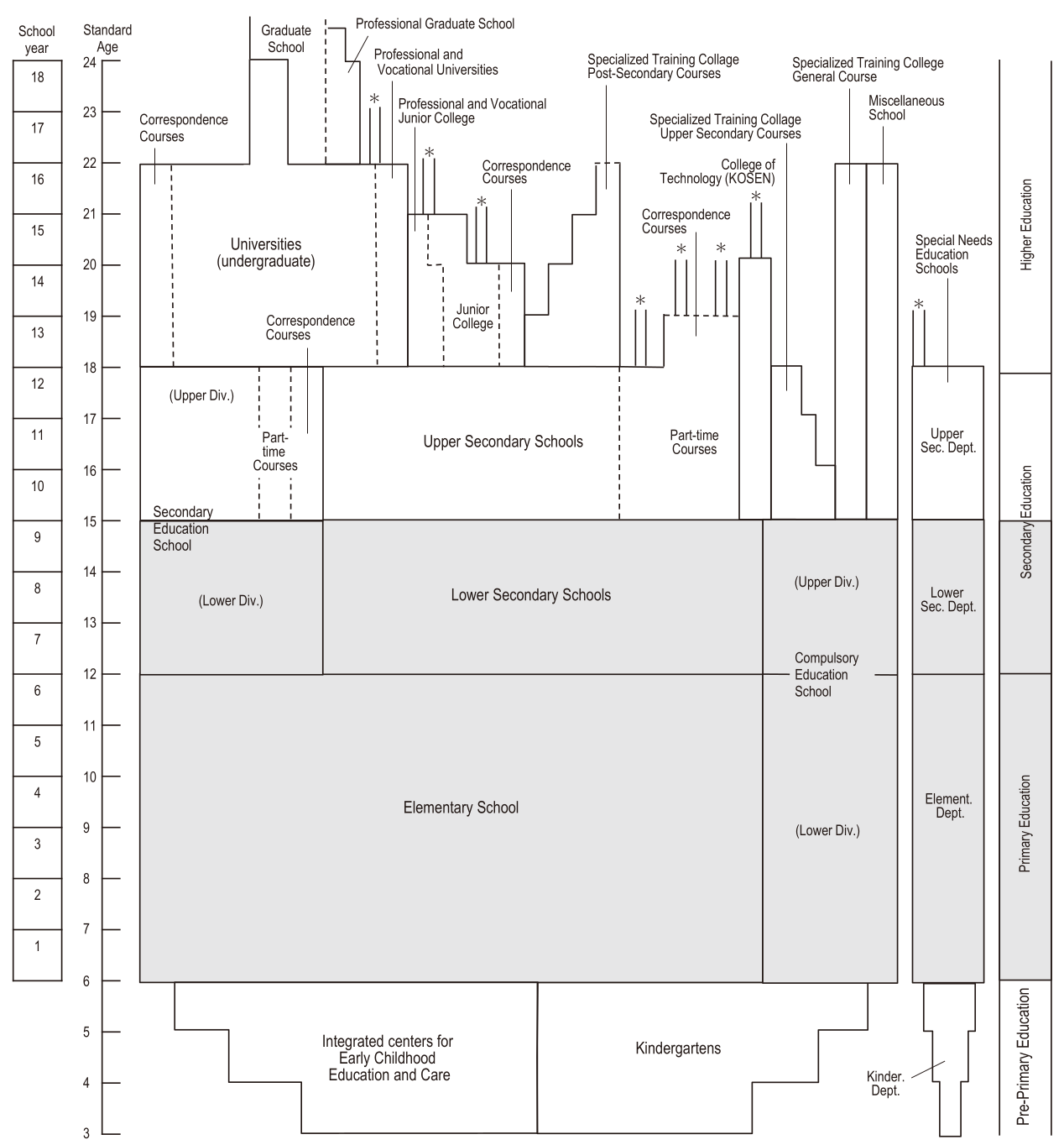
Text from this illustration: Diagram of the school system in Japan, source page 69
School year
School year
18
17
16
15
14
13
12
11
10
9
8
7
6
5
4
3
2
1
Standard Age
Standard Age
24
23
22
21
20
19
18
17
16
15
14
13
12
11
10
9
8
7
6
5
4
3
Higher Education
Graduate School
Correspondence Courses
Universities (undergraduate)
Professional Graduate School
Professional and
Vocational Universities
* Professional and Vocational Junior College
*
Correspondence Courses
*
Specialized Training Collage Post-Secondary Courses
Specialized Training College General Course
Miscellaneous School
Specialized Training Collage Upper Secondary Courses
College of
Technology (KOSEN)
*
Correspondence Courses
*
*
Higher Education
Correspondence Courses
Junior College
*
Secondary Education
(Upper Div.)
Part-time Courses
Upper Secondary Schools
Part-time Courses
Secondary Education School
(Lower Div.)
Lower Secondary Schools
Secondary Education
Compulsory Education School
(Upper Div.)
Compulsory Education School
(Lower Div.)
Primary Education
Elementary School
Primary Education
Special Needs Education Schools
Special Needs Education Schools
*
Upper Sec. Dept.
Lower Sec. Dept.
Element. Dept.
Kinder. Dept.
Pre-Primary Education
Integrated centers for Early Childhood Education and Care
Kindergartens
Pre-Primary Education
Notes:
(1) The gray sections are Compulsory education.
(2) *indicates advanced courses
(3) Upper secondary schools, upper division of Secondary Education Schools, universities, junior colleges, and upper secondary department of schools for Special Needs Education can have separate courses with course terms of year or more.
(4) A child aged from 0 to 2 years old can attend Integrated centers for Early Childhood Education and Care because it functions as school as well as child welfare institution.
(5) Age and admission requirments for Specialized Training College General Courses and Misecellaneous Schools are not defined uniformly.
Printed page 55
PDF page 70 ↗1-1 Elementary and junior high school
Enrollment in a public elementary and/or junior high school
• Custodians have the obligation to enroll their children aged 6 to 15 who are Japanese nationals in elementary school, junior high school or compulsory education school.
• In the case of foreign children, the children can be accepted by Japanese public elementary and junior high school etc. Tuition and textbooks are free of charge.
• Tell your local municipal office that you wish to send your children to Japanese public school.
• Visit an appointed school with required documents and the Enrollment Permit for International Students issued by the municipal office.
• In Japan, besides elementary and junior high schools, there are compulsory education schools which provide compulsory education comprising grade one through nine, and special schools for physically and/or mentally challenged children.
(See 1-4 for Night Junior High School.)
Ministry of Education, Culture, Sports, Science and Technology “Guidebook for School Enrollment for Foreign Children”
https://www.mext.go.jp/a_menu/shotou/clarinet/003/1320860.htm

Ministry of Education, Culture, Sports, Science and Technology “Videos for foreign children and their parents”
https://casta-net.mext.go.jp/multilingual-contents/videos-for-learners

Ministry of Education, Culture, Sports, Science and Technology “CASTA-NET" information search site to support the learning of children and students with connections to foreign countries

1-2 High school
• High schools are for those who have graduated from junior high school and wish to continue their studies. To get enrolled in high school you have to take an entrance examination and pass it, as a general rule.
• High schools are categorized into schools offering full-time courses, part-time courses and correspondence courses.
• High school graduates are entitled to apply to university.
1-3 Schools for foreign students
• Besides elementary, junior high and high schools, there are various types of educational institutes for foreign students, and the facilities aimed exclusively at educating foreign children are called “schools for foreign students.”
• Each school has different background of cultures, ethnicities, languages, curriculums and post-graduate paths, so you should choose one suitable for your children. (Enrollment qualifications
Printed page 56
PDF page 71 ↗for those who have graduated from schools for foreign students can be found in 1-7 Higher educational institutes (colleges and universities).)
The below is a website for persons related to schools for foreign students:
https://www.mext.go.jp/a_menu/kokusai/gaikoku/index.htm

1-4 Evening Classes at Junior High Schools
• In Japan, there are Evening Classes at Junior High Schools for those have not completed their compulsory education either in Japan or in their home country as well as for those beyond school age who were unable to receive a full compulsory education due to various circumstances.
• 32 prefectures and designated cities across Japan have 53 Evening Classes at Junior High Schools (as of October 2024).
• If you wish to get enrolled in Evening Classes at Junior High Schools near you, first of all, contact your municipal Board of Education.
Ministry of Education, Culture, Sports, Science and Technology: “For those who wish to learn at Evening Class at Junior High Schools”.
https://www.mext.go.jp/a_menu/shotou/yakan/index_00005.htm

See the Ministry of Education, Culture, Sports, Science and Technology’s “Evening Classes at Junior High Schools PR Materials” to watch videos showing what these classes are like.
https://www.mext.go.jp/a_menu/shotou/yakan/index_00004.htm

1-5 Examination for Granting an Equivalency Certificate of Lower Secondary School Graduation
• Those who have not graduated from junior high school in Japan can take this test.
• The test is held once a year.
• By passing the test, you will be qualified to take an entrance examination for Japanese high schools.
1-6 Upper Secondary School Equivalency Examination
• Those who have not graduated from high school can take this test.
• The test is held twice a year.
• If you pass it, you will be entitled for the following:
i. To take entrance examinations for colleges/universities, junior colleges or professional training colleges in Japan.
ii. To take tests for employment or qualifications which entitles people who have graduated from high school.
Outline (in English):
https://www.mext.go.jp/a_menu/koutou/shiken/mext_01319.html

Printed page 57
PDF page 72 ↗1-7 Higher educational institutes (colleges and universities)
Admission to college and university
• Those who have graduated from “high schools”, “middle schools” or an accredited international schools in Japan (http://www.mext.go.jp/a_menu/koutou/shikaku/07111314/003.htm) are entitled to apply for the following schools:

i. Colleges and universities
ii. Professional and vocational universities
iii. Junior colleges
iv. Professional and vocational Junior colleges
v. Professional training colleges
(post-secondary course of specialized training colleges), etc.
• Those who have obtained one of the following certificates will also be qualified to apply for the above-mentioned educational institutes:
i. International Baccalaureate
ii. Abitur
iii. Baccalaureate
iv. General Certificate of Education, Advanced-Level
v. International A Level
vi. European Baccalaureate
(List of International Baccalaureate-accredited schools in Japan: https://ibconsortium.mext.go.jp/about-ib/school/)

• Those who have completed their 12-year education and graduated from an educational institute that is certified by any of the following groups are also entitled to apply for the above-mentioned educational institutes:
i. WASC (The Western Association of Schools and Colleges)
ii. CIS (Council of International Schools)
iii. ACSI (Association of Christian Schools International)
iv. NEASC (New England Association of Schools and Colleges)
v. Cognia
vi. COBIS (Council of British International Schools)
Other institutes for higher education
• There are other institutes for higher education in Japan as follows and each has its own application requisites:
i. Graduate schools mainly for postgraduates
ii. Professional graduate schools mainly for postgraduates
iii. Colleges of Technology mainly for junior-high graduates
Printed page 58
PDF page 73 ↗1-8 Entrance examination to higher educational institutes
• To get enrolled in a higher education institute, you have to pass an entrance examination or document screening.
• Some institutes offer special assessments for foreign applicants.
• The Examination for Japanese University Admission for International Students (EJU), operated by the Japan Student Services Organization, is employed by many colleges and universities as a special evaluation reference for international students.
The below is a website for foreign nationals:
https://www.jasso.go.jp/en/ryugaku/eju/index.html

Printed page 59
PDF page 74 ↗2 Financial support for the education costs
2-1 Financial support for elementary and junior high students
• There is a system that offers assistance for the expense of school supplies such as uniforms, school bags, stationery and school lunches.
• Low-income parents whose children go to elementary or junior high school are eligible for this assistance.
• The requirements for the assistance and the amount to be paid vary on the municipality in which the applicant resides.
For further information on this system, please visit:
https://www.mext.go.jp/a_menu/shotou/career/05010502/017.htm

2-2 High School Tuition Support Fund
• High-school students whose annual household income is less than 9,100,000 yen, can receive financial aid to cover the expense of high school tuition.
• Students who go to national or public high school are eligible to receive financial aid equal to the amount of the tuition.
• The amount of the aid for private high-school students varies depending on their household income.
• In order to receive the aid, an application form must be submitted.
• Details will be announced by the school you attend.
For further information on this system, please visit:
https://www.mext.go.jp/a_menu/shotou/mushouka/1342674.htm

If you want to read it in English:
https://www.mext.go.jp/a_menu/shotou/mushouka/20220329-mxt_kouhou02-2.pdf
Printed page 60
PDF page 75 ↗2-3 High School Supplemental Scholarship Fund
• Low-income parents whose children go to high school can receive benefits to cover the expense other than tuition fees, such as the expense of textbooks and school supplies.
• The amount of the benefits differs in the kind of schools students attend.
• In order to receive the benefits, you have to apply for an application form must be submitted.
• Details will be announced by the school your child attends.
For further information on this system, please visit:
https://www.mext.go.jp/a_menu/shotou/mushouka/1344089.htm

If you want to read in English:
https://www.mext.go.jp/a_menu/shotou/mushouka/20240326-mxt_kouhou02-2.pdf
2-4 Scholarship for undergraduate and postgraduate students
• Scholarships are provided by the Japanese government, local governments and private foundations.
• National financial aids consist of two types:
i. Grant type: scholarships that do not need to be repaid
ii. Student loan type: financial aids that must be repaid

* Some student-loan type scholarships have interest charges while others don’t.
• Foreign students who continue with higher education and have one of the following residence statuses may be eligible for the financial aids offered by the Japanese government:
i. Special Permanent Resident
ii. Permanent Resident
iii. Spouse or child of Japanese national
iv. Spouse or child of Permanent Resident
v. Long-Term Resident (who intend to live in Japan permanently)
iv. Dependent who meet the requirements (those who have graduated from elementary school, junior high school, or high school in Japan and intend to work and settle in Japan even after graduating from university)

• There are also grant-type scholarships for those whose status of residence is “Student” and have satisfied the academic requirements.
The below is a website for foreign nationals:
https://www.jasso.go.jp/en/ryugaku/scholarship_j/shoreihi/index.html

Printed page 61
PDF page 76 ↗3 Learning Japanese
Knowing Japanese will make your life easier in Japan. You can get to know others and make friends with them. They may help you when you need any help. You may be able to fulfill your dreams. In order to live your own life in Japan, it is strongly recommended that you keep studying Japanese.
3-1 About the Japanese language
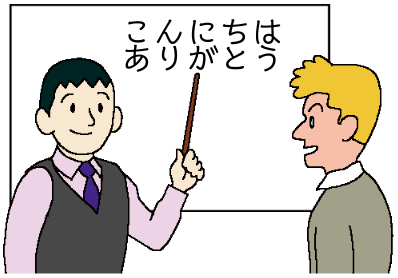
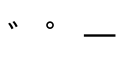
• Japanese language uses five types of characters: hiragana, katakana, kanji, and English letters (romaji) and numbers. Both Hiragana and Katakana have 46 characters each and those written in smaller versions (four characters for Hiragana and nine characters for Katakana). The special symbols are also used.
• Kanji will be helpful once you memorize them. Some may look complicated. Start by learning the simple ones.
• Learn about romaji as well, which is often used when you type or text for mails and social media
• If you live in Japan, it is very important to know the names of local places and streets by reading and writing characters such as Kanji. Japanese also has many dialects and they have an important role in your community life. You can learn these dialects at Japanese classes in your area and through communication with local residents.
• Other than the above-mentioned, there are forms of polite speech in Japanese. It would be better if you become able to use polite Japanese depending on who you are speaking to.
3-2 Reference Framework for Japanese Language Education
• “Reference Framework for Japanese Language Education” was newly established in 2021 to make learning Japanese easier for you, with reference to CEFR (Common European Framework of Reference for Languages; Learning, teaching, assessment).
• This describes learning contents and action targets according to six levels of Japanese language (A1 to C2) and Japanese language proficiency (“listening,” “reading,” “speaking (interaction),” “speaking (expression),” and “writing”).
* Please use it as a reference to check your Japanese language level and to study setting the next goal.
• Resources that we have created and made available include “Seikatsu Can Do,” a guide to using the reference framework, and “Nihongo Check!,” a Japanese language self-assessment tool.
Reference Framework for Japanese Language Education, guide, Seikatsu Can Do and more
https://www.nihongo-ews.mext.go.jp/information/framework_of_reference

Printed page 62
PDF page 77 ↗| C2 | Can understand with ease virtually everything heard or read. Can express him/ herself spontaneously, very fluently and precisely, differentiating finer shades of meaning even in the most complex situations. |
|---|---|
| C1 | Can understand a wide range of demanding, longer texts, and recognize implicit meaning. Can express him/herself fluently and spontaneously without much obvious searching for expressions. Can use language flexibly and effectively for social, academic and professional purposes. |
| B2 | Can understand the main ideas of complex text on both concrete and abstract topics, including technical discussions in his/her field of specialization. Can interact with a degree of fluency and spontaneity that makes regular interaction with proficient speakers of Japanese quite possible without strain for either party. |
| B1 | Can understand the main points of clear standard input on familiar matters regularly encountered in work, school, leisure, etc. Can produce simple connected text on topics which are familiar or of personal interest. |
| A2 | Can understand sentences and frequently used expressions related to areas of most immediate relevance (e.g. very basic personal and family information, shopping, local geography, employment). Can communicate in simple and routine tasks requiring a simple and direct exchange of information on familiar and routine matters. |
| A1 | Can understand and use familiar everyday expressions and very basic phrases aimed at the satisfaction of needs of a concrete type. Can interact in a simple way provided the other person talks slowly and clearly and is prepared to help. |
3-3 Where to learn
By attending Japanese classes, you can not only study the language, but also exchange information and make friends at the same time. Find a language school or lesson near you.
Nowadays an increasing number of learners choose distance learning through social media or E-learning. Find the method that is suitable for you.
(1) Japanese language school
• There are courses with different purposes: to prepare for school study, for work, or to prepare for examinations
• There are classes for beginners through advanced learners.
• You can choose to learn in a group or in a private class.
• You have to pay for the classes.
Printed page 63
PDF page 78 ↗(2) Japanese classes in local communities
• Japanese classes are organized by local governments, international associations, or NPOs.
• Classes are held in community centers, schools, churches or volunteer centers.
• Teachers are volunteers in many cases.
• Some classes are free of charge. They are more economical than studying at a language school.
• Generally, classes are held once or twice a week for one to two hours.
The below is a list of responsible departments for Japanese language education in each region and Japanese classes organized in the region:
https://www.bunka.go.jp/seisaku/kokugo_nihongo/kyoiku/nihongokyoiku_tanto/pdf/93036701_01.pdf

* Check the following when you search for Japanese classes:
①Name of the class ②organizer ③venue ④contact number ⑤how to contact ⑥supported languages ⑦course period ⑧number of sessions ⑨timetable (day and time) ⑩qualification for application ⑪cost ⑫ class type (group or private) ⑬number of students ⑭level ⑮who teaches ⑯what to learn ⑰availability of parking, baby-sitting services, etc.
(3) Online classes, distance learning
If you are too busy to go to language school because of working or parenting, you can study Japanese online using SNS or E-learning. There are various version of tuitions and services, so find the one that is most suitable for you.
3-4 Website for Japanese learners: “Connect and Enhance Your Life in Japanese” (known as Tsunahiro)
This website is for foreign nationals who live in Japan to learn Japanese, aiming to communicate in Japanese or use Japanese in daily life.
You can choose learning contents in videos and scripts based on your Japanese level, the situation and keywords that interest you. Study and use Japanese to connect with society and broaden life’s possibilities.
Available languages: Japanese, Chinese (Simplified), Chinese (Traditional), English, Filipino, French, Indonesian, Khmer (Cambodian), Korean, Mongolian, Myanmar, Nepali, Portuguese, Russian, Spanish, Thai, Ukrainian, Vietnamese (18 languages)
Situations for learning: Scenes from daily life such as greeting people, shopping, using a bank, using a train, going to a municipal office, and preparing for disaster and emergency, child rearing
“Connect and Enhance Your Life in Japanese”:
https://tsunagarujp.mext.go.jp

Printed page 64
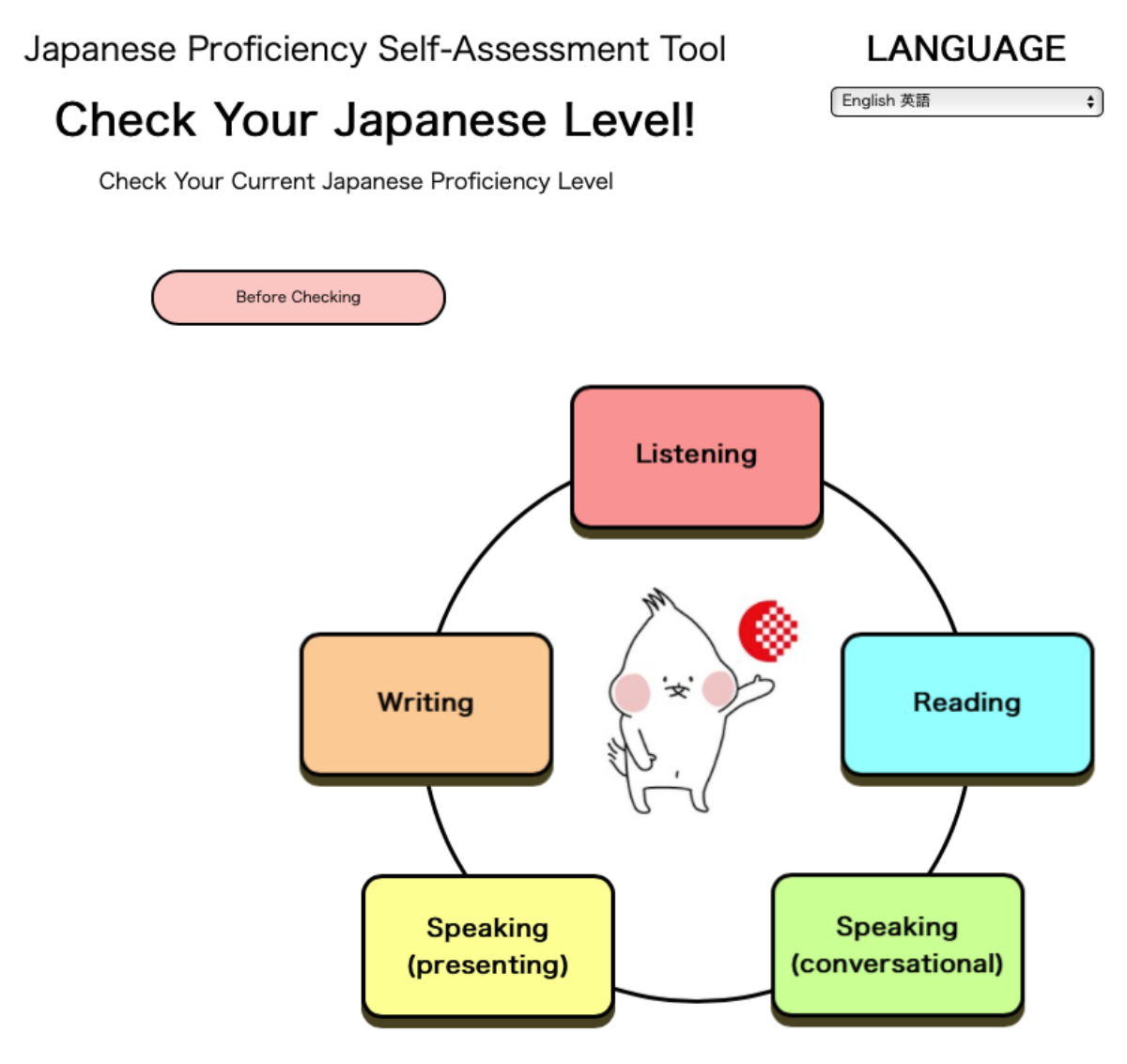
PDF page 79 ↗3-5 “Nihongo Check!,” a Japanese language self-assessment tool based on the Reference Framework for Japanese Language Education
This online system has a self-assessment tool targeting Japanese language learners both in Japan and internationally that allows users to answer questions from a “Can do” section, providing a straightforward assessment of their Japanese language skills. It is designed to encourage individual study based on the results and help set goals for learning Japanese.
The Reference Framework for Japanese Language Education has six levels (A1 to C2) and covers five language activities, including listening, reading, speaking (interaction and expression), and writing. Japanese language learners assess their own proficiency by answering questions regarding their language abilities on a four-point scale as follows: “1. I cannot,” “2. I can hardly do it,” “3. It’s difficult, but I can just about do it,” and “4. I can.”
Supported languages: 14 languages, including Japanese. Chinese, English, Filipino, Indonesian, Khmer, Korean, Mongolian, Burmese, Nepali, Portuguese, Spanish, Thai, Vietnamese, and Japanese (with furigana readings).
Check your level at the following page.
https://www.nihongo-check.bunka.go.jp/